








Swiss Alpine farms complain of staff shortages

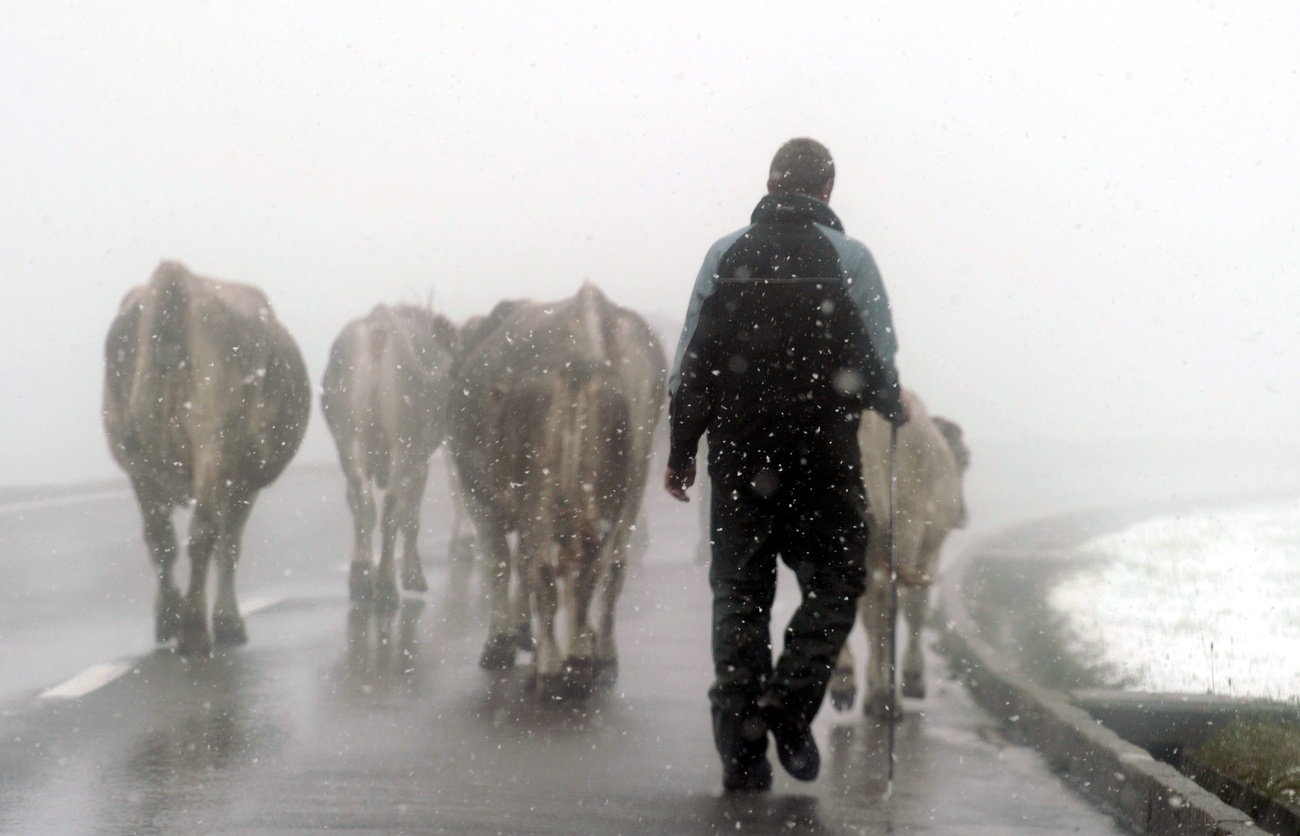
The alpine farming sector is complaining about staff shortages, particularly when it comes to experienced dairy farmers.
Select your language
Generated with artificial intelligence.
Listening:
Swiss Alpine farms complain of staff shortages
+Get the most important news from Switzerland in your inbox
In mid-March, the Bauernzeitung newspaper wrote of an “Alpine alarm” in a report on the staffing situation on Alpine pastures. At first glance, it does not look so alarming: around 100 jobs were advertised on the Zalp portal in March, with the number of applications being roughly equal.
Asked by the Keystone-SDA news agency, Zalp employee and cattle herder Giorgio Hösli does not talk of an emergency situation. But, he says, “we have had a shortage of experienced and well-trained staff for many years”.
In order to fill all positions in the summer period from May, there would have to be a third more job applications than availabilities. According to Hösli, many job seekers are only partially available, have the wrong ideas about the job, drop out of work or have the wrong profile. The ability to “grit one’s teeth” and persevere is not high on the list of competences for many applicants, who simply “want to go the Alps”, he says.
More
What do Alpine farmers do in the winter?
Employees from abroad
This means specialists are all the more important. According to Hösli, the high turnover rate is a hindrance to developing such specialised skills. Alpine farming demands experience, he explains: you have to know the animals, quickly recognise diseases, take care of the pasture and make “really good cheese”. You don’t learn this from books and courses, he says. For him, it’s regrettable that too few people stay on for longer than three years.
The sector increasingly relies on employees from other countries, with an estimated third of the staff coming from abroad, explains Hösli. Italy and Germany are the main sources.
Applicants from South Tyrol are seemingly highly valued because many of them have experience and often stay for several years. Students from agricultural universities in Germany and Austria also have at least some specialised knowledge, Hösli explains.
In order to improve things, Hösli believes it is important to make the Alps a more attractive place to work. Among other things, there needs to be more work opportunities outside the summer season.

More
Swiss want to inscribe Alpine foodstuffs on UNESCO list
Adapted from German by AI/dos
We select the most relevant news for an international audience and use automatic translation tools to translate them into English. A journalist then reviews the translation for clarity and accuracy before publication.
Providing you with automatically translated news gives us the time to write more in-depth articles. The news stories we select have been written and carefully fact-checked by an external editorial team from news agencies such as Bloomberg or Keystone.
If you have any questions about how we work, write to us at english@swissinfo.ch
External Content

In compliance with the JTI standards
More: SWI swissinfo.ch certified by the Journalism Trust Initiative

You can find an overview of ongoing debates with our journalists here . Please join us!
If you want to start a conversation about a topic raised in this article or want to report factual errors, email us at english@swissinfo.ch.