








At the forefront of nuclear, biological and chemical threats, Swiss lab marks centenary

To mark the 100th anniversary of Switzerland's Spiez Laboratory – a world leader in protection against nuclear, biological and chemical dangers – the International Atomic Energy Agency (IAEA) has renewed its status as a collaborating centre. The lab near Bern will continue to support environmental monitoring of the Fukushima disaster in Japan, for example.
Select your language
Generated with artificial intelligence.
Listening:
At the forefront of nuclear, biological and chemical threats, Swiss lab marks centenary
On October 23, IAEA Director General Rafael Grossi confirmed the existing partnership and extended Spiez Laboratory’s status as a reference centre for another four years. Together with the IAEA, the institution has defined its work programme for 2025–2028. One of its priorities will be monitoring the environment in areas affected by the Fukushima disaster in Japan. Spiez will continue to collect and analyse samples of water discharged into the sea off Fukushima.
+ Working to counter weapons of mass destruction
According to the Federal Office for Civil Protection, the Swiss lab is internationally recognised for its contribution to protecting against nuclear, biological and chemical threats.

From gas analysis to global crisis response
Founded in 1925 under the name Gas Laboratory in the town of Wimmis in Bern, its mission has evolved considerably over the past century. Since 1923, it has also housed a centre for studying the military threat posed by chemical weapons.
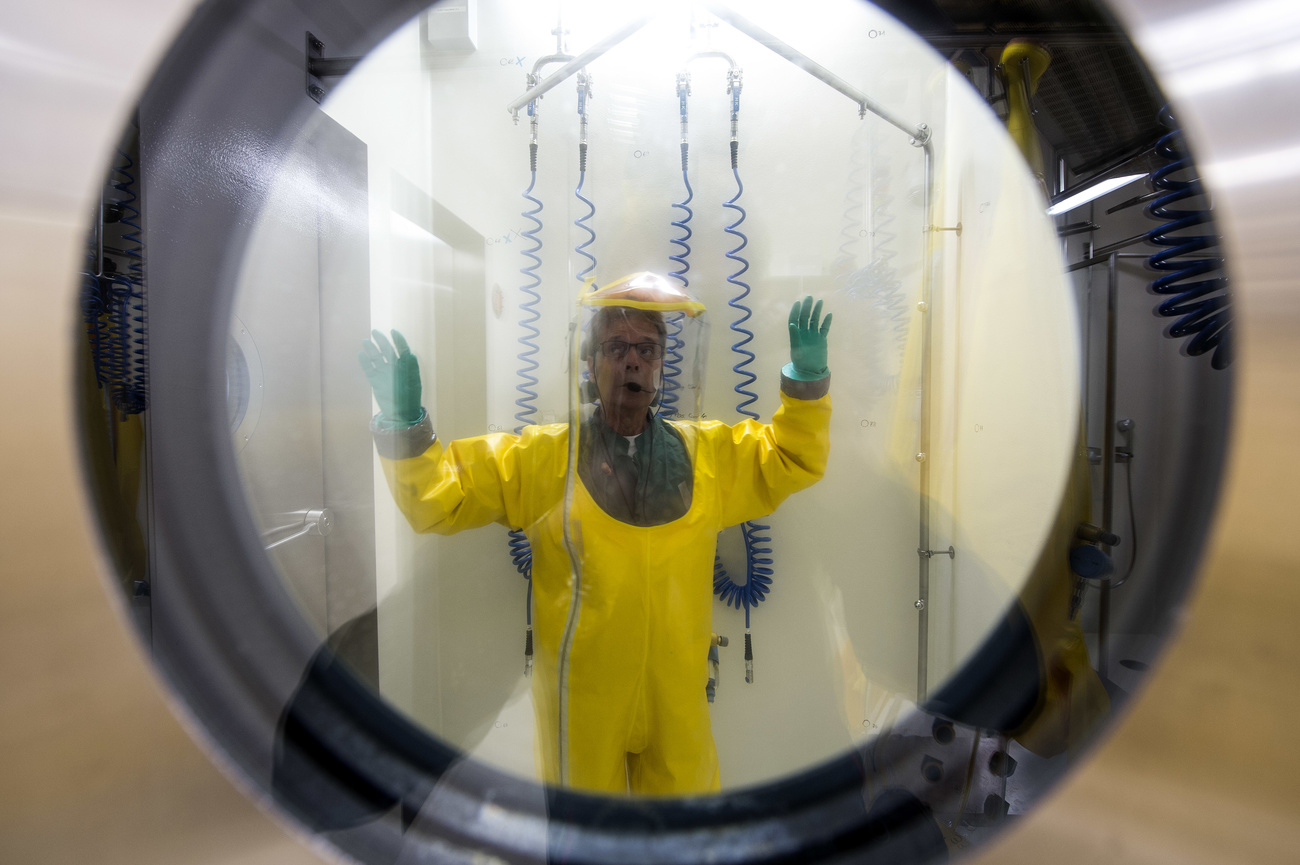
Today, Spiez Laboratory is the only facility in Switzerland authorised to create and handle chemical and biological warfare agents, and to analyse highly radioactive soils.
More
How the Swiss-based WHO BioHub is preparing for future pandemics
Its scientists were among the first to detect the Chernobyl nuclear disaster and have since analysed the sarin gas attacks in Syria and the Novichok poisoning of a former Russian agent in the United Kingdom. These ultra-hazardous substances are handled by only a handful of specialists working under extreme security conditions.
Spiez Laboratory also stores one of the rarest and deadliest coronaviruses, MERS-CoV. The World Health Organization (WHO) announced on Monday that it has added this pathogen to its international repository of biological samples at the Bern site.
MERS-CoV causes fatal respiratory illness in around 37% of cases. At present, there is no authorised vaccine or treatment for the virus.
External Content
Translated from French using DeepL/amva

In compliance with the JTI standards
More: SWI swissinfo.ch certified by the Journalism Trust Initiative

You can find an overview of ongoing debates with our journalists here . Please join us!
If you want to start a conversation about a topic raised in this article or want to report factual errors, email us at english@swissinfo.ch.