








Why EU direct democracy has struggled to take off

Well over a decade after its launch, the European Union’s tool for citizen participation has largely failed to take off, especially compared to the wide popular rights enjoyed in Switzerland. Swissinfo analyses why.
Select your language
Generated with artificial intelligence.
Listening:
Why EU direct democracy has struggled to take off

As ongoing debates over a new set of bilateral deals with Brussels show, any hint of European Union (EU) meddling in Swiss domestic affairs – and especially its direct democracy – tends to spark criticism. But influence can flow the other way too.
Recently, a European Citizens’ Initiative (ECI) – a signature-gathering tool for proposing EU reform – came with a Swiss twist. “HouseEurope!External link”, which called for incentives to renovate rather than demolish old buildings, was linked to Switzerland’s top university, the federal institute of technology ETH Zurich. Not only did a professor from its architecture department co-initiate the campaign; the department itself is listed as having contributed €50,000 (CHF45,900) to it. A canton Zug foundation was also a donor.
Foreign interference from a non-EU state? Not according to ETH Zurich – the €50,000, it told Swissinfo, was an estimate of “non-monetary support” like research input, not a cash donation. But the initiative is still revealing for a more prosaic reason: despite Swiss-based backing, it turned out to be a textbook ECI – it failed. By the January 31 deadline, it had gathered some 83,000 names; one million are required.
Signature problem
In missing the mark, it is in good company. Since the ECI was introduced in 2012, just 14 of 125 registered initiatives have managed to reach the threshold necessary to put a proposal onto the European Commission’s desk. As such, while its supporters still describe the ECI as the world’s only transnational instrument of direct democracy, even they admit it has fallen short of its original aim: to help close the EU’s democratic deficit – the gap between decision-makers in Brussels and citizens on the continent, who feel their voice is not heard.
Struggles to meet the signature quota are one symptom, which a look at Switzerland helps to put in context. In the Alpine nation – which admittedly has a long direct democracy tradition – campaigners routinely collect the 100,000 names needed to force a constitutional vote. The ECI threshold, at one million, is ten times higher – but then the EU’s population is 55 times bigger. And yet most ECIs never come close; many fizzle out with a few thousand names.
External Content
One reason for this is obvious: the transnational nature of the tool. It’s neither easy nor cheap to run a campaign across multiple languages and countries (signature thresholds also need to be met in at least seven EU states). Public visibility is also tough in a continent-wide setting, where media remain largely national and EU issues rarely dominate headlines. Meanwhile, political parties – and private firms – which are important for signature-gathering in Switzerland, are less engaged at the EU level, leaving campaigns more dependent on NGOs and private donors.
For an overview of how popular initiatives and referendums work in Switzerland, watch our video explainer below:

More
How Swiss direct democracy works
No binding impact
Yet even beyond practical issues, the ECI is simply a weak instrument by design. Swiss initiatives and referendums involve votes on concrete, legally binding texts. ECIs, says Daniel Moeckli from the University of Zurich, are “agenda” initiatives – they carry more weight than a petition, but far less than a people’s initiative. Even when an ECI reaches one million signatures, the European Commission is only obliged to examine the issue – but it doesn’t have to act on it. Not to mention that there is no public vote.
Left to its own discretion, the Commission can simply choose to ignore the proposals, or only implement them where it sees fit. On its website, it refers to ECIs which make the signature threshold as “successful”, but this is rather optimistic – in reality only a few have led to real change. The very first “successful” initiative, “Right2WaterExternal link”, prompted partial revisions of water-quality rules in the EU. But for most others, including a proposed ban on animal testingExternal link, the Commission found reasons not to do anything.
In Switzerland, too, the implementation of initiatives can spark debate. But here, the final authority is parliament, which is accountable to voters. In the EU, it’s the Commission – an unelected body already accused of embodying the “democratic deficit” the ECI was meant to tackle in the first place. Critics warn scepticism will deepen if initiatives don’t deliver. As EU Ombudsman Emily O’Reilly put itExternal link: “if a successful initiative never results in a proposal for new EU rules […] people will stop believing in the process – not just in the ECI but, potentially, in democracy itself”.
Embracing the ECI as a limited tool
Aware of these criticisms, the EU hasn’t been entirely inactive. Legal challenges brought by frustrated campaigners have pushed the Commission to take a more permissive stance on admissibility of initiatives. Another pending case, linked to the animal welfare ECI “End the Cage AgeExternal link”, could clarify how far the Commission is bound to respond – or not –to successful ECIs. Brussels has also improved the technical and digital infrastructure for registering signatures and funding sources, making life easier for campaigners.
External Content
Yet not many still expect ECIs to evolve into hard tools for proposing or rejecting laws via popular votes. Instead, some argue that the future lies in doubling down on its agenda-setting role. Alberto Alemanno from the HEC Paris business school has writtenExternal link that, as civil society comes under pressure in parts of Europe, the ECI at least offers a “guaranteed platform” for transnational engagement. On this front, even a failed idea can claim success if it sparks cross-border debate, he reckons.
Others see the ECI as just one element within a wider – and underestimated – European direct democracy landscape.
According to MoeckliExternal link, some 6,874 initiatives of various kinds were launched across Council of Europe countries between 1990 and 2020; roughly two-thirds of them were “agenda” initiatives. Here, the ECI has acted as a catalyst, Moeckli says, in that it prompted several similar tools at the national level, especially in northern Europe. Even in Switzerland, some are calling for such anExternal link instrument – the so-called “people’s motion”.
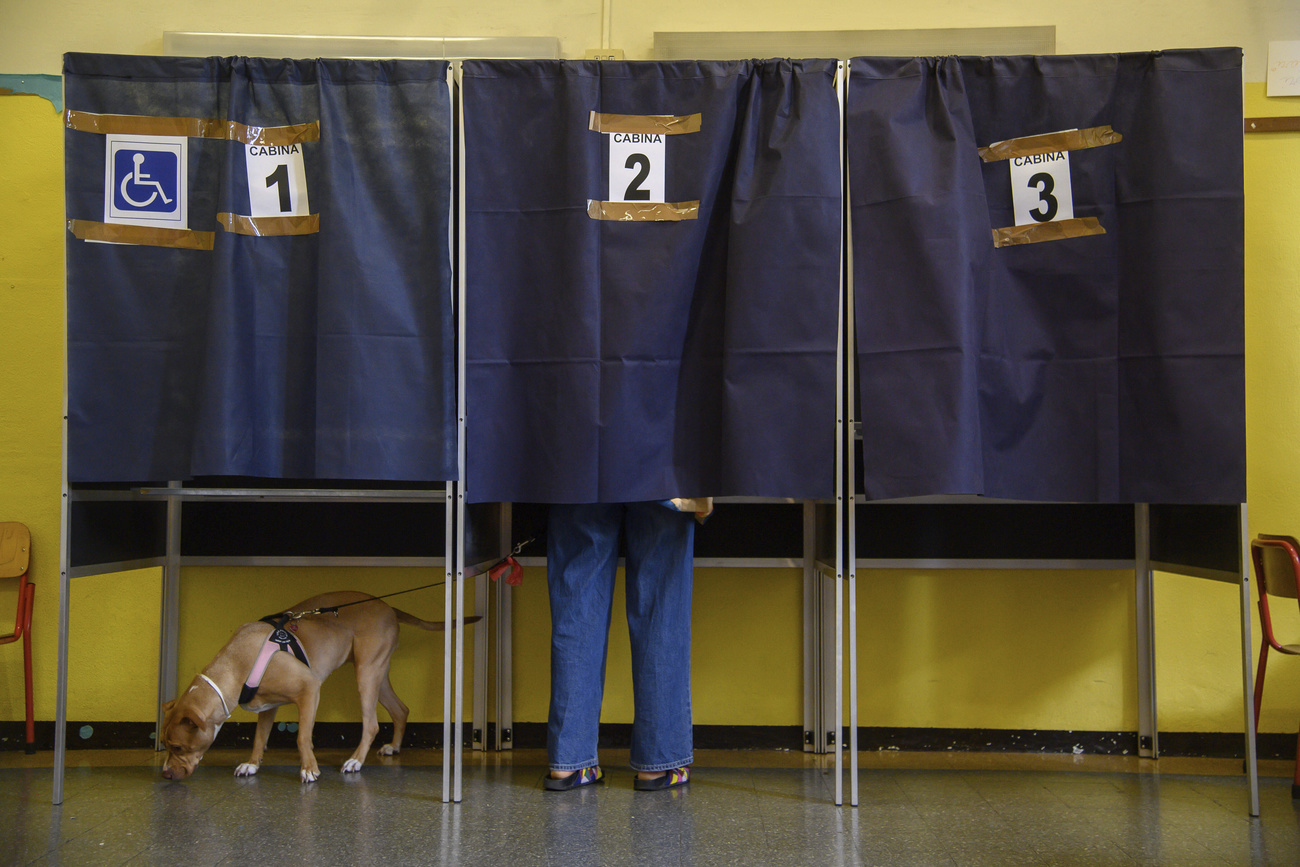
Grassroots enthusiasm, limited impact: in Italy, direct democracy meets some of the same hurdles as the ECI:
More
E-collecting brings new lease of life to Italian democracy
Yet whether a flurry of agenda initiatives is a sign of direct democratic health is unclear. As with the ECI, success is hard to measure when it doesn’t hinge on concrete legal change. Moeckli points to Finland, where citizens have broadly welcomed the instrument since its introduction in 2012; more generally, he argues, it can have advantages over referendums, which can be politically divisive (Brexit is an obvious case). Others are sceptical and say agenda initiatives shouldn’t count as direct democracy at all, since they don’t spark a public vote.
From a Swiss perspective, at least, such tools – and the ECI – have to be seen in a specific light: as a somewhat soft complement to well-established referendums and people’s initiatives, rather than as an effort to spur bottom-up democracy from scratch.
Edited by Benjamin von Wyl/ds
This article was updated on February 6 to reflect the correct amount of non-monetary support provided to HouseEurope! by ETH Zurich.

In compliance with the JTI standards
More: SWI swissinfo.ch certified by the Journalism Trust Initiative

You can find an overview of ongoing debates with our journalists here . Please join us!
If you want to start a conversation about a topic raised in this article or want to report factual errors, email us at english@swissinfo.ch.