








AI is big business at Europe’s borders
Exemptions for research and growing militarisation of border policy across Europe are creating lucrative opportunities. Defence firms benefit most and now research institutes in Switzerland are also cashing in.
Select your language
Generated with artificial intelligence.
Listening:
AI is big business at Europe’s borders
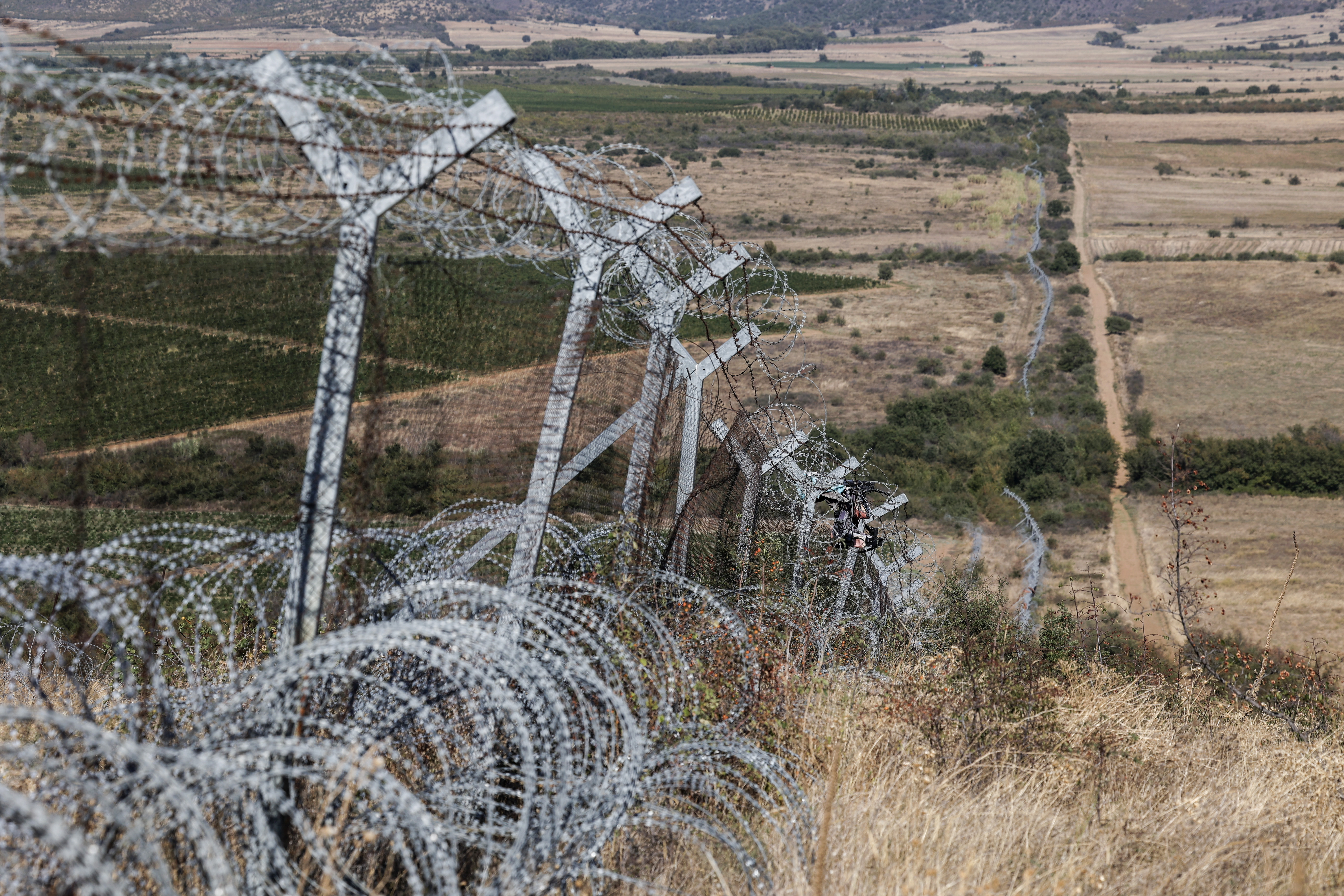
For years, Greek border guards along the frontier with North Macedonia relied on an unusual early-warning system. The abrupt take off of startled storks from their resting spots on the bridge over the Axios River signalled that someone was moving in the bushes. Often it was migrants attempting to leave Greece to continue along the Balkan route towards northern Europe.

But the long-legged birds will soon be replaced by cameras, radar systems, and drones. Greece is rolling out the “Evros model” from here to Albania. It is a high-tech, AI-supported border wall along the Turkish border. Northern European states, led by Germany, want fewer asylum seekers, and the European Union is providing substantial funding for new technologies, including the €35.4 million ($41.2 million) “E-Surveillance” programme.
Lack of democratic oversight
Across Europe, migration is increasingly being defined as a security risk. “Anything to do with borders is gradually being insulated from democratic scrutiny, accountability and transparency,” explains Bram Vranken of Corporate Europe Observatory, a Brussels-based watchdog that investigates lobbying in the tech and defence sectors.
This article is the product of a cross-border investigation conducted by five journalists from Greece, Germany, the UK, and Switzerland.
The team examined developments across eight countries for publication partners Swissinfo (Switzerland), Die Tageszeitung (Germany), Solomon (Greece), and Inkstick Media (US).
More than two dozen interviews were conducted with officials, border guards, and other individuals with first-hand knowledge. The team conducted research on site and reviewed hundreds of pages of public documents, as well as internal files, freedom-of-information requests, procurement papers, and technical records.
The months-long investigation was supported by the fund for investigative journalism in Europe IJ4EUExternal link, the Pulitzer CenterExternal link and Real21 media fundsExternal link.
The move to treat migration as a military and defence sector issue, against a backdrop of loosely regulated data laws, confidentiality clauses, and minimal public scrutiny, has opened up a lucrative line of business backed by powerful lobbyists in Brussels. A new AI ecosystem is fuelling profits for defence contractors, security firms, and increasingly research institutes, including in Switzerland
More
In Switzerland, migration isn’t just inbound
Idiap is a research institute based in the town of Martigny in southwestern Switzerland. Funded by both public and private money, it is classified as a “research institution of national importanceExternal link”. Its work centres on foundational research in artificial intelligence, such as medical prosthetics, democratic-process applications and the detection of digital forgeries. According to Idiap’s website, it actively collaborates with industry and puts strong emphasis on nurturing start-ups.
How a gait-recognition database is created
Idiap also hosts a biometrics research group headed by Sébastien Marcel. In autumn 2025 it received research fundingExternal link from Frontex, the European border and coast guard agency. According to the project description, the group is producing a dataset of simulated images and videos of “challenging scenarios at border crossings”. In a second step, a larger dataset of more than 10,000 artificial identities will be generated. Real and artificial data will then be tested against each other to assess their suitability, with the aim of building a “multispectral dataset for gait and facial recognition at borders”, Marcel explains. This will use visible and non-visible imagery such as infrared and thermal imaging, enabling people to be identified by their facial features, movements and gait.


“This project was submitted by Idiap as part of an open call from Frontex to meet the needs of research projects such as CarMen or PopEye,” Marcel explains. Both of these projects are part of Horizon Europe, the EU’s flagship research and innovation programme in which Switzerland participates. CarMen and PopEye are run by international consortia that specialise in biometric applications.
According to Marcel, all recordings for the Frontex project will be made solely on Idiap’s premises. During the ten-month project, only the research group will work with the collected and generated data. “Idiap retains full control of the data,” he says.

What becomes of the dataset after the project ends remains unclear. “Idiap and its partners will use its findings for academic research and for assessing how different technologies perform.” Exactly who those partners will be is not yet “precisely” known, Marcel says. “In principle, they will be research institutions which are prepared to sign a licensing agreement with us.”
Marcel says Idiap has an internal ethics committee for data-driven research that is informed about all projects. “There are also internal rules and procedures for collecting data in research projects,” he explains. What those rules are exactly is not known because they are not publicly available.
Military-grade AI tested on migrants
The route from foundational AI research to its application in the field of migration control is often complex and obscured to outsiders. In the applications currently being developed, a clear trend towards militarisation appears. The same systems used by armies are now being deployed to deter and manage migration.
In September 2025, senior EU border officials took part in an internal innovation meeting at Frontex headquarters in Warsaw. According to the investigation, a drone-surveillance network was presented which was tested by Frontex and developed by the US defence company Shield AI. The firm is led by a former US Navy SEAL.
The V-BAT drones, which take off vertically, hovered along the Bulgarian Turkish border for 60 days. They streamed real-time footage to a command centre, where an AI system alerted police to attempted border crossings by migrants.
According to Frontex, the pilot project “led to a visible reduction (…) in criminal activity” and included “extensive guarantees for fundamental rights”. Bulgaria is frequently criticised for mistreating migrants. Shield AI declined to answer questions about the system, its deployment, its costs, or how the data are used.

More
How Switzerland and Europe use AI tech for migration control
Blurring the line between testing and operation
The pilot project illustrates Frontex’s AI strategy at the EU’s external borders and how hard it is to tell where testing ends and operational use begins. Niovi Vavoula, a professor of law and cyber policy at the University of Luxembourg has carefully studied Europe’s AI regulations. She increasingly considers it impossible to distinguish between pilot project and operational deployment.
As soon as systems are tested on real people in uncontrolled environments, as with Shield AI in Bulgaria, one can no longer refer to it as a “research test phase”, Vavoula says. Despite being called a pilot project, such deployments have concrete consequences for real people. “Research exemptions should no longer apply,” Vavoula argues.
In August 2024, the EU’s regulatory framework for the use of artificial intelligence took effect. The AI Act, as it is known, is set to be fully operational in all policy areas by August 2026. The law classifies AI systems according to low, limited, high and unacceptable riskExternal link. Examples of unacceptable risk include social-scoring systems like those in China, or facial recognition deployed across an entire public space.
The AI Act focuses on high-risk uses, such asExternal link AI-enabled biometric classification. National security applications are exempt and exceptions are made for research as well.
In a written response, Frontex says it “does not operate or deploy any high-risk AI systems”. The Greek coast guard similarly states that it “does not operate any artificial intelligence systems” and that all procurements include data-protection clauses, although it admits to using EU-supplied “electronic platforms with an AI component”.

The choice of words is no accident, says Vavoula. Authorities prefer to speak of algorithms, automation or innovation. “They hide behind generic terms,” she says. In this way, they can avoid scrutiny and continue to develop the systems “without having to call them AI”.
But under the EU regulation, this is precisely where strong safeguards should apply. According to the law, the areas of migration, asylum and border control involve “people who often find themselves in precarious situations” and AI systems should “under no circumstances” be used to undermine the rights of asylum seekers. Using AI-equipped drones and sensors to detect and deter migrants before they can apply for asylum would seem to be one such example.
Switzerland increases funding for EU migration-related technology
Switzerland lags behind the EU with AI regulation. It has not joined the AI Act, and a Swiss regulatory frameworkExternal link is not expected for several years. For economic and legal compatibility reasons, however, its rulebook will likely mirror the EU’s.
More
AI regulations must strike a balance between innovation and safety
At the start of 2025, the Federal Office of Justice produced a briefingExternal link for the government on the Council of Europe’s AI Convention, which addresses human rights, democracy and the rule of law. It highlights that defence is excluded from the scope of the convention, as is research and development.
Meanwhile in May 2025, the European Commission increased the Schengen instrument for border management and visa policy, the BMVI fund, by €1 billion. This means that Switzerland’s contribution, as a Schengen member, will also rise. The Swiss government says in its media releaseExternal link that by 2027, it expects Switzerland to contribute an additional CHF15 million, which will raise the total for the current seven-year period to around CHF315 million.
This fund finances projects in infrastructure, equipment, IT systems, and “measures to address migration and security challenges”, the government writes. The additional resources are made available particularly for the asylum sector. Switzerland also stands to benefit financially. “Depending on the project proposals submitted, it will likely be able to draw around €22 million from the increase for its own BMVI measures,” the government concludes.
This research was made possible with support from:
Investigative Journalism for Europe Fund IJ4EUExternal link
Real21 media fundsExternal link

More
Our newsletter on geopolitics
Edited by Giannis Mavris. Adapted from German by David Kelso Kaufher/ac

In compliance with the JTI standards
More: SWI swissinfo.ch certified by the Journalism Trust Initiative

You can find an overview of ongoing debates with our journalists here . Please join us!
If you want to start a conversation about a topic raised in this article or want to report factual errors, email us at english@swissinfo.ch.