








Far-right US blogger reaches hundreds of thousands from Switzerland

US author Vox Day was behind the manosphere concept of “sigma males”. He disseminates his right-wing extremist ideas from Switzerland. We meet him in a quiet village in canton Fribourg.
Select your language
Generated with artificial intelligence.
Listening:
Far-right US blogger reaches hundreds of thousands from Switzerland


The Wall Street Journal once called Vox Day “the most despised man in science fiction”. Academics describe him as a “white supremacist”. He rejects this label and sees himself as a Christian nationalist.
“If you want to criticise me on something, then what you should criticise me on is I reject the Enlightenment,” Day says. Two hundred years ago, the Enlightenment sounded good, he says. “We didn’t know where free trade, democracy and so on would get us.” Today, the “collective West” is on the brink of the abyss, he says, adding that this is why the rest of the world rejects the values of the Enlightenment: because they want to “survive” and “thrive”.
We meet Day in an unfinished residential building in an industrial park in the village of Cressier, canton Fribourg. In the half-empty flat, Day has set up a gym and machinery for his leather-binding business.
The reason Swissinfo is interested in Day is the reach of his influence. According to Similarweb, his blog gets over half a million hits per month – mainly in the US, the UK, Australia and Hong Kong.

Day uses harsh, discriminatory language. He recently titled an article “Ben Shapiro Is Cancer” about the right-wing Jewish US publicist – because of his pro-Israel stance.
In another post, from 2025, Day asked whether racist politics might not be a “rational containment strategy” to regulate coexistence with a “visually distinct population of low-IQ savages”.

More
Sharp rise in Swiss racism incidents in 2024
Plans to become Swiss
Day operates from Switzerland, where he has been living since 2005. This was the same year when his article “Why Women Can’t ThinkExternal link” came out.
He is not a Swiss citizen, Day tells us in the cold, sparse flat. But, he says, “I have passed my necessary language tests and all that. I do plan to apply for citizenship.”
He appreciates direct democracy, he says, but believes Switzerland should focus more on itself, instead of trying to please the EU.
‘Clown world’
A recurring theme on his blog is resistance to “clown world” – a conspiracy theory about satanic forces that Russia and China are fighting against.
Day has most of his followers on Gab.com. Some 35,000 people follow him on this platform, where only registered users can read his posts. Here he expresses himself even more bluntly. When a user accused him in spring 2024 of avoiding certain words in a post about “clown world”, Day replied: “I’m not avoiding any words, you retard. The Jews with whom you’re obsessed are the tools of the global satanists of Clown World, who themselves are just wicked servants of the true inhuman evils.”
Here he is giving voice to anti-Semitic conspiracy theories. Day sits back quietly while this comment is read to him. Then he says: “If you’re a Christian, you believe in the supernatural.” People like “George Soros or Hillary Clinton” are themselves just tools, he says.
Day denies that the description of “clown world” draws on the anti-Semitic “Protocols of the Elders of Zion”. “It has nothing to do with the protocols. It has to do with the bit in the Bible where Satan offers Jesus all the kingdoms of the world.” Since Jesus did not deny Satan this power, Satan rules the world, he says.
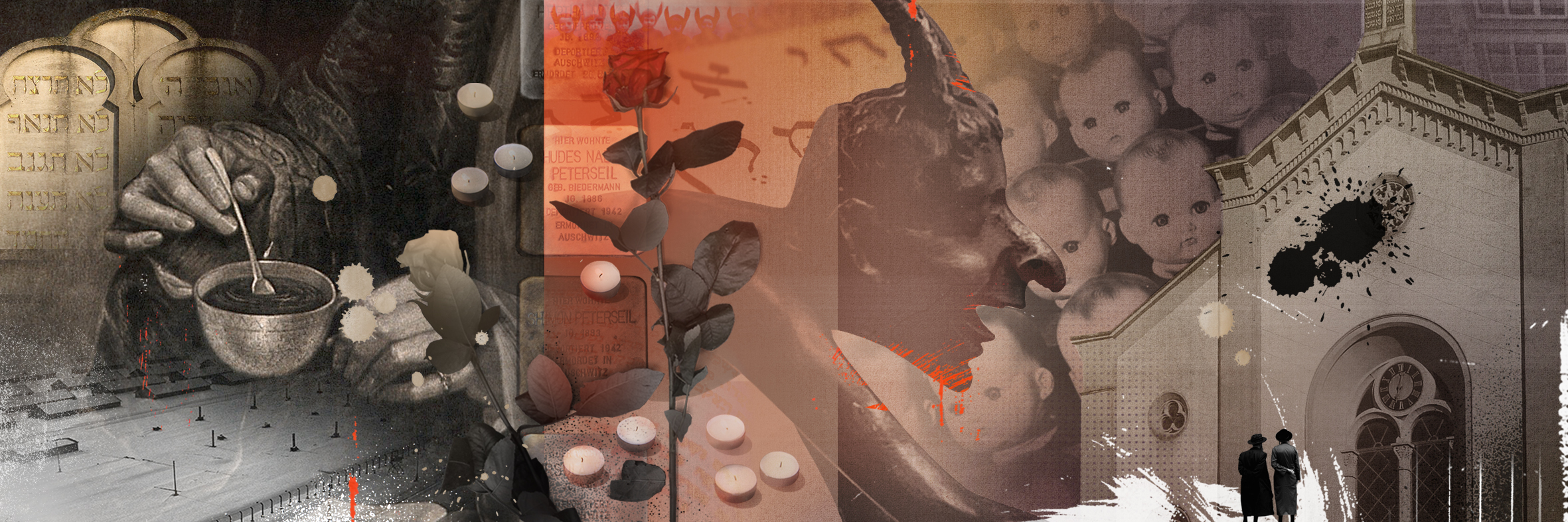
You can also read our background articles on anti-Semitism in Switzerland:
More
Anti-Semitism in Switzerland
Statements about women and evolution
Day responds to many questions in the interview with a similar kind of logic and a sense of intellectual superiority. He says he cannot be a “white supremacist” because, he claims, he is himself a Native American.
He does not believe in Darwinian evolution. His main argument in the interview is based on the conclusion that “biologists don’External linkt do math very well”. The Enlightenment philosophers, he asserts, “barely know what they’re talking about.”
Although he rejects many scientific findings out of hand, he takes certain questionable studies and observations as absolute – when they fit his worldview. He argues, for example, that women should not have the right to vote “under a system where they’re allowed their choice of two different men”. This is because “they reliably vote for the taller candidate with better hair. They did a study of this in the US.” Day is often described as misogynistic. He sees himself neither as misogynistic nor as racist.

Local library holds story reading in Day’s castle
He feels more at home, he says, in “black culture than pretty much anybody here in Switzerland”. His “African teammates”, with whom he plays football, could not care less what he writes about, he says.
A few years ago, Day bought the castle in the centre of Cressier. The tabloid Blick ran the headline: “American turns Swiss castle into neo-Nazi stronghold”. Allegedly, he wanted to use the castle “exclusively for his followers”. So far, this has not happened.
The municipality seems not to care much either what the owner of the castle writes. Most recently, in mid-November, the local library held a bilingual story nightExternal link for the public at Day’s castle.
Football club sponsor and leather book publisher
From the unfinished flat, Day runs his Castalia publishing house and the comic book imprint Arkhaven Comics. During the interview, an employee is busy in the basement binding externally printed books in leather and engraving the design on them with a laser.
Day imports the leather for this. In one room there are boxes of leather labelled “Made in Korea”. Some 1,500 books are bound in leather here each month, he says. Next year, they will have to increase production tenfold in response to high demand.
Castalia Library publishes classics of world literature as well as new releases. It is not possible to independently verify how many books are sold. However, Vox Day clearly has means. His publishing house also sponsors the British football club Dorking WanderersExternal link.
Day, who hails from a wealthy family, found success with techno musicExternal link in the early 1990s. He then went on to develop video games. For a while he was primarily a writer.
But the US academics who study Day do so not for his cultural value, but because of the controversies he has been involved in.

‘Puppygate’: involvement in reactionary online campaigns
Communication academic Max Dosser of Vanderbilt University calls Day a “white supremacist”. In 2016, Day published a “Core Philosophy of the Alternative Right”, which lists, in point 14, that “the alt-right believes we must secure the existence of white people and a future for white children”. This is a slight variation on the far-right code, The Fourteen WordsExternal link.
In his dissertation Nostalgic Futures, Dosser examines how hatred and anger drive reactionary fan dynamics on the internet. He cites the example of “Puppygate”, an online campaign in which Day played a central role. In the mid-2010s, reactionary fans attempted to hijack the Hugo Awards for science fiction with their own politically acceptable list. “On the surface it is about letting ‘popular’ literature win awards or preserving a nostalgic vision of what the genre used to be,” Dosser says. At first glance, he adds, these things seem harmless. But the worldviews behind them often are not. Such online controversies poison the discourse, he concludes.
From today’s perspective, campaigns such as Puppygate were the beginning of politicised online outrage. Controversies like this now take place constantly, Dosser notes, and no longer on the fringes of society. And “with people like Donald Trump, Elon Musk, and countless others with international reach platforming these opinions and ideologies, there’s less of a need to hide them”.
Literary academic Jordan S. Carroll also looks at Day in Speculative WhitenessExternal link: Science Fiction and the Alt-Right. Carroll wrote to Swissinfo that Day’s involvement in Puppygate was an act of revenge. “That was Vox’s attempt to get back at the science fiction community for ostracising him after he made a series of racist statements.” In the end, he says, the mainstream science fiction community clearly distanced itself from him.

Inventor of the ‘sigma male’
Carroll’s assessment is Day will be remembered neither as a publisher nor an artist but, “if at all”, as a blogger, and for the masculinist term “sigma”.
Day coined the term “sigma male” back in 2010. This concept of masculinity has spread on social media platforms such as TikTok, catching on “among 12-year-old Gen Z boys who have never heard of Vox Day”, Carroll writes.
Thus, one of the roots of the global cult of masculinity – centred around figures such as Andrew Tate and Joe Rogan – can probably be traced back to a computer in French-speaking Switzerland 15 years ago.
You can also read our historical article on the international networking of the New Right:

More
How the far right became a Europe-wide movement
Edited by Giannis Mavris. Adapted from German by Julia Bassam/ts

In compliance with the JTI standards
More: SWI swissinfo.ch certified by the Journalism Trust Initiative

You can find an overview of ongoing debates with our journalists here . Please join us!
If you want to start a conversation about a topic raised in this article or want to report factual errors, email us at english@swissinfo.ch.