








Are pesticides making farmers sick? What we know so far
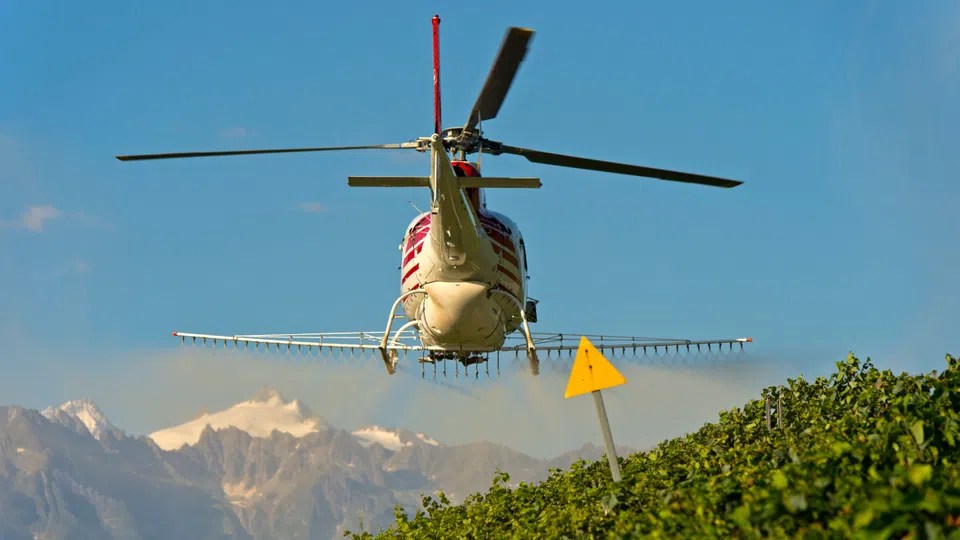
Switzerland is investigating whether exposure to pesticides increases the risk of Parkinson’s disease among farmers. While Parkinson’s is recognised as an occupational disease for farmers abroad. Switzerland, however, lacks key data to draw firm conclusions.
Select your language
Generated with artificial intelligence.
Listening:
Are pesticides making farmers sick? What we know so far
In Germany, farmers who have used pesticides for more than 100 days during their working lives and later develop Parkinson’s disease are entitled to financial compensation. The disease is classified there as an occupational illnessExternal link, as it is in Italy and France.
“Large long-term studiesExternal link from France and the United States clearly show a link,” says Samuel Fuhrimann, a researcher on pesticide exposure at the Swiss Tropical and Public Health Institute. Together with a major health insurer and other researchers, he is now examining whether similar patterns can be identified in Switzerland.
Reassurance for helicopter spraying in Valais
Concerns extend beyond farmers. In canton Valais, some parents worry about recurrent respiratory problems among children between March and May, the same period during which helicopters spray pesticides in wine-growing villages such as Salgesch and Chamoson.
Researchers from Basel examined the situation on behalf of canton Valais. Around 200 children were equipped with wristbands that recorded exposure to 35 different pesticides during four measurement phases. Lung function was tested at the same time.
Health impairments were observed during the study period. However, these coincided with higher pollen levels and increased air pollution, not with pesticide exposure. The researchers were therefore able to give the all-clear at least in the short term.
Studies cancelled, transparency reduced
“Much larger studies would be needed to assess the long-term effects of these pesticide mixtures,” Fuhrimann cautions. Although many of the pesticides used in Switzerland are also applied abroad, the findings cannot simply be transferred.
“Most of the evidence linking pesticides to Parkinson’s comes from substances that are no longer authorised today,” he adds.

To make reliable assessments of the current situation, researchers would need up-to-date, comprehensive data. This would include a long-term health study with urine samples from across the population, as well as digitally accessible records showing who applied which pesticides, where and when.
Parliament decided five years ago to collect such data. However, transparency in the pesticide reporting system – known as Digiflux – has since been so restricted that it is of limited use for research. In addition, the planned large-scale health study was cancelled for financial reasons.

It may therefore become increasingly difficult to assess the health effects of pesticides in Switzerland. Authorities and policymakers are largely dependent on international studies. Without robust domestic data, some substances may be unnecessarily demonised, while others – potentially more harmful – risk being overlooked.
In the run-up to the vote on the initiative “For food security – by strengthening sustainable domestic production, more plant-based food and clean drinking water” in 2021, parliament decided to create a system to make the consumption of pesticides in Switzerland more transparent.
Farmers who receive direct payments already have to record their pesticide use in a book. In future, this should be done digitally so that researchers, for example, could easily track which products were used on which areas and when.
Meanwhile, the wind has changed in parliament. Farming circles are calling for transparency to be significantly restricted or even cancelled altogether. Only traders should have to disclose how much pesticide they sell and to whom. A compromise proposal envisages that farmers will only have to record what they use on their farms, but no longer on which areas. This also significantly restricts research.
External Content
Translated using AI/amva/sb
How we translate with AI
We use automatic translation tools, such as DeepL and Google Translate, for some content.
Each translated article is carefully reviewed by a journalist for accuracy. Using translation tools gives us the time for more in-depth articles.
Learn more here about how we work with AI.
External Content

In compliance with the JTI standards
More: SWI swissinfo.ch certified by the Journalism Trust Initiative

You can find an overview of ongoing debates with our journalists here . Please join us!
If you want to start a conversation about a topic raised in this article or want to report factual errors, email us at english@swissinfo.ch.