








Protests in Switzerland less radical, but just as frequent as elsewhere

Switzerland is hardly known as a hotbed of unrest. But in some of its cities, demonstrations have been more frequent than ever. What does a protest look like in the land of political stability?
Select your language
Generated with artificial intelligence.
Listening:
Protests in Switzerland less radical, but just as frequent as elsewhere


Switzerland is more often associated with pernickety rules than political upheaval. So when things do occasionally turn violent, outsiders can be surprised. In August 2025, when Lausanne saw nights of rioting after a teenager died fleeing the police, the British Spectator magazine saw fit to specify that this was happening not in “Paris or Lyon” but “just along the lake from Geneva, in supposedly calm and orderly Switzerland”.
But is everything really always so calm?
For Marco Giugni, a political scientist at the University of Geneva, there is some truth to the cliché: protests in Switzerland tend to be less radical than in Germany, Italy, or France. Some historical exceptions were squatter movements in the 1980s, right-wing extremism, or anti-globalisation protests: the memory of 2003 violence in Geneva, during a G8 summit across the border in France, has recently dominated debates as the city prepares for a similar G7 gathering in Evian in June 2026.
Yet overall, if Swiss demonstrations are usually peaceful, it’s largely thanks to its politics. Citizens can get involved democratically, which helps to dampen fervour. Meanwhile, Giugni explains, the country’s federalist system offers lots of “access points” for making demands, while authorities take a comparatively permissive line on protests. In France, by contrast, where politics is centralised and authorities tougher, protests can be heftier, whether it’s gilet jaunes occupying roundabouts or youth-led riots.
However, Giugni adds, Swiss protests might be less violent and smaller, but they are not less numerous. Research in 2020 put the country around the European averageExternal link; since then, cities like Bern have even noted an uptick. And while strikes and class-based protest were historically less present than in some other countries, movements like ecology or feminism were very visible in Switzerland beginning in the late 1960s. More recently, protests linked to Covid-19, farming, or Gaza have not been lacking.
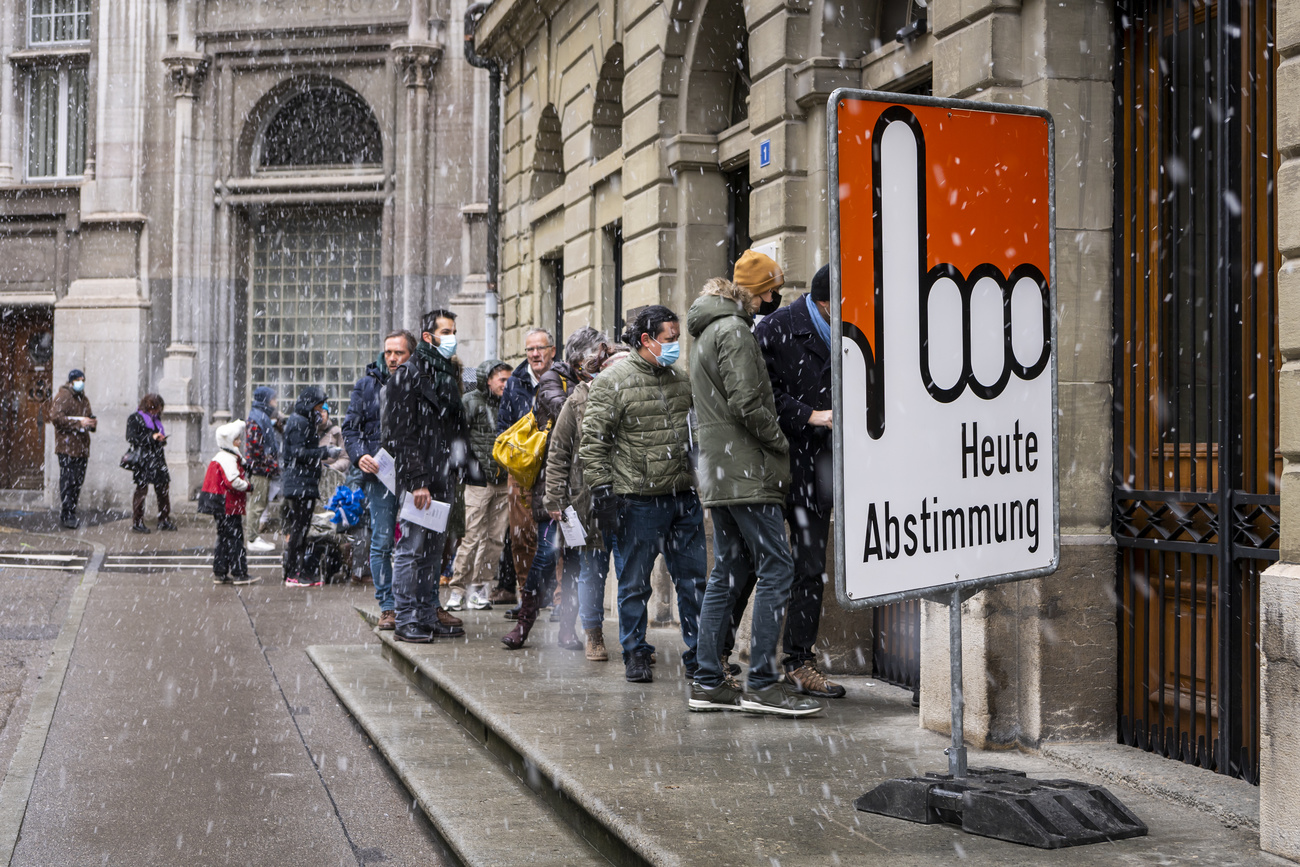
Historical impressions of protests in Switzerland:


What’s the link between protest and direct democracy?
In a rich country with ample direct democratic rights and high trust in politics, why protest at all? People in a more centralised system might take to the streets out of frustration that they can’t change things otherwise. In Switzerland, citizens can force their idea onto the agenda directly. Why should, say, climate activists glue themselves to the road when they can collect signatures for a people’s initiative?
For protestors, it’s not so simple. Many – including those in the climate movement – see themselves as responding to an emergency situation for which institutions (especially Swiss ones) are too slow. They want action now, not in a few years. Organising an initiative also requires money, time, and connections. By contrast, the right to protest is seen by some experts as the most accessible channel for those unable to participate in institutional politics.
Giugni argues there’s no clear division between politics and protests. People don’t only take to the streets when politics doesn’t work for them; demonstrations are a “complement” to institutional participation, he says. They can also temper each other. Opposition to Swiss Covid-19 measures, for example, led to hefty street action; after voters approved the government’s pandemic policy in three separate public votes, opposition largely calmed.
Read more about Switzerland’s trio of votes on pandemic laws – it was the only country to hold such referendums:
More
Why the Swiss have voted three times on the Covid-19 law
Who is doing the protesting?
In terms of willingness to demonstrate, European data also shows Switzerland is no outlier. In 2025, 8% said they had gone out to protest in the past year. Who are they?
External Content
This is hard to pin down, but older data cited by GiugniExternal link found some common features: Swiss protestors are more likely to be qualified, middle-class, and already involved in associations or political parties. Women and men are also equally likely to protest. Naturally this will vary across issues; a pro-Palestine march is unlikely to pull the same crowd as an anti-abortion rally, while a national “women’s strike” won’t draw a majority of men.
One thing that can be stated with more certainty is political stance: protestors in Switzerland tend to be left-leaning. This reflects the progressive nature of many movements, but also a different understanding of politics. On the left, protests are often seen as a legitimate means of politics; the right tends to endorse a narrower view of politics confined to traditional institutions. At least, this is the case in Switzerland and countries around it; in Eastern Europe, right-leaning people are more likely to protestExternal link.
Yet even in Switzerland it’s not all about left-wing activism. Some movements are more heterogeneous, or break out of old typologies completely. The Covid-19 protests, for example, mobilised what researchers have calledExternal link a “motley crew” of personalities: middle-class, middle-aged, well-educated, esoteric, conspiratorial, with a tendency to see their actions as heroic – and “alienated from liberal democracy”.
In the past few years, new political profiles and phenomena have emerged, in Switzerland and elsewhere:

More
Why some people turn to authoritarianism in the name of freedom
Do Swiss protests actually achieve anything?
Giugni says they “mostly don’t get what they demand, or at least get only part of it”. This is hardly surprising, given that some demands are hard to meet; Zurich authorities can’t end the war in Gaza. And beyond the protest itself, success depends on support in parliament or among the public. There’s also the general attitude towards demonstrations. In Japan, they are “mocked by ruling elites as the mood swings of those with nothing else to do”, Swiss public media RTS recently wroteExternal link. This is not the case in Switzerland.
Media coverage is also important. How the press shows a protest naturally impacts how the public perceives it. Swiss farmers clearly had this in mind when they organised a photogenic gathering of tractors beaming the term “SOS” in February 2024 (see below). The climate movement, meanwhile, has learned that big coverage of disruptive acts like road blockages doesn’t necessarily mean success. Numbers at their rallies have been shrinking.

Is Switzerland tightening the room for protest?
In recent years, cities like Bern, Zurich or Basel have noted upticks in protests, something which has sparked headlines of “every day a demoExternal link” and grumblings from businesses. For Giugni, this doesn’t amount to a paradigm shift. Protests come in cycles, and “the global situation in recent years has created political instability and uncertainty which favour the emergence of movements”, he says. Uncertainty opens windows for attempts at change.
But there have been counter reactions. In March 2024, Zurich voters approved the so-called “anti-vandal” initiative, enabling the costs of unauthorised protests to be put on demonstrators rather than authorities. Citing security concerns, Bern banned protests for over a month in late 2023 – a period of heated debates around the war in Gaza. And after a violent Gaza-related march in the capital in October 2025, police published the photos of 31 individuals, attracting criticism of an “online pillory”.
The country has been criticised from outside. Human rights NGO Amnesty International said in its 2024 reportExternal link that difficulties getting a demonstration approved in Switzerland – often because the process varies from canton to canton – can discourage protestors from exercising their right in the first place. Amnesty also questioned the use of rubber bullets and tear gas by police.
UN experts have criticisedExternal link the Swiss federal technology institute ETH Zurich for pursuing legal cases against students who protested the university’s ties to Israeli institutions. And in 2025, the global “civil society atlasExternal link” by the German NGO Brot für die Welt even demoted Switzerland from “open” to “impaired”, citing police violence against pro-Palestine protestors and a hard line on climate activists. This fits into a larger picture in which free assembly and protest are under pressure globally, the group wrote.
Despite criticisms, however, Switzerland is still at the free end of this global picture: according to a ranking External linkby the V-Dem institute, only four countries guarantee freedom of association better.
Join the debate:
More

External Content
Edited by Benjamin von Wyl/gw

In compliance with the JTI standards
More: SWI swissinfo.ch certified by the Journalism Trust Initiative

You can find an overview of ongoing debates with our journalists here . Please join us!
If you want to start a conversation about a topic raised in this article or want to report factual errors, email us at english@swissinfo.ch.