








How Switzerland became known as the land of chocolate

Swiss chocolate is part of the country’s identity. But its global success owes as much to clever marketing as to taste and quality. In a new non-fiction book, Dominik Flammer examines how the myth of Swiss chocolate was created.
Select your language
Generated with artificial intelligence.
Listening:
How Switzerland became known as the land of chocolate

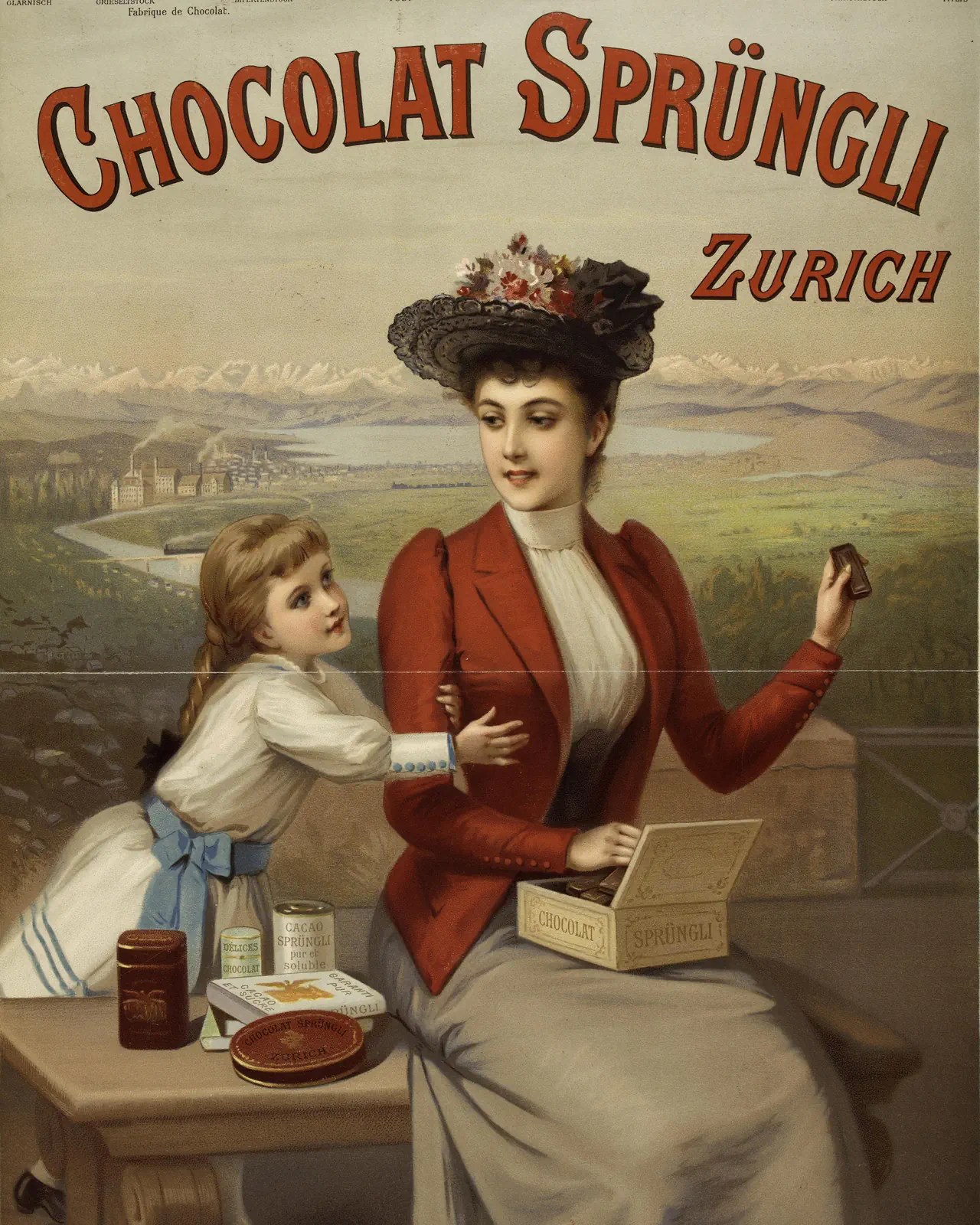
Alpine dairy maids against a mountain backdrop, cows grazing on lush pastures, and St Bernard dogs with chocolate around their necks: from the 19th century onwards, Swiss chocolate manufacturers used idyllic Alpine imagery to promote their products. First at home, then worldwide.
The Neuchâtel-based chocolate maker Philippe Suchard was a pioneer of this approach. According to Flammer, he likely brought these marketing ideas back from trips to the United States.
“Suchard distributed his posters internationally. His advertisements travelled through European cities on thousands of trams,” Flammer explains. In doing so, he created a powerful selling point: chocolate made with milk from pure Alpine environments.

The target audience: women, children and soldiers
Swiss producers also included elaborately designed collectible cards with their chocolate to attract customers, particularly women and children.

“Until around 1900, chocolate was not especially popular with men,” says Flammer. “Men drank coffee and schnapps.” That changed when armies began purchasing chocolate as a source of energy. Switzerland followed suit and supplied chocolate to armies around the world during the First World War.

As a result, Swiss chocolate gained a new audience – including male consumers.

Marketing alone does not explain the success of Swiss chocolate. Swiss producers also made key technical innovations, including the conching machine, which gives chocolate its smooth texture, and the development of milk chocolate itself.
The darker side of chocolate history
Flammer also addresses more problematic aspects of Swiss chocolate’s past. Until the 1960s, some advertising relied on racist stereotypes of people from cocoa-producing regions.
Swiss chocolate flourished during the colonial era, and Switzerland benefited indirectly from colonial structures. Flammer points to the role of Basel missionaries in West Africa, who, with support from the British colonial authorities, helped establish some of the first cocoa plantations. These were located in what was then the Gold Coast – today Ghana – and in regions that are now part of the Ivory Coast. Today, these two countries are the world’s largest cocoa producers.
A small player with a big image
Despite its reputation, Switzerland is a minor producer on the global market. “Only around one per cent of the chocolate consumed worldwide is made in Switzerland,” Flammer notes.
Yet the image of Switzerland as a chocolate nation endures – a testament to the lasting impact of marketing that helped turn chocolate into a national symbol.
Dominik Flammer: Schweizer Schokolade – Alpen, Milch und Pioniere (Swiss chocolate – Alps, milk and pioneers). AT Verlag, 2025.
Translated from German using DeepL/amva

In compliance with the JTI standards
More: SWI swissinfo.ch certified by the Journalism Trust Initiative

You can find an overview of ongoing debates with our journalists here . Please join us!
If you want to start a conversation about a topic raised in this article or want to report factual errors, email us at english@swissinfo.ch.