








Switzerland edges toward lifting ban on new nuclear plants
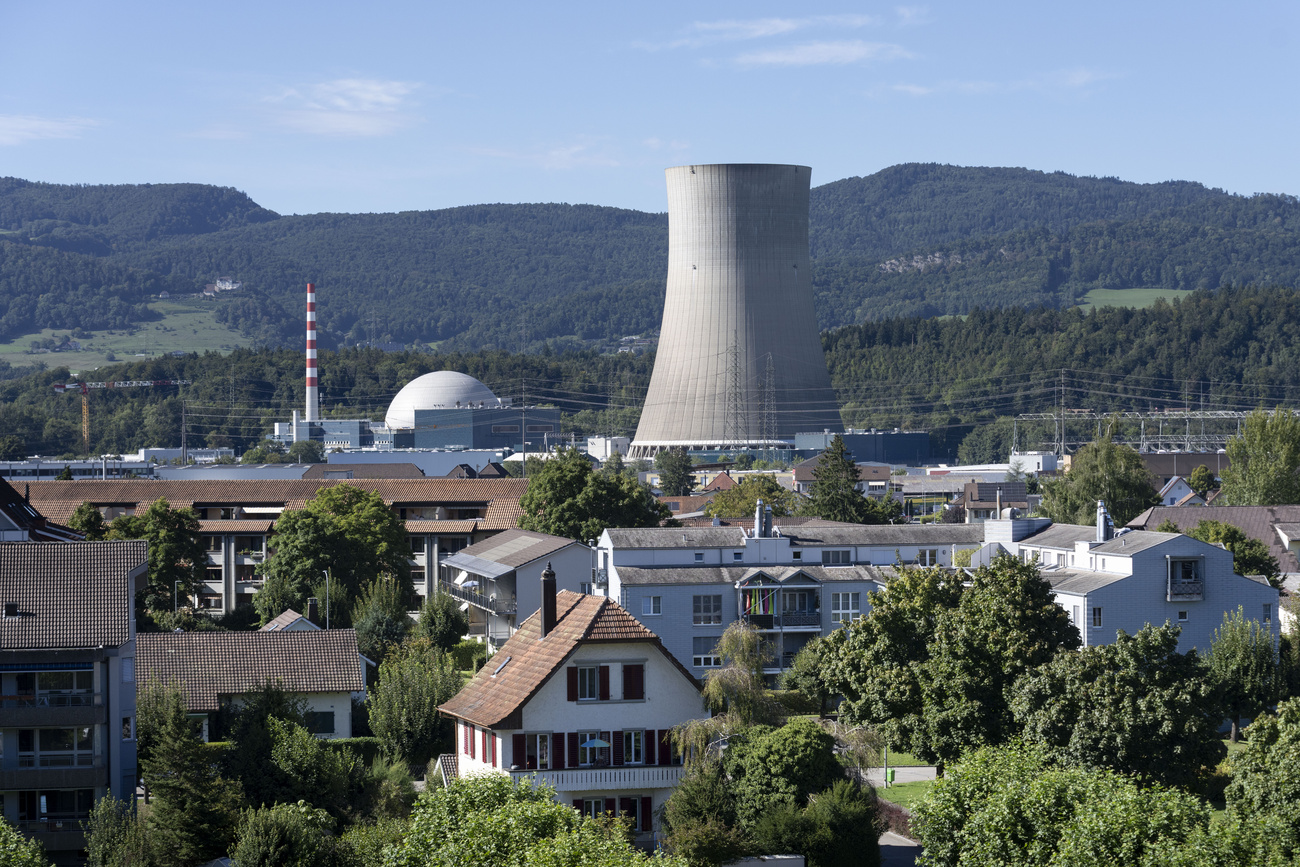
The Senate has voted to lift Switzerland’s ban on building new nuclear power plants. On Wednesday it approved the government’s indirect counterproposal to the so-called “Blackout Initiative”. The House of Representatives will now take up the issue. Here’s why nuclear energy is back in the spotlight.
Select your language
Generated with artificial intelligence.
Listening:
Switzerland edges toward lifting ban on new nuclear plants
Even as Switzerland phases out its ageing reactors, the debate on building new ones has been revived. In response to the popular initiative “Electricity for all at all times (Stop blackouts)”External link, the Swiss government decided in 2024 to amend the Nuclear Energy Act, aiming to lift the existing ban on constructing new nuclear power plants. Parliament is now discussing the proposal, which could ultimately be decided by a nationwide vote.
In 2024, centre-right parties and business representatives launched the popular initiative “Electricity for all at all times (Stop blackouts)”, which seeks to overturn Switzerland’s ban on building new nuclear power plants.
The initiative proposes amending the Constitution so that “all forms of climate friendly electricity production” are permitted, effectively guaranteeing the right to generate energy using any non-fossil fuel technology. It also aims to reverse the 2017 energy law reform, approved by 58% of voters, which set Switzerland on a path to phasing out nuclear power while expanding renewables such as solar, geothermal and hydropower.
Supporters argue that nuclear energy is essential for Switzerland’s energy security and climate strategy.
The Swiss government also believes new nuclear plants should be authorised again but has put forward a counterproposal that limits itself to amending the law and not the Constitution.
A majority in the Senate from the right-wing Swiss People’s Party, the centre-right Radical-Liberal Party, and most of the Centre Party backed the counterproposal. The left-wing Social Democrats and Greens, as well as the Liberal Greens, the Protestant Party and environmental groups oppose it, arguing that new reactors would take decades to build – potentially not before 2050 – and still carry significant technical risks. The House of Representatives must now debate the issue. Energy Minister Albert Rösti has said a referendum is likely.
For now Switzerland remains committed to a gradual nuclear phaseout, a policy launched after the 2011 Fukushima disaster in Japan, approved by voters in 2017. The country still has three ageing nuclear plants with four reactors – Beznau I and II, Gösgen and Leibstadt – which together produce about 30% of the country’s electricity.

Why is there a rethink in Switzerland now?
The Alpine nation’s climate policy has created a sense of urgency. Switzerland aims to become climate neutral by 2050, which means replacing fossil fuel heating systems and combustion-engine cars with electric alternatives, driving up electricity demand. At the same time, the country’s four ageing nuclear reactors will likely be shut down in the coming years. Whether hydropower, solar and wind can fully compensate remains contested.
New nuclear plants could help close the looming energy supply gap with a low carbon footprint. Since the war in Ukraine, energy security has also taken on new importance. Policymakers want to reduce dependence on imported gas and electricity in winter. In short: concerns about blackouts and climate targets are increasingly outweighing the safety fears that prevailed after the nuclear disaster in Fukushima 15 years ago. In addition, new reactor designs promise to be cheaper and safer.
What is the state of the latest nuclear power plant technology?
Here, optimism from certain politicians and industry officials contrasts with the technical reality. Hopes rest largely on Small Modular Reactors (SMRs), advanced nuclear reactors with a power capacity up to 300 MW (about a third produced by traditional reactors) which could be mass produced and assembled modularly. Only two SMRs currently operate worldwide – one in Russia and one in China. The European Union aims to deploy the first SMRs in the early 2030s, but recent US projects have suffered setbacks.
Another focus is on so-called fourth-generation large reactors, which are designed to be safer and more sustainable, and minimise the nuclear waste problem. According to the most optimistic timelines, such plants will be operational in the mid-2030s at the earliest, and Swiss approval processes typically take longer.
External Content
Are new nuclear power plants financially viable?
Financing is likely to be the biggest obstacle. Estimates of the cost of a new plant in Switzerland range between CHF15 billion and CHF25 billion ($19.2 billion and $32 billion). Experts believe that private financing alone is unrealistic; state guarantees or subsidies would be needed. Various models are possible. Either consumers co-finance through a small levy on their electricity consumption – as is the case today with renewables – and/or the Swiss government participates as a co-owner, as some cantons did with existing nuclear power plants.
External Content
What does the recent EU decision mean for the energy transition?
The EU has signalled a renewed emphasis on nuclear energy. Reducing Europe’s nuclear energy sector was a “strategic mistake”, European Commission chief Ursula von der Leyen said on Tuesday, as governments grapple with an energy crunch from the conflict in the Middle East. Her statement is highly controversial. Supporters argue nuclear power enhances energy security and that fossil fuels – oil, gas and coal – could be replaced by climate-friendly nuclear power. But critics warn it could undermine investment in hydropower, wind and solar.
In Switzerland, the federal government says new nuclear plants could complement the development of renewable energies. But the technology remains politically divisive, as surveys show. Any new project would face major political resistance and likely lengthy legal challenges – delays that could significantly slow the country’s broader energy transition.
More
Why climate change and wars are reviving interest in nuclear energy
External Content
Translated from German using AI/sb/ac

In compliance with the JTI standards
More: SWI swissinfo.ch certified by the Journalism Trust Initiative

You can find an overview of ongoing debates with our journalists here . Please join us!
If you want to start a conversation about a topic raised in this article or want to report factual errors, email us at english@swissinfo.ch.