








Former Swiss intelligence officer targeted by new EU sanctions against Russia
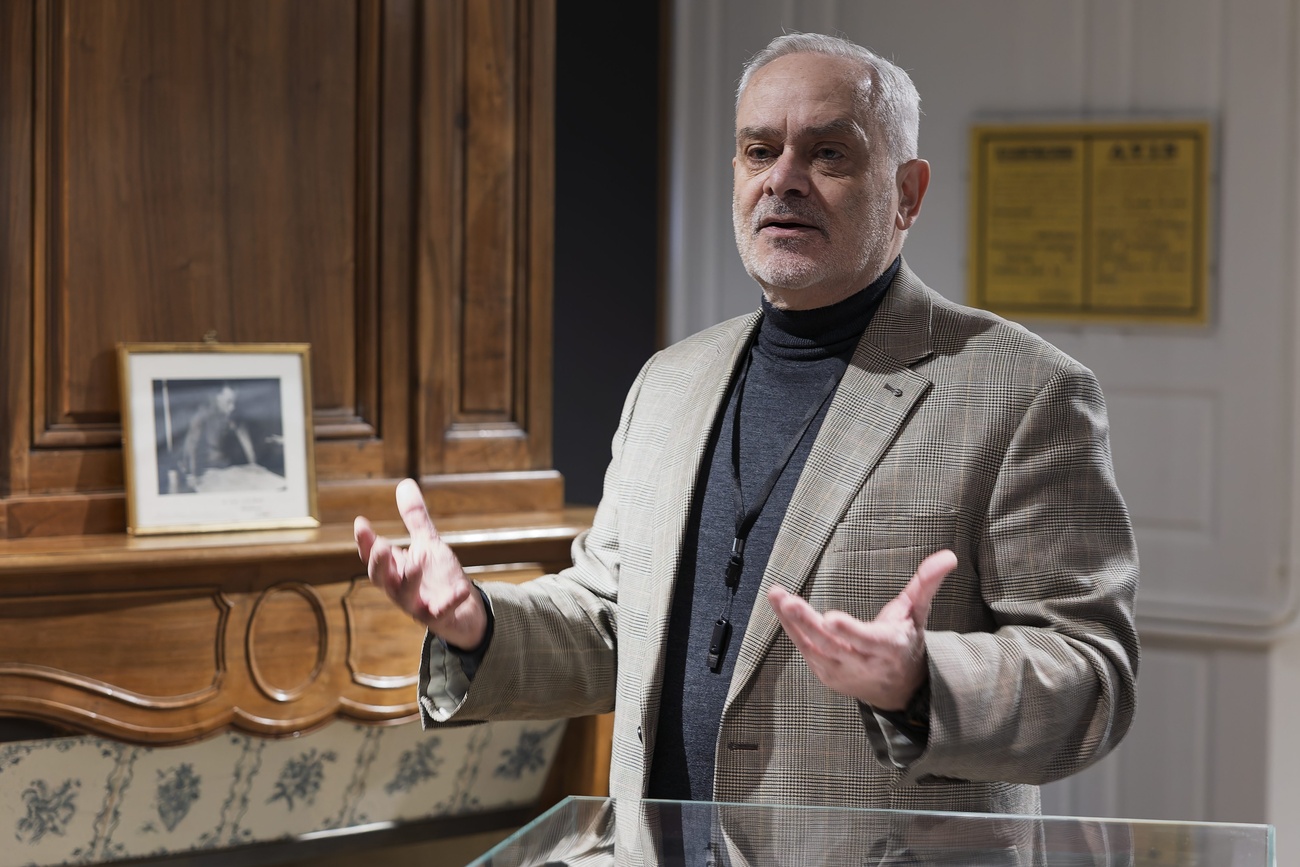
The EU has sanctioned former Swiss colonel Jacques Baud for promoting conspiracy narratives and false claims about the war in Ukraine on Russian media.
Select your language
Generated with artificial intelligence.
Listening:
Former Swiss intelligence officer targeted by new EU sanctions against Russia

A former Swiss army officer is on the new European Union sanctions list against Russia-related companies and individuals.External link
The list published on December 15 includes 70-year-old Jacques Baud, a retired colonel and former strategic analyst specialising in intelligence and counterterrorism.
The Official Journal of the European Union states that Baud acted “as a mouthpiece for pro-Russian propaganda and makes conspiracy theories.”
As a result Baud will not be allowed to travel within EU countries and his assets in the Euro zone will be frozen.

In total the EU has imposed new sanctions on 12 individuals and two entities over information manipulation and cyberattacks. Those targeted are analysts and influencers linked to pro-Kremlin networks who have promoted pro-Russian propaganda. Among them are five experts associated with the Valdai Club, a Russia-based international forum External linkand think tank where President Vladimir Putin speaks annually.
Will Switzerland follow the EU?
So far Switzerland has followed EU on sanctions on Russia which apply to over 2,600 individuals and entities. Switzerland, however, does not apply the EU measures targeting so-called “destabilising activities” and hence will not be applying sanctions on Baud.
In response to questions from Swissinfo, the Swiss Secretariat for Economic Affairs (SECO)External link said it was aware a Swiss citizen was on the EU sanctions list.
“Switzerland joined the EU sanctions linked to Russia’s war against Ukraine but did not adopt the EU sanctions regime on Russia’s hybrid threats, non-military actions, including disinformation and propaganda, cyberattacks, election interference enacted in October 2024,” SECO said in its email response. “As a result, Switzerland is not currently considering taking over the latest listings.”
It is unclear if Baud is a resident of Switzerland. According to the website of Swiss media 24 heures, he lives in Brussels and his current main publisher, Max Milo,External link is French. In principle, the sanctions would also prohibit Baud from receiving royalties within the EU.
Ilya Shumanov, managing partner at TriTrace Investigations and ex-head of Transparency International Russia says Baud is a Swiss resident according to open sources he has seen. This would make monitoring his movements between from Switzerland to neighbouring EU countries difficult, he said. Switzerland does not systematically monitor its borders with France, Italy and Germany.
“These borders are a ‘blind spot’ when it comes to monitoring the movement of individuals who are on EU sanctions lists but not on Swiss ones”, Shumanov said.
More
Magnitsky case: How Switzerland failed to investigate Russian millions
From intelligence officer to controversial commentator
From 1983 to 1990, Baud worked for Switzerland’s Strategic Intelligence Service, monitoring military forces in Eastern Europe and other regions during the Cold War era, when Europe was divided between East and West.
His analysis on currents affairs have always been controversial. He is notably known for stating that accusations against Osama bin Laden, the mastermind behind the 9/11 terrorist attacks in 2011 in the United States were based on “speculation”.
A quick online search by Swissinfo found Baud to be present in numerous Russian state media television and radio programmes where he is presented as a Russia specialist and an expert on the “conflict in Ukraine.”
He also features on video podcasts published in the United States and Europe, and regularly appears on the YouTube channel Dialogue Works, known for interviews and analytical videos that often criticise Western policies and feature speakers aligned with pro-Russian or anti-NATO narratives.
On air, Baud regularly uses the same terminology as official Russian authorities. For instance he states that Russia has not violated the Minsk agreements.
These agreements were signed in 2014 and sought to end the war in Eastern Ukraine between armed Russian separatist groupsExternal link and UkraineExternal link.
Russia claims they haven’t violated the agreements which Ukraine denies, arguing Russia failed to implement the ceasefire including the withdrawal of heavy weapons in the Donetsk and Luhansk regions.
Baud also appears on the website of the think tank Centre Français de Recherche sur le Renseignement or CF2R (French Centre for Intelligence Research). Behind this name is a group of Russian-focused experts who are sometimes featured in the media and often take pro-Russian positions. Frequently invited to speak on television and radio, CF2R members tend to promote a one-sided narrative about Russia.
More
How Switzerland is caught up in Russia’s propaganda machine
In a recent video on YouTube Baud said that “no one in the White House cares about Ukraine,” and that “Russia will carry out the task of demilitarising Ukraine, which will ensure the future security of the Russian Federation.”
Just days before the publication of the new sanctions list, Baud said on a YouTube channel that “Europe has not yet realised that the Ukrainian conflict will end on Russia’s terms.”
“It is critically important for Russia to have alternative voices that justify the Kremlin’s actions,” Shumanov says. “Such individuals often receive fees for their appearances on media.”
Contacted by Swiss media La Tribune de Genève External linkahead of the EU decision, Baud said he was not aware of the sanctions and had received no warning.
SECO told Swissinfo that EU sanctions decisions are taken within a “rule-of-law framework” and that individuals concerned have the right to challenge them through legal channels. Swiss authorities generally take note of such decisions.

More
Fake news versus facts: the role of international media
More

Edited by Virginie Mangin/ac

In compliance with the JTI standards
More: SWI swissinfo.ch certified by the Journalism Trust Initiative

You can find an overview of ongoing debates with our journalists here . Please join us!
If you want to start a conversation about a topic raised in this article or want to report factual errors, email us at english@swissinfo.ch.