








Study: at least half of world’s glaciers to disappear by 2100
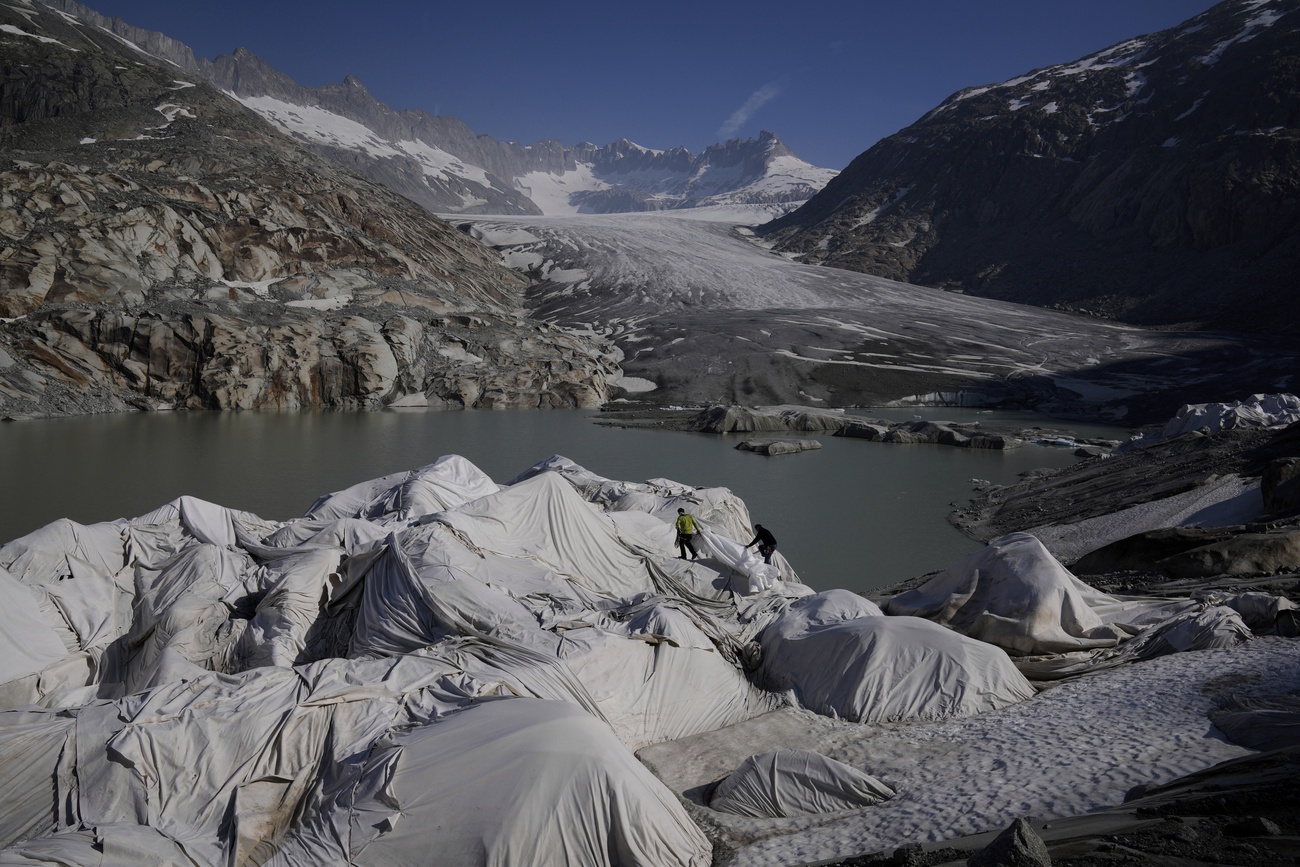
Up to 4,000 glaciers a year could disappear as a result of climate change, warn Swiss researchers in a new study published on Monday. They estimate that at least half of the world's glaciers will no longer exist by the end of the century.
Select your language
Generated with artificial intelligence.
Listening:
Study: at least half of world’s glaciers to disappear by 2100
+ Get the most important news from Switzerland in your inbox
The retreat of glaciers is more than just a natural science problem, say the researchers in their study, published in the journal Nature Climate Change.
“Each glacier can be decisive at a local level; it can be a cultural monument, an important tourist destination or the symbol of a regional identity,” said the study’s lead author, Lander Van Tricht, from the Swiss federal technology institute ETH Zurich.
Even the disappearance of a small glacier with a low meltwater contribution can have major consequences. Unlike previous studies, it was important not just to analyse the volume of glaciers and the surface area they cover, but also to focus on their number.
Four out of five glaciers gone
For their new study, the researchers posed the following question: how many of the 200,000+ glaciers around the world will exist in the future?
The answer depends on the extent of global warming. If the planet warms by 2.7° degrees Celsius – the current global warming estimate based on climate measurements – four out of five of the world’s glaciers will disappear.
More
Why melting glaciers affect us all
If warming were limited to 1.5°C – as foreseen in the Paris climate agreement – half of the current glaciers would be preserved. In the worst-case scenario, with global warming of 4°C , only one in ten glaciers would remain by the end of the century.
“These contrasts illustrate how an ambitious climate policy can make an essential contribution to preserving glaciers,” say the researchers.
Already 1,000 fewer glaciers in Switzerland
According to the study, glaciers are disappearing first in regions where there are many small glaciers, such as the Alps and the Caucasus. Larger glaciers in regions such as Greenland and Antarctica are retreating more slowly.
By the middle of this century, between 2,000 and 4,000 glaciers will disappear each year as a result of rising temperatures. At present, according to researchers, around 750 to 800 glaciers are already disappearing around the world every year.

More
Alpine glaciers are melting even on the highest peaks
“In Switzerland, we have already lost more than 1,000 glaciers over the past three decades,” says glaciologist Matthias Huss, who took part in the study. Four out of ten glaciers in our country have already disappeared. “Most of these were small glaciers, and most of them didn’t even have a name.”
Burials for glaciers
“In recent years, funerals have been held for glaciers in every region of the world,” said Huss.
He himself took part in the funeral of the Pizol Glacier (SG) in 2019, where more than 250 people turned out to pay their last respects. “For me, it was impressive to see the number of people interested in this small glacier that I measured for so long,” said the researcher.
A glacier is considered to have disappeared when its surface area falls below 0.01 square kilometres or its remaining mass is less than 1% of its initial mass.
What is your opinion? Join the debate:
External Content

More
Why the Swiss are leading efforts to track melting glaciers
Adapted from German by AI/sb
We select the most relevant news for an international audience and use automatic translation tools to translate them into English. A journalist then reviews the translation for clarity and accuracy before publication.
Providing you with automatically translated news gives us the time to write more in-depth articles. The news stories we select have been written and carefully fact-checked by an external editorial team from news agencies such as Bloomberg or Keystone.
If you have any questions about how we work, write to us at english@swissinfo.ch
External Content

In compliance with the JTI standards
More: SWI swissinfo.ch certified by the Journalism Trust Initiative

You can find an overview of ongoing debates with our journalists here . Please join us!
If you want to start a conversation about a topic raised in this article or want to report factual errors, email us at english@swissinfo.ch.