








Russian state broadcaster accuses Swiss public broadcaster SRF of manipulation
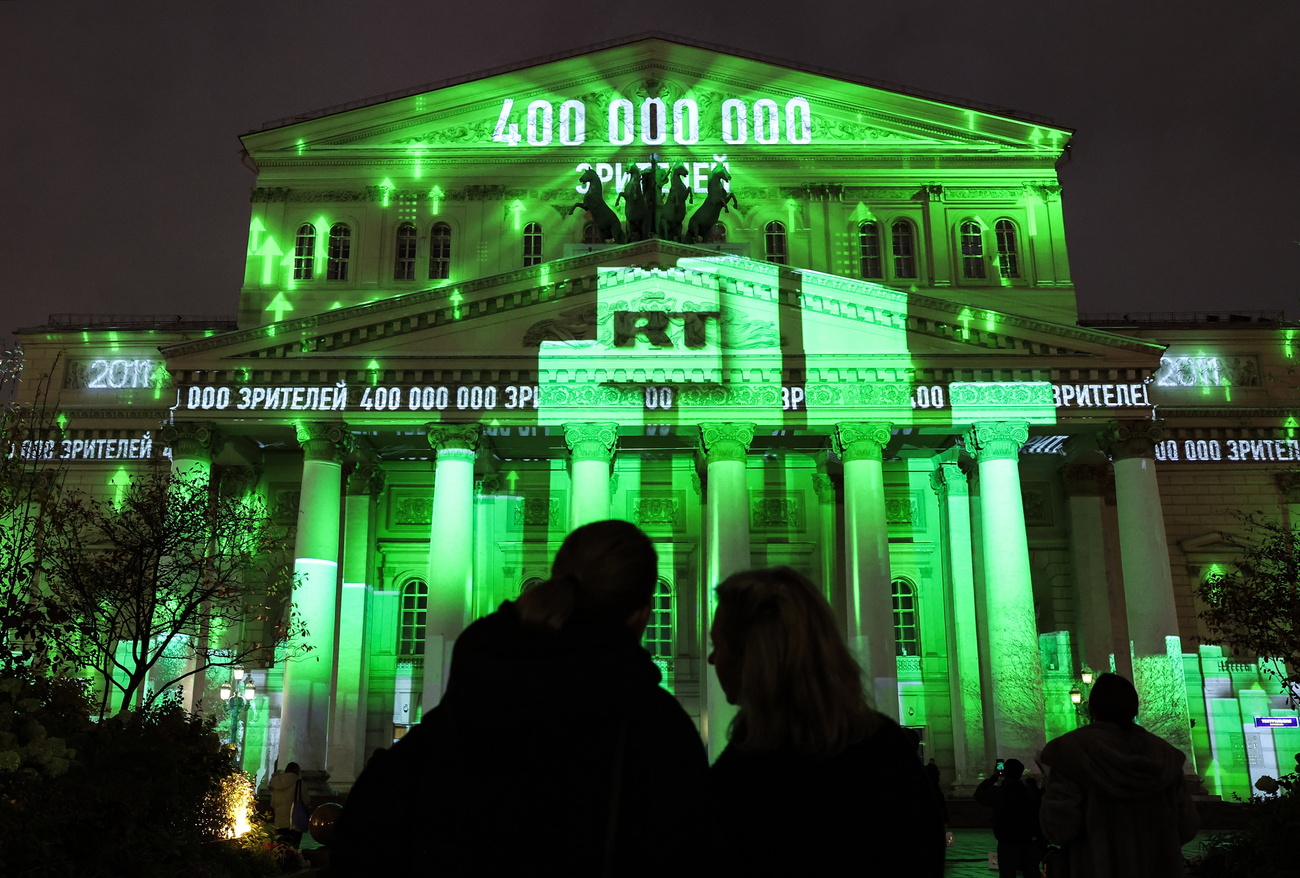
The Russian state media outlet RT DE has become involved in a Swiss debate around an initiative to halve the public media licence fee.
RT (formerly Russia Today) has accused the Swiss Broadcasting Corporation (SBC) of “targeted manipulation of the population” and of being “part of social conflicts”, according to a report in the Tages-AnzeigerExternal link newspaper.
In an article published on its German-language platform, RT used a doctored screenshot taken from the website of the Swiss public broadcaster, SRF, to criticise coverage of the SBC media licence fee initiative, which will be put to voters on March 8.

More
Explainer: Swiss to vote on initiative to cut media licence fee
RT, which is financed by the Russian state, has long been accused of spreading disinformation and pro-Kremlin narratives in Western countries.
The SBC reacted with a statement: “We take note of the RT DE article. We firmly reject the accusation in it of deliberately manipulating the population. The advert shown on the screenshot in the article did not appear on SRF’s website; it is a falsification. According to its licence, the SBC does not place any advertising on its online platforms, and as such there is also no advertising content on SRF platforms.”
Why target a Swiss vote?
Ulrich Schmid, a professor of Russian culture and society at the University of St Gallen, says SRF’s reporting on Russia is a likely reason.
“SRF’s coverage, which is justifiably critical of Russia, is a thorn in the Kremlin’s side,” Schmid says. “Weakening the SBC would open up more space for propaganda narratives.”
According to Schmid, RT’s coverage is thus aimed at influencing public opinion ahead of the vote.
Asked by SRF why it was commenting on the Swiss ballot, RT responded simply: “RT and our authors have the right to express their opinion on topics of their choice and on any country of their choice.”
Defamation and influencing
The Swiss government has warned that the country is increasingly a target of disinformation campaignsExternal link since it adopted sanctions against Russia. Russian state media have also repeatedly targeted Swiss political figures.
The State Secretariat for Security Policy (SEPOS) are also aware of instances of Russian influence attempts ahead of public votes. Overall, Russian disinformation activity increased by around a quarter in 2025, according to federal authorities.
The authorship of some of the articles remains unclear. Some appear anonymously, others under the suspected pseudonym “Hans-Ueli Läppli”.
Several Swiss media outlets picked up on the Tages-Anzeiger report. Shortly afterwards, RT DE published another article – this time advocating a “no” vote on the initiative to halve the SBC licence fee.
Sylvia Sasse, who researches Russian disinformation at the University of Zurich, believes RT may have been surprised by the broad media coverage and inadvertently scored an “own goal”. “They probably assumed that Swiss voters would not do what RT recommends. So they switched to supporting those who oppose the initiative,” she says.
According to Sasse, achieving the opposite effect through overt support is a strategy dating back to the Cold War. “You support in order to harm,” says the German scholar of Slavic studies. She adds that it is typical for RT to put out multiple narratives simultaneously and observe which one has the desired impact.
Schmid describes RT’s strategy as reinforcing opinion bubbles, fuelling mistrust and sowing division. The broadcaster relies on what he calls “news dissemination through mass production”, flooding social media with content, including AI-generated articles.
Overlap with Kremlin narratives
Switzerland is not a primary target of Russian propaganda, Schmid says. A bigger focus is Germany, where some far-left and far-right political actors hold very pro-Russian positions, he explains.
In Switzerland, RT is less focused on justifying Putin’s policies or Russia’s war in Ukraine. However, it amplifies themes that overlap with Kremlin narratives, such as scepticism towards the European Union (EU) or concerns about neutrality. Vaccination sceptics and peace activists are also target groups.
The EU banned RT after the start of Russia’s full-scale invasion of Ukraine, citing systematic disinformation. The German-language channel RT DE, however, remains accessible in Switzerland.
Schmid notes that RT has openly spread false claims in the past, for example by portraying the Russian massacre in Bucha as staged by Ukraine. In his view, this would be one justification for a ban.
However, “in Switzerland, freedom of expression is high priority,” he says. “The argument is that the public sphere must also be able to tolerate broadcasters like RT.” A ban, he adds, could even lead to more attention: “What is forbidden can be more attractive – and it could fuel accusations that there is no freedom of expression in Switzerland.”
Read more on the impact of international misinformation and disinformation about Switzerland below:

More
Fake news spread abroad about Switzerland is a liability
Translated from German using AI/amva,dos
How we translate with AI
We use automatic translation tools, such as DeepL and Google Translate, for some content.
Each translated article is carefully reviewed by a journalist for accuracy. Using translation tools gives us the time for more in-depth articles.
Learn more here about how we work with AI.
External Content

In compliance with the JTI standards
More: SWI swissinfo.ch certified by the Journalism Trust Initiative

You can find an overview of ongoing debates with our journalists here . Please join us!
If you want to start a conversation about a topic raised in this article or want to report factual errors, email us at english@swissinfo.ch.