








Swiss universities hail success of lab rat adoption programme
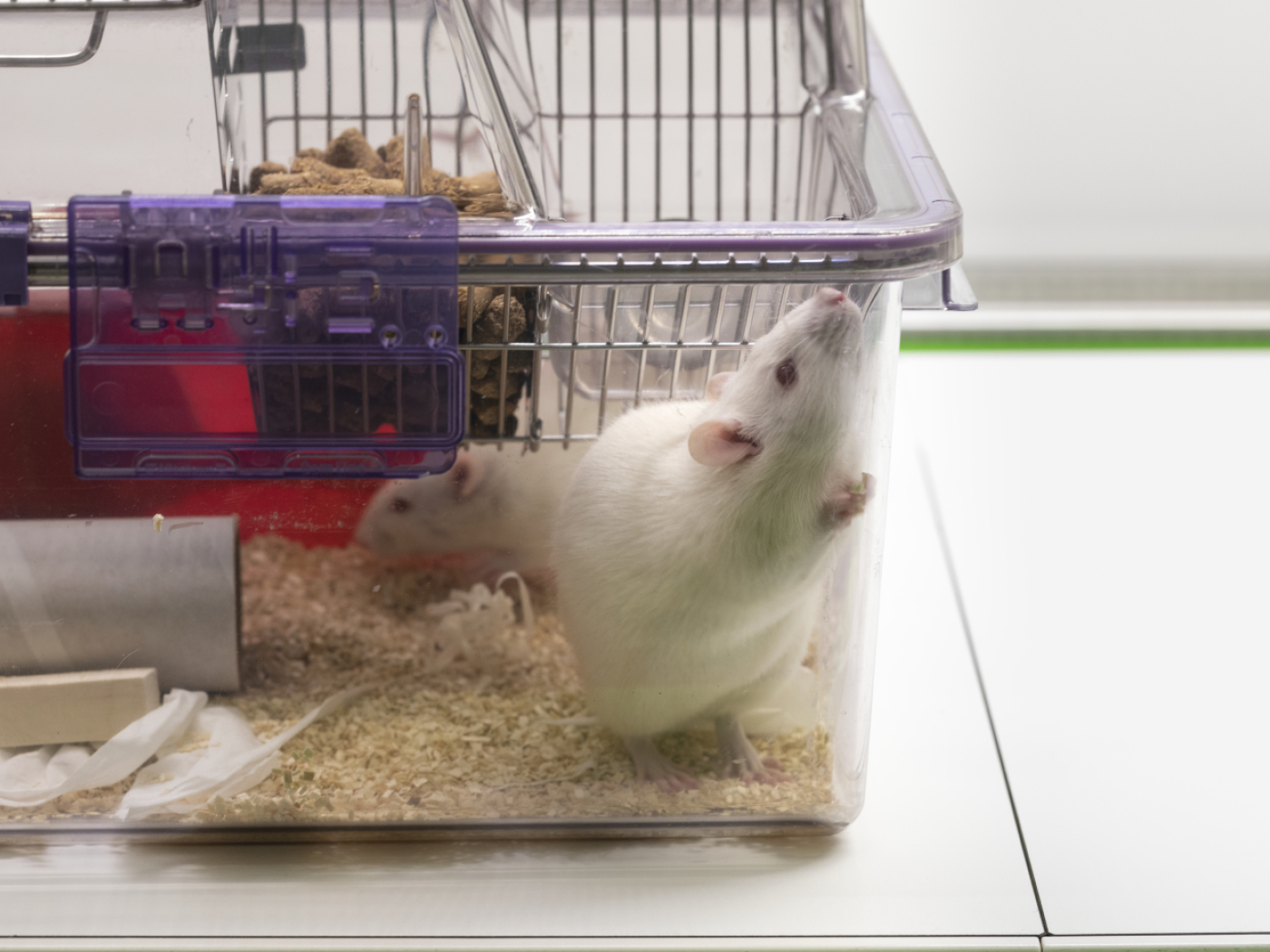
The Swiss Federal Institute of Technology in Lausanne (EPFL) is pleased with the programme it is running with Swiss Animal Protection (SAP) for the adoption of laboratory rats by private individuals. Since the project began in April 2022, some 254 rodents have found homes outside the EPFL.
Select your language
Generated with artificial intelligence.
Listening:
Swiss universities hail success of lab rat adoption programme
+Get the most important news from Switzerland in your inbox
“For us, the results are positive. Researchers are happy to be able to give these animals up for adoption rather than having to euthanise them,” Alexandre Widmer, head of the EPFL’s “rehoming” project, told Keystone-ATS news agency. “We manage to give away all the eligible rats. Although it’s still a small number, it’s positive,” he added.
In 2024, 644 laboratory rats were used by EPFL. Of these, 45 were adopted, while 599 took part in experiments. The latter will all eventually be euthanised. “You have to understand that euthanising the animal to remove tissue is an integral part of the experiment,” explains Alexandre Widmer.
Rats that have taken part in scientific experiments cannot be given up for adoption. The cantonal authorities require that only non-genetically modified rats that have not undergone any experiments can be placed in a home.

More
Swiss government rejects initiative against animal testing
Most of the rats for adoption are therefore females that have given birth to pups intended for experimentation. The rats used by the EPFL come either from its own farms or from professional farms abroad, mostly in France, Germany and Italy.
In the case of foreign orders, the institution generally receives pregnant females aged between 5 and 10 months. Some time after they have given birth, they can be put up for adoption, provided that the kennel from which they came has given its agreement.
“Before, we would have had no choice but to euthanise them. But now we keep them for a while at home, until we have enough to donate to the PSA,” continues Widmer. At the last donation on December 18, 12 rats were given to the PSA.
Rehabilitation phase
After receiving the rodents in transport crates at EPFL, the PSA transfers them directly to one of its sections. “This is usually the Rat Friends Club,” the PSA told Keystone-ATS. “It is then up to this section to accustom the animal to life outside the laboratory and to place it with private individuals,” it adds.
The rats stay at the refuge for around thirty days before they can be adopted. “They have to adapt to living in larger cages and to a less standardised diet, including vegetables and seeds,” points out Widmer. The EPFL covers half of the rehabilitation costs and the PSA the other half.
“We generally get positive feedback from the shelters, because these rats are often more docile and more used to being handled than others,” says Widmer. Neither the EPFL nor the PSA have precise figures or data on the profiles of adopters.
Rats, rabbits and even horses
The rehoming project began at the end of 2018, thanks to dialogue between the PSA and the University of Zurich. Initially, it exclusively concerned rats, says the PSA on its website. The EPFL followed in 2022, then the Universities of Basel and Bern in 2023. By August 2025, “more than 1,000 animals had been taken in and successfully placed, including more than 750 rats, 260 mice, 22 rabbits, 26 dogs and one horse”, it states.
“If all goes well, the University of Geneva should also be involved in the rehoming project in 2026,” the PSA added.
It should be noted that while a growing number of universities are taking part in the project, the number of rats used in experiments is tending to fall. At EPFL in any case, the number of rats will fall from 1,306 in 2022 to 734 in 2023 and 644 in 2024.
Adapted from French by AI/jdp
We select the most relevant news for an international audience and use automatic translation tools to translate them into English. A journalist then reviews the translation for clarity and accuracy before publication.
Providing you with automatically translated news gives us the time to write more in-depth articles. The news stories we select have been written and carefully fact-checked by an external editorial team from news agencies such as Bloomberg or Keystone.
If you have any questions about how we work, write to us at english@swissinfo.ch
External Content

In compliance with the JTI standards
More: SWI swissinfo.ch certified by the Journalism Trust Initiative

You can find an overview of ongoing debates with our journalists here . Please join us!
If you want to start a conversation about a topic raised in this article or want to report factual errors, email us at english@swissinfo.ch.