








Swiss-funded study finds cows are smarter than originally thought
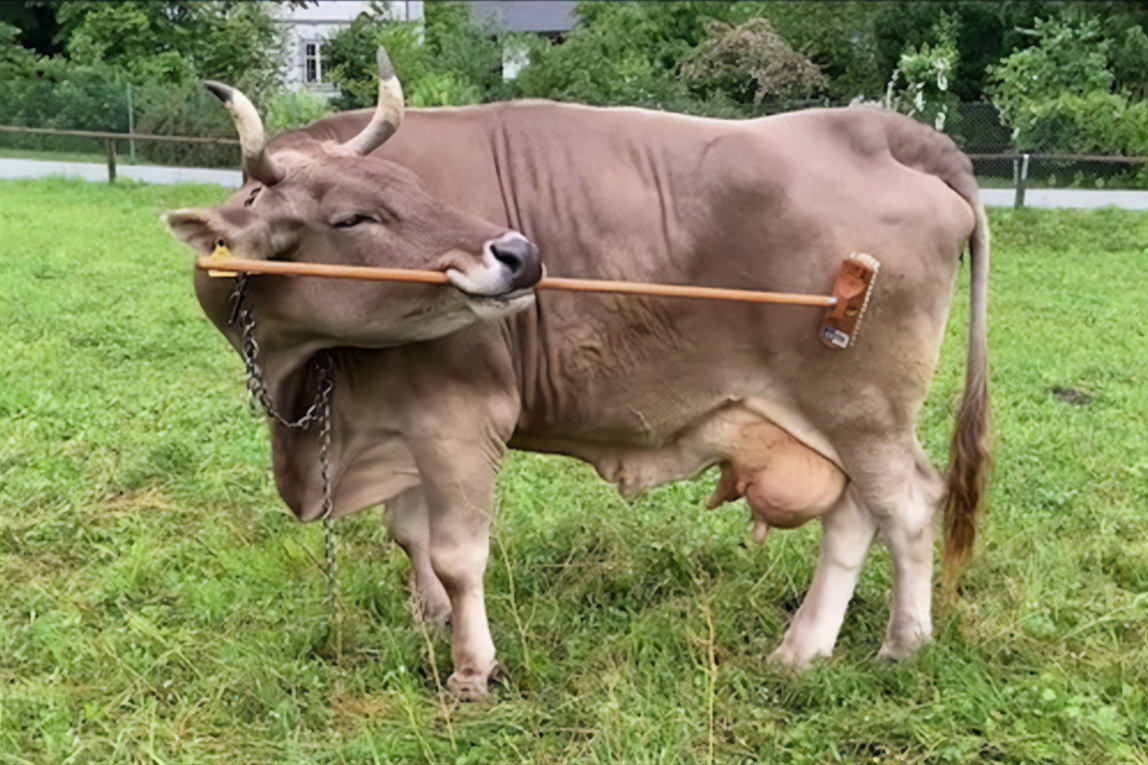
Veronika the cow has amazed researchers by using a broom to scratch specific areas of her body. This is considered tool use – a skill that was not previously known to be possessed by cattle.
Select your language
Generated with artificial intelligence.
Listening:
Swiss-funded study finds cows are smarter than originally thought
+ Get the most important news from Switzerland in your inbox
This calls into question the previous assessment of the cognitive abilities of cattle, as reported by scientists from the Research Institute for Human-Animal Relations in Vienna, funded by the Swiss Messerli Foundation. The study was published on Monday in the journal Current Biology.
“For a long time, it was virtually automatically assumed that cows were stupid,” said study leader Alice Auersperg in an interview with the Keystone-SDA news agency. However, the study has shaken the common mockery of the “stupid cow”.
Initial doubts
After publishing a book on animal intelligence, Auersperg received an email with a video of the cow Veronika. “We are always cautious with videos like this. In the age of deepfakes, you never know if videos are real,” said the researcher.

More
The difficult search for real Swiss cows
So the researcher traveled with her postdoctoral fellow Antonio Osuna-Mascaro to the small mountain community in Carinthia, Austria, where Veronika lives. “We thought it might take a day or two to see this behavior,” said Auersperg. “But we walked into that pasture, and within seconds, Veronika picked up a stick with her tongue, held it in her mouth, and started scratching herself with it.”
Previously observed in chimpanzees
In the study, the researchers describe Veronika’s remarkable flexibility. In one experiment, they gave the cow a broom. Veronika used the bristle end of the brush for the upper, thicker-skinned areas of her body, such as her back. For more sensitive lower areas, such as her udder or skin flaps on her belly, she used the smooth end of the handle.
This differentiated approach is referred to in the study as multi-purpose tool use. According to the study, such behavior, in which different properties of a single object are used for different functions, has so far only been consistently documented in a comparable way in chimpanzees.
However, tool use is not always the same, the researcher explained. Behavior directed at one’s own body, as demonstrated by Veronika, is considered cognitively simpler than tool use directed at the environment, such as chimpanzees fishing for termites with sticks.
Nevertheless, Veronika’s flexibility and technical finesse are impressive for a cow, the researcher emphasised.
Not all cows use tools
Veronika is a Braunvieh cow, one of thousands that can be found in Swiss barns and pastures. She is 13 years old and is kept as a pet rather than for agricultural production. According to her owner, she began picking up fallen branches and scratching herself with them on her own at the age of three or four.

More
Why Swiss cows climb mountains
The case of Veronika does not prove that all cows use tools, the researcher explained. But it does show that cattle may have the cognitive prerequisites for doing so. In conventional farming, which often offers little incentive, this potential probably remains hidden.
Research by the scientists on social media platforms uncovered further videos of cattle scratching themselves with sticks. These included both European domestic cattle (Bos taurus) such as Veronika and zebu cattle (Bos indicus). This suggests that the ability to use tools may be an older predisposition anchored in the cattle lineage.
More genius cows wanted
The researchers are looking for more animals with such special abilities for further investigation. “People who observe similar behavior in cows, or even in pigs, sheep, or other farm animals, are asked to let us know,” said the researcher.
This is because the cognitive abilities of farm animals have hardly been studied to date. “It’s actually absurd that we have shown so little interest in these animals, which are so prevalent in our environment,” said Auersperg.
Yet the cognitive abilities of these animals also have moral implications for the relationship between humans and animals. Intelligent animals have higher demands on their environment. The results could therefore be relevant to the discussion about species-appropriate animal husbandry.
Translated from German by AI/jdp
We select the most relevant news for an international audience and use automatic translation tools to translate them into English. A journalist then reviews the translation for clarity and accuracy before publication.
Providing you with automatically translated news gives us the time to write more in-depth articles. The news stories we select have been written and carefully fact-checked by an external editorial team from news agencies such as Bloomberg or Keystone.
If you have any questions about how we work, write to us at english@swissinfo.ch
External Content

In compliance with the JTI standards
More: SWI swissinfo.ch certified by the Journalism Trust Initiative

You can find an overview of ongoing debates with our journalists here . Please join us!
If you want to start a conversation about a topic raised in this article or want to report factual errors, email us at english@swissinfo.ch.