








Tracing roots back to a Swiss witch trial

Series Genealogical research,
Episode 4:
Tammy Mackenzie travelled from Canada to Glarus, in central Switzerland, to trace her grandmother’s roots, recognising scenes from old photos and even meeting relatives who helped her understand how the village still shapes her values.


Tammy Mackenzie stands in front of a three-metre-tall family tree in the Anna Göldi museum in Glarus, central Switzerland, where an exhibition recalls the story of the “last witch of Europe”. Her gaze moves from her phone to the tree and back to her phone, where she swipes and zooms through pictures. “There she is!” she says, pointing somewhere at the top of the tree. “Eva Tschudi, that’s her, that’s my ancestor!”.
Tammy is 49 years old and was born in Canada, but her family roots are Swiss. So Swiss, that her ancestors might have played a role in a significant historical event: the execution of Anna Göldi, accused of witchcraft by her employer Johann Jakob Tschudi in 1782. Tammy came across Göldi’s story by chance through her interest in witchcraft, and was shocked to discover her lineage could have been involved in the accusation that led to the beheading of the young woman.
Family history resonates
Standing before genealogical evidence linking her, like many others in Glarus, to the Tschudi family, Tammy feels the shame of her ancestors’ involvement in the crime. “They were the privileged family that were able to put this accusation on somebody who didn’t have privilege. She’s a woman, she had no husband, no power. And I do inherit of that, of lines of power and privilege through my family,” she says, touched by the exhibition. “I also inherit the world in which this sort of thing happens to women. As a feminist, as a woman in romantic life, this is still part of the dynamics.”
In 2023, Tammy co-founded the Aula Fellowship, a think-tank advocating for inclusive AI. She explains that her advocacy comes from the values her family passed on to her. “My mom and my grandmother are people who’ve taught me feminism from very small as something that is about justice. What is right for people is to love each other and respect each other.”
She stresses that she, her siblings and relatives were raised with Swiss values about how to be good people: staunchness, respect, self-control, sympathy for others and the ability to be diplomatic, the right to self-determination, and high expectations for children.
‘Swissness’ in Canada
The family values were not the only Swiss element in Tammy’s upbringing. She describes how her grandparents’ house had a distinctive “Swissness” to it, with lots of wool craft, massive oak furniture, laced window coverings and a big cowbell hanging from the rafters. “Outside there were handmade wooden shutters and eaves and flower boxes,” she recalls.
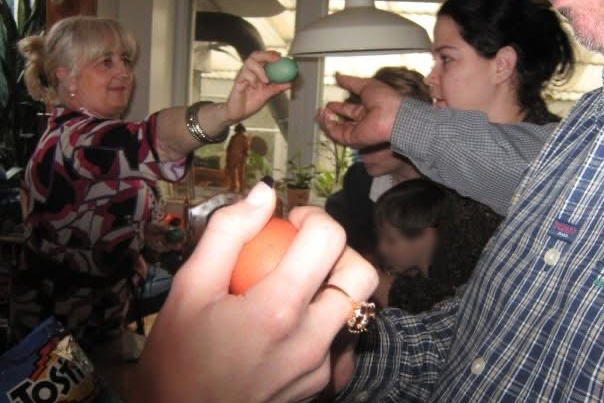
“We were raised to be from Glarus, so my accent is Glarnischer. I don’t speak high German,” explains Tammy, who learnt Swiss German from her mother, who still speaks it with her brothers. She occasionally took language classes offered by the protestant church in the town of Mount Royal, which she attended with her cousins. As children, they had their Swiss blouses and skirts, they heard stories of William Tell and the Habsburgs, and learned Swiss songs and how to use guns. Every year, at Easter, they did Eiertütsche, a Swiss tradition which involves smashing your own boiled egg against someone else’sExternal link.
A Canadian with a Glarnischer accent
While in Glarus, Tammy visited the Landesarchiv (cantonal archive) where she sifted through genealogical information that could complement what she had already compiled in an extensive Excel sheet, based off family records and internet research. “Before she died, my grandmother told me the family genealogy. So I have records going back really far: she knew six generations. I have her photo album, with numerous obituaries of family members because people here were sending her information over there,” she said.
Tammy strolled around town, searching for the spots where her grandmother, Margrit Beglinger, posed in her youth. “The last time our family visited Glarus was in 1975,” she recalls. “My mom and dad came with my grandparents and a couple uncles. I was there too: Mom was pregnant with me. My uncle says I was there but had a terrible view” she laughs. With pride, the Canadian takes pictures of buildings which have the Beglinger and Leuzinger names on them.


Born in Glarus in 1926, Margrit married Fernand Théodore Amstutz and moved to canton Vaud, where she had three children, one of them being Marguerite, Tammy’s mother. In 1957, pregnant with her fourth child, Margrit Amstutz moved with her family to Canada.
“The Consulate for Canada showed them beautiful videos, saying ‘come to Canada!’. There was no winter at all in the Canadian videos. In reality, there’s six months of winter, but my grandparents didn’t mind,” says Tammy. “They did well, had a nice house there and six kids. At first my grandfather was a mechanic and owned the first Texaco gas station, then he taught at college. My grandmother raised the kids and then she ran a successful flower production business: they had a small hold farm and some forest acres.”
Emigration runs in Tammy’s paternal family as well: her great-grandparents Alphonse Mackenzie – born in Scotland but raised in Switzerland, in a religious commune that took in orphans – and Jeanne Marulaz moved from Switzerland to France after the First World War. There, Alexandre Mackenzie – Tammy’s grandfather who was born in Chexbres, canton Vaud – became a French citizen. He later married, had children, and moved to Canada as well, where his son John Mackenzie met Marguerite Amstutz, Tammy’s mother.
An unplanned encounter
What Tammy wasn’t expecting from the trip was meeting some of her relatives in the flesh. Yet, in a small village like Glarus where people greet each other on the streets and everybody knows everybody, it was just a matter of time. While Tammy was photographing the Bären’s entrance, the small restaurant her relatives owned, an employee came out to check on her. In a tentative Swiss German, the Canadian tried to explain she was related to the Beglinger-Leuzinger family, and was in town to retrace their footsteps.
It turns out the Leuzinger family still lived in the house behind the Bären, and a moment later, Tammy was standing at her mother’s cousin’s daughter’s front door. “My husband called out to me saying that my cousin from Canada was here,” explains Maya Leuzinger. “I thought: ‘relative perhaps, but surely not a cousin’. We welcomed her in, and she knew everything about us: that I have a sister called Erna, one called Heidi, our birthyears, and that Köbi is my father.”
Tammy’s Glarnischerdütsch is a bit rusty, and she understands older family members more easily than the new generation. But thanks to a simultaneous translator on the phone, and Maya’s husband Fritz’s help, the two started exchanging memories and confirming family ties.

Tammy came back home with her phone full of photographic proof that will help her fill the gaps in her family tree. She’s thrilled to reconnect the Swiss and Canadian sides of the tree, having invited Maya, Erna and their families to visit Montréal.
“We will try and do a virtual family reunion in June. I am encouraging all family members to plan for visits, and several have offered their homes already” she says. “We are looking for other family members and would love to hear from them. The last time Glarus family visited Canada was in the mid 1980s. Today, there’s 57 of us over there in Canada”.
Edited by Samuel Jaberg/ds

In compliance with the JTI standards
More: SWI swissinfo.ch certified by the Journalism Trust Initiative

You can find an overview of ongoing debates with our journalists here . Please join us!
If you want to start a conversation about a topic raised in this article or want to report factual errors, email us at english@swissinfo.ch.