








Human rights film festival mirrors uncertain future for International Geneva
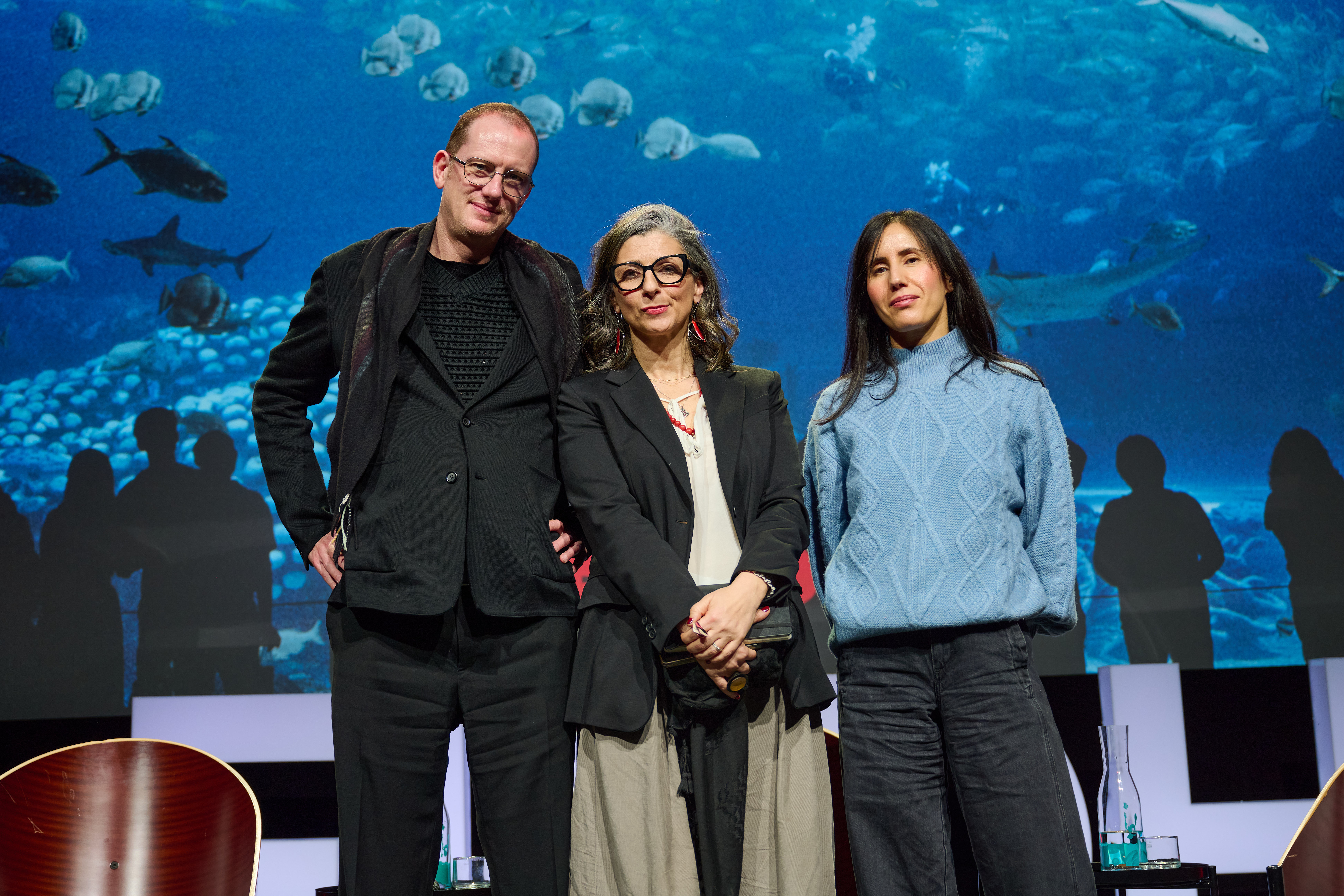
Since 2003, Geneva’s International Film Festival and Forum on Human Rights (FIFDH) has put the spotlight on abuses and crises around the world. This year, the festival also reflects a crisis at home for International Geneva.
Select your language
Generated with artificial intelligence.

Listening:
Human rights film festival mirrors uncertain future for International Geneva
Taking the stage to cheers and applause after the screening of Disunited Nations, Francesca Albanese, UN Special Rapporteur on the situation of human rights in the Palestinian territories, spoke of her anger and frustration over the failings of the global community to prevent widespread death and destruction in Gaza.
At the sold-out event, the discussion offered behind-the-scenes insights about the film that follows Albanese for two years as she documented violations of international law in the Gaza war under intense political pressure.
“International law is not dead but it’s not [a matter of being] dead or alive,” she told the audienceExternal link alongside Disunited Nations director Christophe Cotteret at one of the most anticipated sessions of this year’s International FIFDHExternal link in Geneva.
“It’s an instrument. There’s no point being romantic and saying international law is going to stand up with its sword, slay the evil in the world, and save us all. No, the fact is we aren’t capable of exercising the power that we have, even in democracy,” she said.
External Content
A film, a subject, a debate
The annual film festival – launched in 2003 as a “platform against indifference” and timed to coincide with the main session of the UN Human Rights Council in Geneva – brings together filmmakers, international organisations, human rights activists, journalists, academics, philanthropists and audiences from all walks of life.
From March 6 to 15, people packed into screenings of 54 films from 40 countries, plus the forums and community events that embody the FIFDH concept of “a film, a subject, a debate” as a collective way to defend human rights, raise awareness and inspire commitment to universal values.
“The films bring us to issues through their stories. Then we have this format of the forum, the panel discussion that follows the screening to make sense of the geopolitical challenges for multilateralism,” Laura Longobardi, FIFDH’s editorial co-director, told Swissinfo.
For audiences, it was a chance to share in the lives, struggles and hopes of people dealing with the perilous state of human rights and international law all over the world – from the scars of colonialism and the plight of the displaced to violence fuelled by natural resources and the dangers of technology for democracy and mental health.
With 29 films in official competition at this year’s festival, the three main award winners all featured deeply personal experiences of exile, prejudice and abuses of power.
A Fox Under a Pink Moon by Soraya Akhlaghi and Mehrdad Oskouei, which won the Grand Prize and the Youth Jury Award, follows a young Afghan artist as she films her attempts to escape Iran over a period of five years while pursuing her love of drawing and sculpture.
Arjun Talwar’s Letters from Wolf Street, winner of the Creative Documentary category, chronicles life in his adopted city of Warsaw and the everyday racism faced by migrants in Poland.
In the Fiction category, Cotton Queen by Suzannah Mirghani took the prize for its portrayal of a young woman in a cotton-growing region of Sudan who is pulled into a power struggle that disrupts and reshapes her community.
Geneva under fire
This year, with conflicts raging on many fronts, geopolitics in flux, and the United Nations suffering from severe cuts, the 24th edition of FIFDH also echoed the uncertainties hanging over International Geneva.
“It stood out quite clearly that there was something to talk about what will happen to International Geneva as much as the concerns about what will happen on the ground as this system is being defunded and attacked,” says Longobardi.
The implications are acute for Geneva as a hub for humanitarian aid, development aid and diplomacy with more than 40 international organisations and nearly 500 NGOs.

Due to huge funding cuts by the United States, delayed payment of dues by China, Russia and other member states, and less foreign aid spending by many governments, the UN and its agencies have seen their budgets slashed by 15% in 2026. The effects of restructuring and staff layoffs are already being felt.
“At a time when multilateralism is undergoing a profound crisis and international institutions are seeing their resources and legitimacy challenged, the festival serves as a reminder of why International Geneva remains essential,” Thierry Apothéloz, President of Geneva’s cantonal government, said in an official messageExternal link on the FIFDH website. “It also questions what Geneva must become in order to continue to uphold, with credibility and courage, the values upon which it was founded,” he added.

More
What lies ahead for International Geneva in 2026
Accordion Geneva
After the screening of Solidarity by David Bernet, a panel of speakers continued the conversation at a forum on the future of International GenevaExternal link, envisioning how multilateralism must evolve and what Switzerland could contribute to a new model of global governance.

One of the possibilities set out by Yves Daccord, chairman of Principles for Peace, a Swiss foundation focused on peacemaking, was an “accordion scenario” where International Geneva would contract before refocusing and recovering.
“The status quo is not an option,” Daccord told the audience, adding that Geneva should have a major role to play in “the new global social contract”.
“What are the things that we need to fight for basic principles? How do we defend international law? That is possible – that Geneva will suddenly find itself again as an interesting and important hub,” he said.
Heba Aly, director of the Article 109 Coalition, a group of civil society organisations seeking to update the UN Charter, said the world needs a more inclusive, effective and equitable system of governance, without throwing away concepts of the UN that still have value.
“If we do this right – and I do think Geneva can be the home of a new multilateral system in the same way it has been at the heart of multilateralism 1.0 – it should help seed multilateralism 2.0,” she told the audience.
“Let’s try to reform it and renew it for a new generation but maintain what I think all of us in Geneva believe in, which is a multilateralism that is truly universal.”
>> Trailer of Letters from Wolf Street, which took the Creative Documentary award.
External Content
United values
In an interview with Swissinfo at a café in Geneva, Cotteret, director of Disunited Nations, said the unresolved conflicts in Gaza and elsewhere highlight why we need to renew respect for international law and put pressure on governments to support the value of the UN.
“That’s the question people ask most basically: There’s the United Nations, it’s absolutely useless because it can do nothing. I disagree with that. The United Nations can do a lot. It’s not a problem of the United Nations. It’s the problem of the nations’ short-sightedness,” he said. “We have to think differently with the new world we have to live in.”
With so many uncertainties ahead for multilateralism and International Geneva, the FIFDH organisers remain committed to investing in filmmaking that supports human rights and international law, including the festival’s professional Impact Days to focus ideas and foster new collaborations.
“In the last seven years we’ve been developing an industry programme on impact production with filmmakers coming from around the world for two days and really reflecting and working together on how films can become tools for social change,” Longobardi, the festival’s co-director, told Swissinfo.
“We will keep on looking for films and voices that can express not only the world around us but also the world that we would like to build together, so that we are going in a direction which is more hopeful.”
>> Trailer of Cotton Queen, which took the main prize for Fiction at the FIFDH. Although the story is set in Sudan, production had to relocate to Egypt because of the Sudanese civil war.
External Content
Edited by Eduardo Simantob & Virginie Mangin/ac

In compliance with the JTI standards
More: SWI swissinfo.ch certified by the Journalism Trust Initiative

You can find an overview of ongoing debates with our journalists here . Please join us!
If you want to start a conversation about a topic raised in this article or want to report factual errors, email us at english@swissinfo.ch.