








Middle East conflict: ‘Everyone has a responsibility to inform themselves before travelling’

Faced with the nearly 5,000 Swiss citizens stranded in the Middle East, the foreign ministry maintains that government assistance will be provided only as a last resort. Interviewed by Swiss public broadcaster RTS, the head of the foreign ministry's consular directorate, Marianne Jenni, defends this firm stance, noting that the risk of escalation had been known for several weeks.
Select your language
Generated with artificial intelligence.
Listening:
Middle East conflict: ‘Everyone has a responsibility to inform themselves before travelling’
The law is the law. That, in essence, is the message delivered by Marianne Jenni, director general of the consular directorate of the foreign ministry on the RTS morning broadcast on Wednesday.
When questioned about the anger and distress of Swiss citizens stranded in the Middle East due to the war in Iran, she reiterated that it is the law concerning Swiss citizens abroadExternal link which applies. “The administration only intervenes in a subsidiary capacity, and any person staying abroad assumes their own responsibility,” she stressed.
The high number of people affected – around 5,000 Swiss according to the ministry, mainly tourists stranded in the United Arab Emirates (Dubai and Abu Dhabi), but also in Doha, Qatar, Oman and Kuwait – changes nothing when it comes to the official position.

More
Anxious Swiss nationals in Gulf caught in limbo
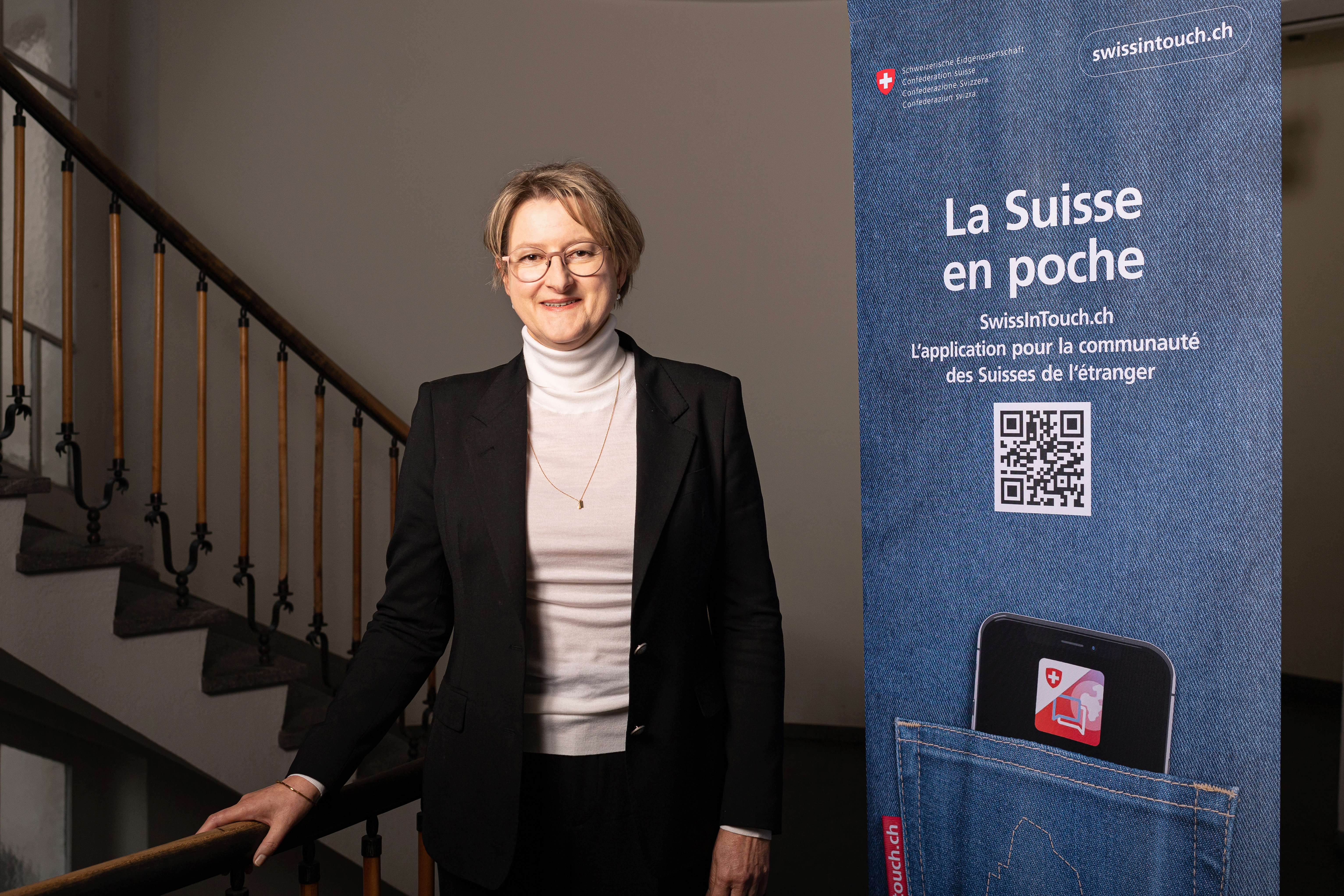
“I completely understand their frustration. We don’t know how long this will last. It’s a distressing situation,” Jenni acknowledged. “Since Saturday morning, we’ve been working flat out to find solutions. We’re regularly providing updates on the Travel Admin App [the official app of the foreign ministry].”
But despite its mission to assist Swiss citizens in difficulty abroad, the consular directorate finds its resources limited. The government does not, in fact, have a dedicated repatriation aircraft. And even if it did, “the airspace is completely closed,” it emphasises.
Stranded Swiss tourists are left to fend for themselves with commercial airlines. However, a glimmer of hope has emerged: Swiss International Airlines is organising a special flight on Thursday from Muscat airport in Oman to Zurich.

More
Consular protection: more and more elderly Swiss are dying abroad
A firmness that is not well received
This firm stance is not going down well with some stranded tourists. Jenni counters that, even though travel to this popular region was not formally discouraged, the foreign ministry had been warning for several weeks about a high risk of escalation in the Middle East which could lead to travel restrictions throughout the region.
“Every citizen has a responsibility to stay informed before traveling,” Jenni reiterated.
The head of the consular directorate also expressed regret over announcements from neighbouring countries claiming they will soon be able to organise repatriation flights for their citizens. According to her, these are merely empty promises that give Swiss citizens the impression of being abandoned. Nothing is concrete, she emphasised. “Our communication policy is to only provide information when we have reliable and verified data.”
In the meantime, she strongly advises those stranded against attempting to leave the area by land. “It would mean crossing borders, sometimes obtaining visas.” And once they arrive at their destination, they still have to find accommodation and available flights, she explains. “It’s just shifting the problem elsewhere.” She therefore strongly recommends following the instructions of local authorities.
More
Swiss Abroad ‘can be proud of the support they give their country’
Helpline available
Furthermore, the foreign ministry has consular staff throughout the region, but its numbers are limited and it cannot meet everyone’s individual needs. “However, in case of an emergency—a medical emergency, a lost passport—assistance will be arranged,” Jenni assures. For other situations, a helpline is available.
“I sometimes hear that no one answers the helpline but that’s not true,” she insists. “A recorded message greets callers. If that’s not enough, you have to call back and ask for an operator by pressing the dedicated button.”
In case of emergency, the foreign ministry helpline in Bern can be contacted 24 hours a day at +41 800 24 7 365 /+41 58 465 33 33 or by email at helpline@eda.admin.ch
Join the debate:
External Content
Adapted from French by AI/ac

In compliance with the JTI standards
More: SWI swissinfo.ch certified by the Journalism Trust Initiative

You can find an overview of ongoing debates with our journalists here . Please join us!
If you want to start a conversation about a topic raised in this article or want to report factual errors, email us at english@swissinfo.ch.