








Eight graphs on free movement and the Swiss economy
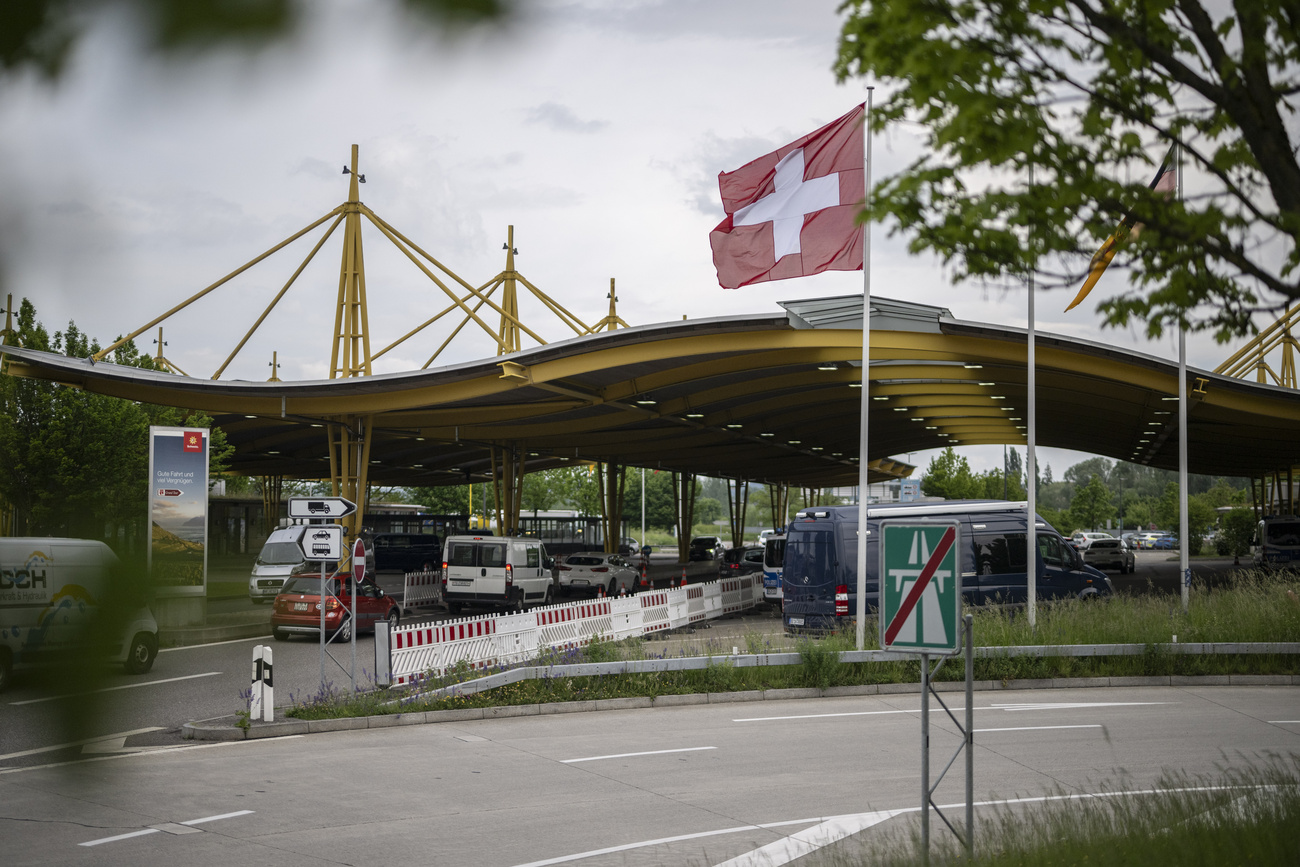
Freedom of movement has spurred immigration from Europe into Switzerland. Swiss authorities, employers’ associations and trade unions argue that this helps meet the needs of the labour market, and that future demographic ageing will make it even more necessary. But the system also has its costs.
Select your language
Generated with artificial intelligence.
Listening:
Eight graphs on free movement and the Swiss economy

Since 2002, nationals from European Union (EU) and European Free Trade Association (EFTA) countries have been able to settle and work freely in Switzerland – and vice versa – provided they have a source of income.
Signed on June 21, 1999 by Switzerland and the European Union (EU), the Agreement on the Free Movement of PersonsExternal link (AFMP) secures better residency and employment conditions in Switzerland for the citizens of EU and European Free Trade Association (EFTA) countries. The agreement came into force on June 1, 2002 and was extended in 2006, 2009 and 2017 to nationals of new EU member states. In addition to the free movement of persons, the agreement provides for the mutual recognition of professional qualifications, the coordination of social security systems and the right to buy property.
Switzerland and the EU have just signed a new package of bilateral agreements after years of arduous negotiations. The new package contains an updated free movement agreement, including a safeguard clause that would allow Switzerland to take measures if implementation of the AFMP were to cause serious economic or social problems.
Of all the bilateral agreements with the EU, the Agreement on the Free Movement of Persons (AFMP) is the one that fuels the most debate in Switzerland. Authorities and economic circles argue that free movement “closely” meets the needs of the economy. This is the conclusion invariably reached in annual reports by the State Secretariat for Economic Affairs (SECO)External link. Trade unions also defend it, saying it “stabilises the labour marketExternal link”.
In contrast, the right-wing Swiss People’s Party considers it harmful and has tried several times to restrict it through popular votes. This will be the case again in June 2026. With the “No to ten million” initiative, the party is calling for a cap on immigration to combat “overpopulation”. It blames high immigration for the strain on infrastructure and rises in rents, social security costs and crime.
>> Read more about the initiative, including the arguments of those for and against it, in the article below:

More
‘No to ten million’ vote – should Switzerland cap its population?
The initiative’s backers claim that much of the reliance on foreign labour is created by immigration itself. Some economists also believe that the free movement of people costs Switzerland more than it brings inExternal link, although there is a lack of data to support this.
>> Strong population growth, when driven by immigration, brings various challenges:

More
How countries are managing immigration between economic needs and social tensions
A “yes” vote to the People’s Party initiative would jeopardise the AFMP. All this begs the question: what impact has the agreement had on the Swiss economy over the past 25 years? Here are some figures to help answer that question.
1. How has immigration evolved with free movement?
2. Which sectors rely most heavily on European labour?
3. How skilled are European immigrants?
4. Has free movement driven wages down?
5. Are European workers taking jobs from the Swiss?
6. What is the impact of immigration on social benefits?
7. What is the impact of free movement on growth?
1. How has immigration evolved since the introduction of free movement?
The AFMP has fostered and altered immigration to Switzerland. Since the agreement came into force, the bulk of immigrants have been European workers, mainly from neighbouring countries. Between 2015 and 2024, more than one million people from EU/EFTA countries (nearly two-thirds of total immigration) arrived in Switzerland, according to the Federal Statistical Office (FSOExternal link).
Over the same period, around 600,000 left the country, meaning a net European immigration balance of over 400,000 people. Switzerland has one of the highest proportions of EU/EFTA immigrants in Europe, behind Iceland and Luxembourg.
External Content
Thanks to favourable residence conditions, many of these people settle permanently in Switzerland. Their numbers have risen steadily, from just under 900,000 in 2002 to over 1.5 million in 2024 (17% of the population).
External Content
The number of cross-border commutersExternal link has also surged since 2002, from just under 163,000 to over 400,000 today.
External Content
2. Which sectors rely most heavily on European workers?
According to SECO, free movement has led to job growth which is “well above” the demographic potential of the Swiss labour market.
In 2024, seven of every ten EU/EFTA nationals arriving in Switzerland came for work. Most of them had been recruited abroad and already had an employment contract on arrival.
Traditionally, the hospitality, construction and manufacturing sectors have had the largest share of European workers in percentage terms. In absolute figures, manufacturing, vehicle repair and healthcare account for the highest numbers.
External Content
Over the past ten years, the European workforce has grown significantly in the information and communication sector, as well as in the field of “professional, scientific and technical activities”. This category encompasses various highly skilled service professionsExternal link, for example in research and development, architecture and consultancy.
The proponents of free movement argue that this will become even more necessary to meet workforce needs in the future, given the ageing population. According to forecasts, the retirement of the baby boomers, coupled with a historically low birth rate, will leave tens of thousands of vacancies in numerous key sectors.
Some, however, such as liberal economist Reiner EichenbergerExternal link, speaking to the business daily L’Agefi, consider this view “too simplistic”. “The newcomers take on jobs, but they also generate new needs elsewhere in the economy,” Eichenberger reckons.
3. How skilled are European immigrants?
EU/EFTA nationals are over-represented at both ends of the skills spectrum. They are more likely to have a higher education qualification than Swiss nationals (55% compared to 45%), but they are also more likely to have no post-compulsory education (19%, compared to 9% of Swiss).
For SECO, this illustrates how the Swiss economy has relied on foreign labour to meet both its needs for highly skilled personnel in the service sector and for low-skilled seasonal workers.
External Content
The educational level of European immigrants has, however, risen in recent years. Since 2015, over 60% of new arrivals have a higher education qualification, compared to 44% previously.
4. Has free movement driven wages down?
The opening of the labour market initially sparked fears that wages would be driven down. In the 2000s and 2010s, various studies were published on this subject. Some identified an impact – either slightly positive or slightly negative – on the wages among certain groups, but the conclusions varied. However, most studies found no significant overall effect.
FSO figures confirm that free movement has not adversely affected general wage trends. Thus, the median wage has risen since 2008 for both Swiss nationals and foreigners as a whole (detailed figures for EU/EFTA nationals are not available) – albeit more so for Swiss nationals: +18% since 2008, compared with +15% for non-nationals (with significant variations depending on their status).
External Content
Most EU/EFTA nationals hold jobs matching their educational level, according to SECO. In equivalent positions, they earn, on average, salaries similar to Swiss nationals.
This does not mean that wage dumping does not exist. Certain sectors – such as construction and catering – and border regions (Lake Geneva area and canton Ticino) are more vulnerable to this. Hence the central role of the so-called “accompanying measures” to protect employees from the undercutting of wages and working conditions in Switzerland, which came into force on June 1, 2004.
Each year, SECO publishes a report on the implementationExternal link of these measures. These reports show that, over the past three years, cases of wage dumping have been found in 10% of the companies inspected.
5. Are European workers taking jobs from the Swiss?
The other concern associated with free movement is that increased labour market competition will come at the cost of Swiss workers. As they come primarily for work, EU/EFTA immigrants have an above-average level of job market participation. Last year, their employment rate was over 87%, compared with under 85% for the Swiss.
Labour market participation has, however, increased across the whole population – including for women (especially mothers) and older workers – leading SECO to conclude that high immigration has not squeezed out the local workforce. On the contrary.
External Content
Most studies agree that this immigration complements the existing labour supply rather than competing with it. Even trade unions, previously more wary of free movement, now supportExternal link it. They, too, believe that, when coupled with accompanying measures, free movement actually helps protectExternal link jobs in Switzerland.
6. What is the impact of immigration on social benefits?
In its last annual report, SECO looked at who the net contributors and who the net recipients were for the various types of social insurance.
EU/EFTA nationals paid in less to unemployment insurance than they got out of it (they contributed 27% but received 33% of benefits). Meanwhile, Swiss nationals were net payers (67% of contributions and 51% of unemployment benefits received).
European immigrant workers are at greater risk of unemployment. This is especially due to their over-representation in precarious sectors and/or seasonal work.
Since 2003, their unemployment rate has fluctuated in line with economic conditions and has remained above the Swiss average (but below the EU average – except in 2025External link). The unemployment rate for Swiss nationals, meanwhile, has varied little and has stayed at a low level.
External Content
EU/EFTA nationals are also likelier to need social benefits, although the rate has moved closer to that of Swiss nationals in recent years. In 2023, it stood at 2.2%, compared with 1.8% for the Swiss.
The situation is the opposite when it comes to retirement provision (the first pillar of the Swiss pension system, OASI) and disability insurance.
Between 2010 and 2022, the contribution of EU/EFTA nationals to the first-pillar pension scheme rose by six percentage points, while that of Swiss nationals fell by the same amount. In 2022, European immigrants contributed 27% but received only 15% of pensions.
SECO has calculated the effects of immigration on the Swiss state pension system up to 2070. It concludes that, even accounting for the ageing of this population group, EU/EFTA nationals will continue to pay in significantly more than they get out.
The regular arrival of young European workers is thus vital for the sustainability of the pension system, according to SECO, employers’ associations and trade unions.
7. What is the impact of free movement on growth?
Research institute Ecoplan has produced for SECO a synthesisExternal link of studies analysing the impact of free movement on growth in the country. It concludes that there is a positive effect on total GDP, as the growth of the working population boosts the Swiss economy’s productive potential as well as demand for consumer goods and housing.
The immigration of highly skilled workers also enhances the productivity and innovative capacity of companies as well as attracting new ones, the report finds.
Immigration is moreover believed to have a positive effect on GDP per capita, although this is not possible to prove. This point is questioned by the economist Eichenberger, who notes that per capita GDP rose by an average of 0.64% per year in Switzerland between 2007 and 2023 – “slightly less than in Germany (0.67%)”.
“The costs induced by the free movement of people should be added to these indicators,” but this type of data is lacking, he says.
In short, as is often the case in economics, the debate on the free movement of persons reveals both costs and benefits and therefore calls for nuanced conclusions.
Edited by Samuel Jaberg. Adapted from French by Julia Bassam/ds

In compliance with the JTI standards
More: SWI swissinfo.ch certified by the Journalism Trust Initiative

You can find an overview of ongoing debates with our journalists here . Please join us!
If you want to start a conversation about a topic raised in this article or want to report factual errors, email us at english@swissinfo.ch.