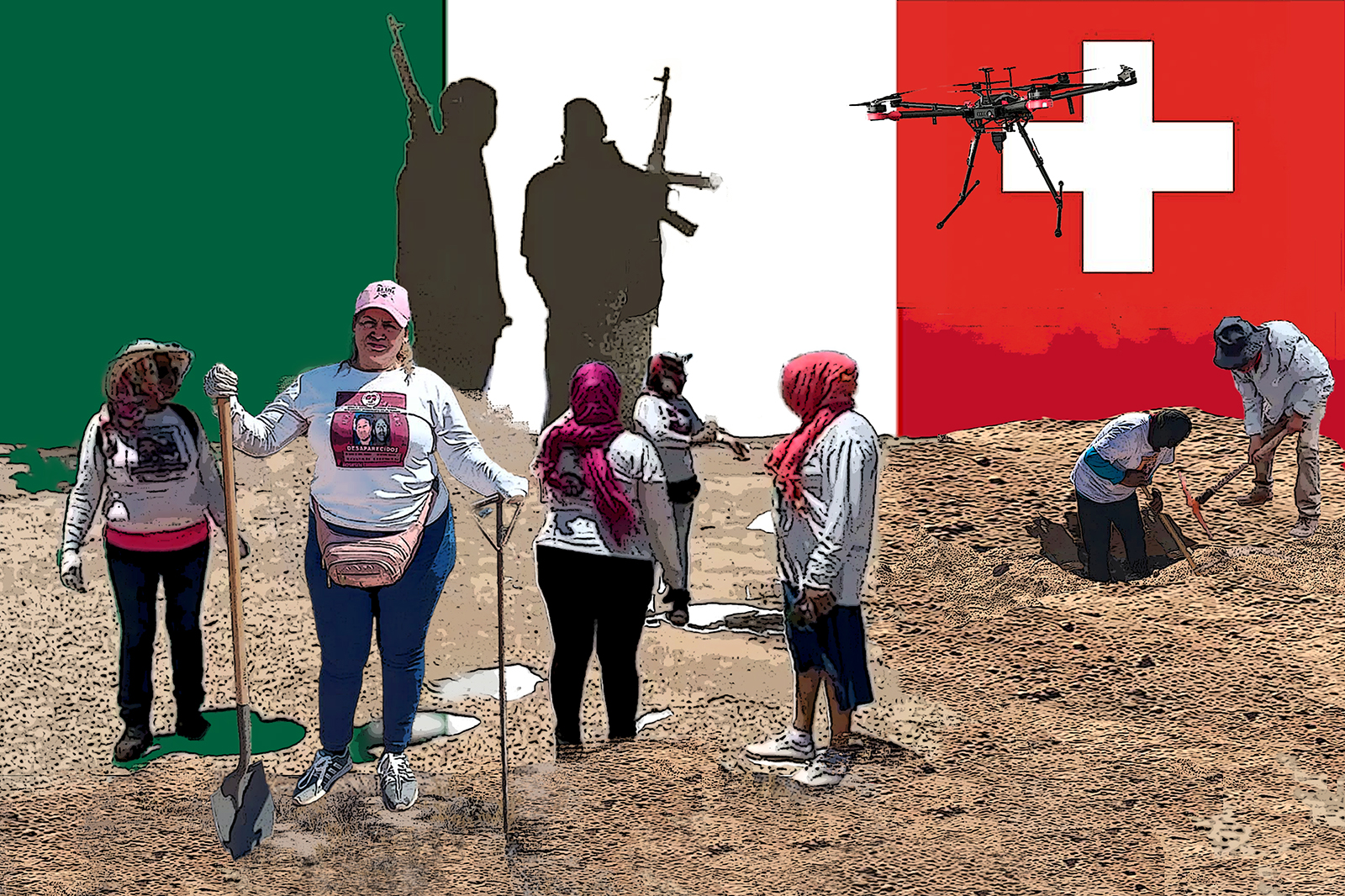
Switzerland is providing training in forensics to Mexican officials who are attempting to solve cases of enforced disappearances in the Latin American country. Behind these cases are stories of loss and determination for thousands of grieving mothers. Ceci Patricia Flores is one of them.
This content was published on
2 minutes
I lead the Spanish-language team at SWI swissinfo.ch, which involves ensuring the quality of our publications and making them understandable for Spanish-speaking people from more than 20 countries. I'm also part of a team of journalists specialising in foreign affairs. Explaining current events and its relations with Switzerland is an essential part of my task.
Senior journalist with over 30 years of experience in investigative journalism, broadcasting, multimedia content production and social media distribution.
I have a wealth of experience as a journalist working in Switzerland and enjoy producing videos, articles and podcasts on a range of subjects, recently focused mainly on politics and the environment.
Born in the UK, I studied law at Nottingham University, then went on to attend the first-ever post-graduate radio journalism college in London. After working as a radio journalist in the UK and then Switzerland from 1984 to 1995, I returned to the UK to complete a post-graduate diploma in film at Bournemouth Film School. I have been working as a video journalist ever since.
Reporter specialised in Swiss foreign affairs, with a side hustle as a sub-editor in the English Department.
Previously my focus was on disinformation and fact-checks, which I still produce occasionally.
Every day Flores heads out with several other relatives of the disappeared onto the desert-like terrain of Sonora in northwestern Mexico, a shovel at the ready in case they see signs of a clandestine grave and need to start digging.
Together they make up the Searching Mothers of Sonora, started by Flores after two of her sons were disappeared. Hers is just one of over 200 collectives across Mexico – made up in large part of mothers – looking for missing loved ones and demanding answers from the authorities.
“Every day we suffer the anguish of not knowing where [our children] are and having to walk around different parts of the country, even digging with our own hands,” says Flores.
Pressure from families
The work carries enormous risk. Often the areas where they’re searching are controlled by organised criminal groups, thought to be behind many disappearances. In the last two years alone, at least half a dozen searching mothers have been killed in Mexico.
More
More
Foreign Affairs
‘Hope never dies’: Swiss help Mexicans tackle enforced disappearances
This content was published on
Switzerland is offering training in forensics to Mexican officials involved in searching for, and identifying, victims of enforced disappearances.
Yet it is thanks to the determination of these families that any reckoning with the country’s enforced disappearances has taken place, says Ana Srovin Coralli, a researcher at the Geneva Graduate Institute. The landmark General Law on Disappearances, she points out, was largely the result of pressure and lobbying by families, civil society and international organisations. The law, in force since 2018, led to the creation of a national search system and special prosecutors’ offices to handle enforced disappearances.
But the road ahead is long. As of August 2021, more than 52,000 unidentified bodies lie in state morgues, a backlog that Coralli says would, according to estimates, take more than 120 years to clear.









You can find an overview of ongoing debates with our journalists here . Please join us!
If you want to start a conversation about a topic raised in this article or want to report factual errors, email us at english@swissinfo.ch.