








Why parliamentary independence matters in North Macedonia


For more than 15 years, Switzerland has provided support to North Macedonia’s parliament, including setting up a parliamentary institute and reinforcing security after the violent events of 2017. Swissinfo reports from Skopje.


The support for North Macedonia’s parliament is a flagship project of Swiss democracy promotion. Switzerland’s official strategy describes it as 15 years of strengthening “administrative capacities and processes”. But what does this actually look like on the ground?
We travelled to North Macedonia to find out. Over two hectic days, we met politicians, budget officials, translators, and IT support staff. “So you are particularly interested in the parliament’s online ticketing system for IT support requests?” one of them asked.
A pillar of parliament – in the basement
What interests us most is the link between democracy and bureaucracy, and how a functioning parliament strengthens the institution. We also want to know how, in a country where the current governing party’s headquarters are bigger than the parliament building, an institution can prove itself and move forward.
The clearest insight comes not from the wood-panelled meeting rooms, but in the basement of the parliament, in the office of Zlatko Atanasov.
Swiss democracy promotion is carried out by the National Democratic Institute (NDI), a non-governmental organisation. One of its first milestones was setting up a parliamentary institute.
The function of a parliamentary institute
The institute is a politically independent research unit for parliamentarians. Atanasov cites energy policy as an example. Politicians may request answers to questions such as, “What is our current situation? How was this handled in the former Yugoslavia? What are other countries in the region doing? How do price levels affect our market?” His team then collects these questions in a dossier. For the first 30 days, it is available exclusively to the parliamentarians who requested it. After that, it is made available to all members of parliament.

Atanasov is proud to be a civil servant in a democratic system. Of the politicians, he says: “There is a high turnover.”
As head of the parliamentary institute and the new Swiss-supported projects, Atanasov works closely with members of parliament. He describes them as counterparts but still maintains a certain distance.
Swiss support draws on international know-how
Atanasov works in a key position. His role is one of the many parts of the Swiss Parliamentary Support Programme (PSP), which includes IT support, training, and scholarships for parliamentary staff.
External Content
What the individual projects have in common is their reliance on international exchange and expertise. Security know-how comes from the German parliament or Bundestag. The parliamentary institute draws expertise from the Czech Republic and Slovakia. IT knowledge comes from Estonia. Taken together, these measures are aimed at reinforcing parliament’s independence.
Swiss support has also helped establish politically neutral recruitment procedures. For Atanasov, this matters for the institution of parliament, which he calls a “cradle of power, policy, and interests.”
Here too, NDI representatives played a role, sitting in on hiring processes to ensure that political or personal loyalties had no influence on appointments.
Respect for parliament as an institution
Asked whether attitudes toward parliament have really shifted over the past 15 years, Atanasov offers a measured response. “There are some indications of it,” he says. After a change in government, demand for the institute’s services remains steady, whether parliamentarians are part of the party in power or not.
The real test, he says, will come in 2027, when Swiss support will endExternal link. “What will happen when the Swiss and the NDI are no longer here?” he wonders. Only then will it be clear whether parliament is respected as an institution.
Atanasov has worked for parliament for more than a decade and witnessed rapid change in North Macedonia’s young democracy. From 1992 until 2009, the president’s office was housed inside the parliament building.
Under such circumstances, it is hard to see how members of parliament could develop a sense of independence from the executive when even the building did not reflect the separation of powers.
The storming of parliament and its aftermath
Atanasov’s time working with parliament has also seen disruption.
Many elements of the PSP can be traced back to the storming of parliament in 2017. Around 200 nationalists forced their way into the building, resulting in more than 100 people being injured. The violence came after the formation of a new Social Democrat-led coalition, which elected a parliamentary president of Albanian origin.
North Macedonia’s party system is still largely split along ethnic lines, between parties representing the mainly Christian, ethnically Macedonian majority and the mainly Muslim, ethnically Albanian minority.
The 2017 attack abruptly ended early efforts to offer public tours of the parliament building and increase transparency. It showed that openness was not just a matter of political will, but also required modernised security infrastructure. A visit to the control room, where cameras cover every corner of the building, offers a glimpse of what that upgrade looks like.
Today, school classes cross paths in the corridors as dozens of representatives from women’s rights organisations pass through security checks. They have come to discuss ways of combating domestic violence.
Parliament also makes its work visible through the media, including a dedicated parliamentary television channel that summarises political proceedings for viewers. Online, video streams broadcast plenary debates and all of the committee meetings.

Seen from Switzerland, this extent of openness is striking. Parliamentary committee meetings in Switzerland take place behind closed doors. The idea is that open debate and compromise come more easily when the deliberations are confidential, beyond the gaze of party leadership or the public.
Nikola Gruevski’s legacy in Skopje
The power of political parties in North Macedonia is also reflected in the urban landscape. Monumental statues of Alexander the Great, giant sculptures of pregnant women, and a Paris-style triumphal arch dominate the centre of the capital, Skopje. There is also the White PalaceExternal link, a building that dwarfs the parliament building.
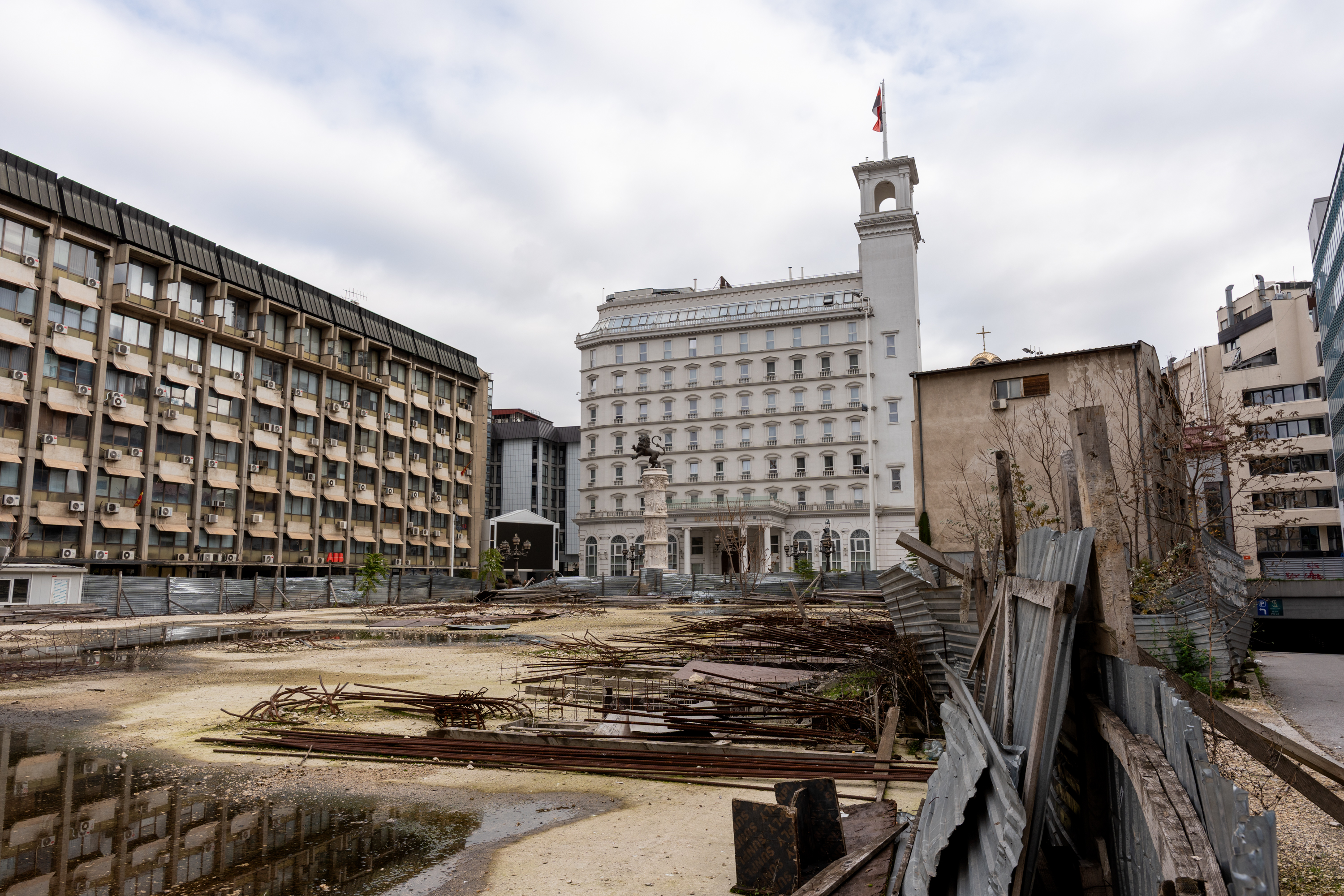
These features of the city date back to the years when Nikola Gruevski led the government from 2006 to 2016. The White Palace is the headquarters of his conservative VMRO party.
Gruevski, a populist politician later convicted of corruption, now lives in Hungary as a political refugee. But his party, VMRO, has returned to power, its flag still flying above the White Palace. In parliament, a small VMRO flag also stands on the desk of Nikola Micevski.
‘We set the rules of the game’
Micevski leads VMRO’s parliamentary group and sits on the steering committee that guides the Swiss-backed projects. In this body, members of parliament from across the political spectrum work on consensus solutions. One outcome was a reform granting parliament control over its own budget.

“We set the rules of the game before it begins,” Micevski says. “We do not yet know if we will win or lose.”
He is blunt about his approach to politics: “We have competing groups, all with the same goal – power. So how can we work together?”
The early days of the steering committee were difficult, Micevski recalls. “There was a lot of talking and a lot of disagreement. Over time, we started laughing together more and more.” Micevski views the Swiss projects positively, especially the initiatives to improve parliament’s public outreach. He says people need to understand that political opponents are not enemies. Ten or 15 years ago, many people imagined politics as a standoff, “like snipers aiming at each other from opposite sides of the room”, he says.
More scrutiny in parliament
Afrim Gashi strikes a more diplomatic tone. He became parliamentary president in 2024. Unlike when the first ethnic Albanian was elected to the post, his appointment did not trigger public unrest. “I can proudly say that the level at which parliament operates today, as one of the country’s strongest institutions, is owed to Switzerland, its embassy, and its partner organisation,” Gashi says.
According to Gashi, the reforms are beginning to have an effect. For the first time in ten years, a survey showed improvement in how the public views parliament.
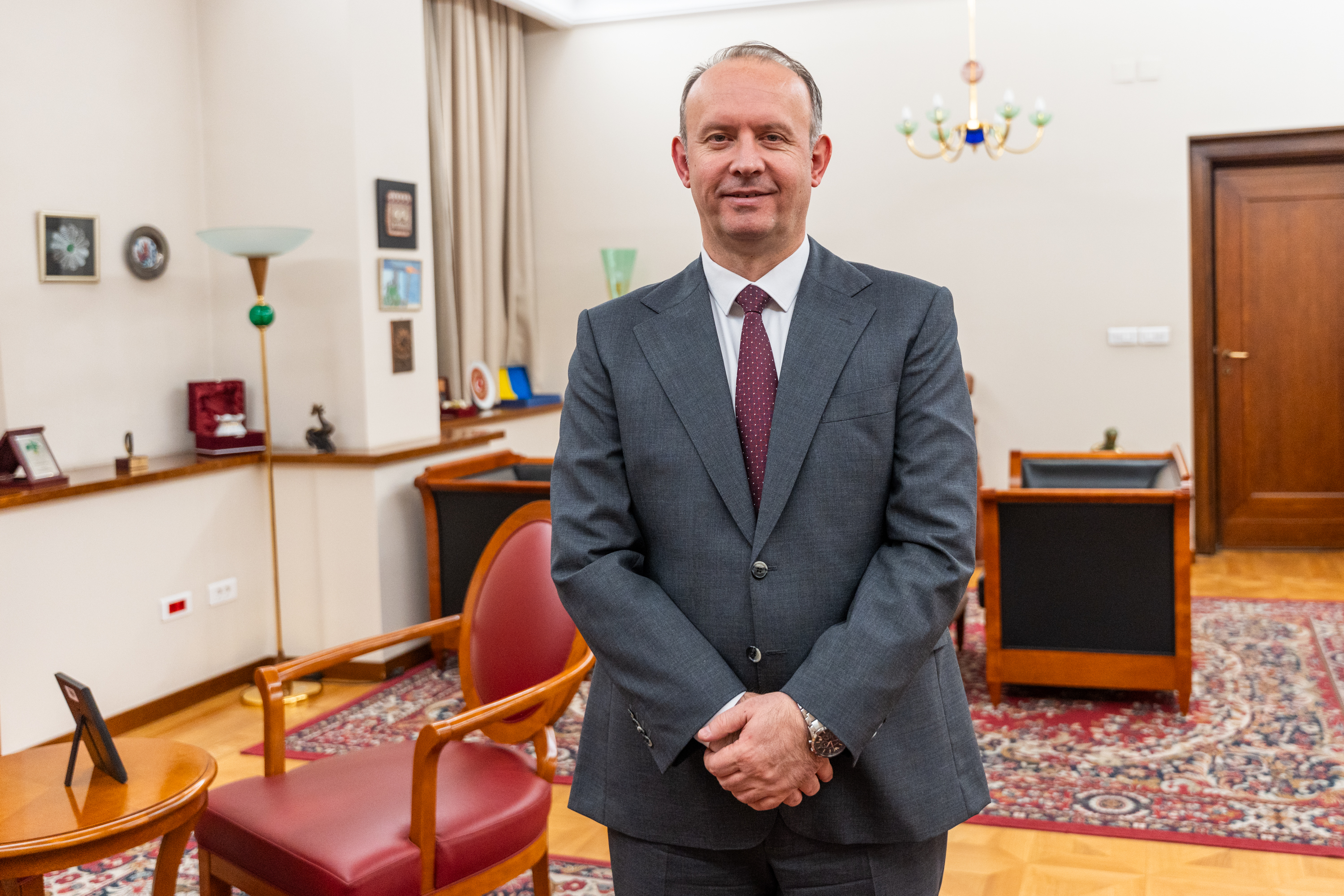
As parliamentary president, Gashi’s goal is to have an “open-door institution”. He meets the media more frequently than his predecessor, and each month an additional session is held in which only opposition members of parliament may question members of the government. The newly introduced parliamentary instrument of interpellation has also strengthened oversight of the executive. Still, Gashi cautions that change takes time: “We are still a country in transition, even though we declared the transition complete long ago.”
Polling and analysis reinforce this cautious perspective. In a 2023 studyExternal link, just 12% of respondents said they believed members of parliament adhered to ethical standards. A year laterExternal link, parliament was viewed more favourably than the judiciary, the public prosecutor’s office, the government, and political parties, yet still scored only 3.7 out of 10. Despite a noted improvement in public perception, a 2025 studyExternal link concluded that parliament’s oversight function remained “systematically weak and largely invisible to the public”.
Read about the upheavals to foreign aid in North Macedonia in our previous article:

More
What USAID’s withdrawal means for North Macedonia
Edited by Mark Livingston. Adapted from German by David Kelso Kaufher/gw

You can find an overview of ongoing debates with our journalists here . Please join us!
If you want to start a conversation about a topic raised in this article or want to report factual errors, email us at english@swissinfo.ch.