








Switzerland Today
Greetings from Lausanne!
Here are the latest news and stories from Switzerland on Wednesday.


In the news: the Swiss Guard barracks, funds for Horizon Europe and wolves in Graubünden.
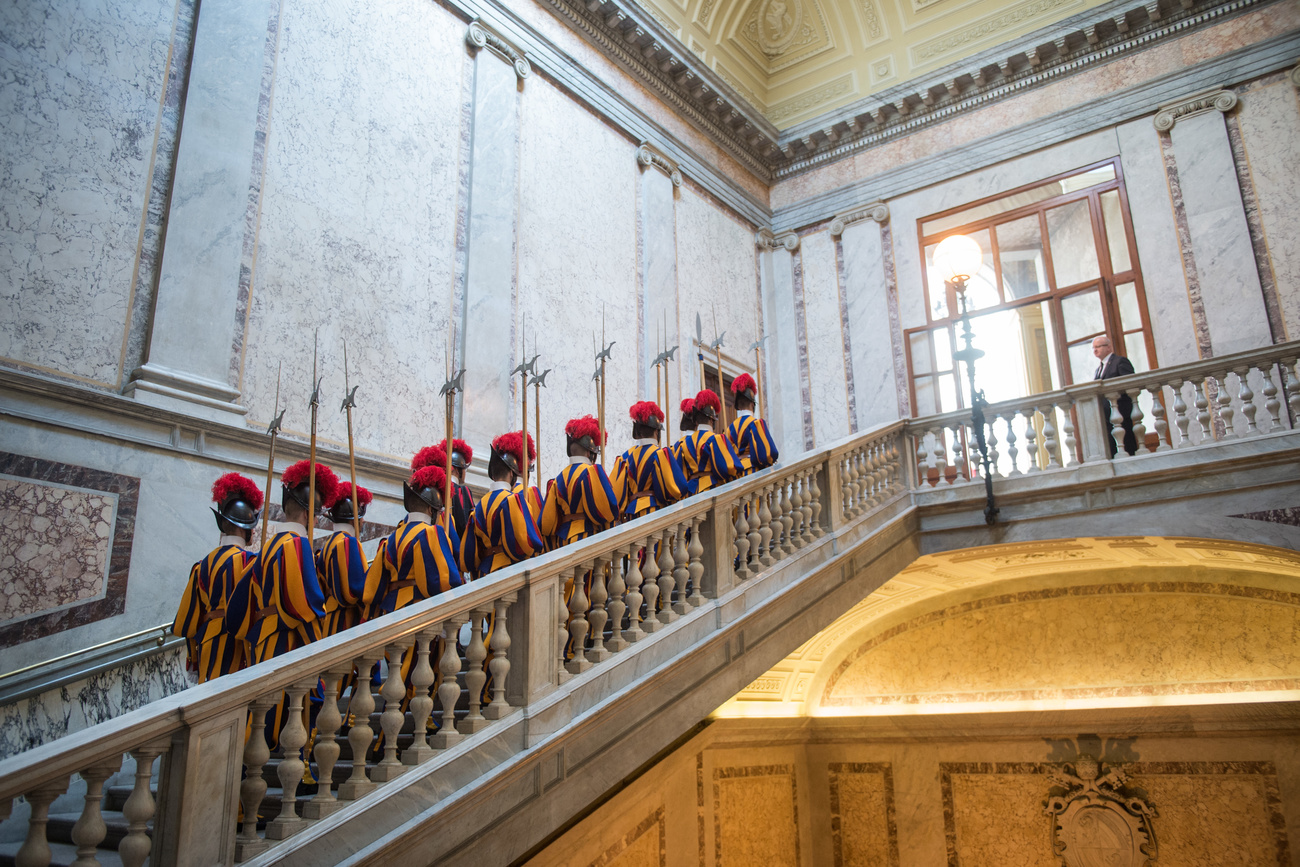
- A Swiss foundation and the Vatican have agreed the terms of the first phase for the renovation of the 19th-century Papal Swiss Guard barracks in Rome. The renovation work, estimated at CHF45 million ($46 million), is likely to begin in 2026.
- The Swiss government has extended measures to support Swiss scientists unable to receive funding for the European Union’s flagship Horizon Europe research funding scheme. The Swiss authorities have agreed to bridge the funding gap for researchers wishing to take part in the €95 billion funding scheme – the largest research and innovation programme in the world – amid the ongoing political impasse between Brussels and Bern.
- A total of 47 wolves have been recorded in canton Graubünden in south-eastern Switzerland over the past 12 months, the authorities said today. Last December, the Valais authorities reported 22 wolves.
- Helene Budliger Artieda has been appointed as the new state secretary at the Secretary of State for Economic Affairs (Seco). She takes over the top job from Marie-Gabrielle Ineichen-Fleisch on August 1. Budliger Artieda is the current Swiss ambassador to Thailand, based in Bangkok.

The latest opinion poll on the May 15 nationwide votes.
The plan to impose a levy on international streaming platforms in Switzerland seems to have come under increased pressure ahead of a referendum on the Swiss film law on May 15.
Pollsters expect a close race over a 4% levy international streaming platforms, such as Netflix and Disney, would have to pay on their revenue from Switzerland. The levy, estimated at more than CHF12 million ($12.3 million) annually is destined for the Swiss audio-visual industry.
Currently, 56% of Swiss voters say they support the legal amendment but this could dwindle, resulting in a close result, say experts.
Pollsters have little doubt about the other two issues on the ballot sheet, however.
The final survey found advocates of reversing the principle of consent for organ donations consolidating their lead over the referendum committee trying to veto a parliamentary proposal. A total of 61% of voters would support the measure.
A clear result is also expected in the vote about a plan to boost the Swiss contribution to the European Union’s Frontex border agency. In all, 69% of people said they support the proposal.

Russian society is deeply divided by the war in Ukraine, according to Dmitry Muratov (in photo above), a Nobel Peace Prize-winning Russian journalist.
“Among the [Russian] people who consume independent media, there are very few people who support the war. But we realise that the people who listen to state media are completely influenced by propaganda,” he toldExternal link Swiss Public Radio RTS. “Among the older population, there is no longer any interest in facts, there are only opinions.”
The divide is particularly wide between generations of Russians. “Young people between the ages of 18 and 30 are aware that their destiny is in jeopardy. Dreams are threatened, while the generation over 60 is convinced by the propaganda. It is an impossible gap to bridge,” said Muratov. “I’m not here to give you optimism.”
Muratov, editor of the investigative newspaper Novaya Gazeta, has been in Geneva the past few days to take part in a ceremony organised by the Freedom Cartoonists Foundation on Tuesday with his joint 2021 Nobel laureate, Philippine journalist Maria Ressa.
He urges people not to blame the entire Russian population for the war in Ukraine. “It is not fair to say that Russia has a collective responsibility… I don’t want people to say that my whole country is responsible for this war, that everyone supports the president. That’s not true.”

Switzerland mulls impact of possible EU ban on Russian oil.
As part of a sixth package of sanctions, on Wednesday European Commission President Ursula von der Leyen proposed phasing out supplies of Russian crude oil within six months and refined products by the end of 2022. This must still be validated by EU governments.
So far, Switzerland has mirrored trade and financial sanctions implemented by the EU against Russia, although it is not a member of the European bloc. Views are mixed on the potential impact on Switzerland of any future ban on Russian oil or gas to Europe.
On Monday, Swiss Economics Minister Guy Parmelin told Swiss public television SRFExternal link that the situation would be “difficult” for Switzerland.
“Switzerland is totally dependent on oil and gas imports,” Parmelin declared.
Gas makes up roughly 15% of Switzerland’s final energy consumption and is mostly used for heating and cooking. Around half of this comes from Russia. Following the outbreak of the war, Switzerland has been stepping up efforts to procure gas from other sources, and to secure additional storage capacity as well as imports of liquefied natural gas.
Meanwhile, a senior representative of the Swiss fuel importers’ association, Avenergy Suisse, is less worried about the impact of a future European ban on oil imports from Russia.
Despite the high consumption of liquid fuels in Switzerland, most imported oil comes from North Africa and North America, not Russia, Deputy Director Fabian Bilger told Keystone SDA News Agency.
According to the Swiss foreign ministry, Nigeria, Mexico and the United States are the main sources; only 0.3% of crude oil is imported from Russia. In total, Swiss imports of crude oil represent only 25% of the total imported, while 75% is oil that has already been refined in the EU, said Bilger.
He says the oil market and their logistics are very flexible and believes Russian oil can be replaced with imports from other oil-producing countries.

The number of new Covid-19 infections continues to fall in Switzerland.
A total of 16,606 new Covid cases were reported on May 3 for the previous seven-day period.
The seven-day daily average for new infections stood at 2,395, down 25% on the previous week. A total of 814 people were in hospital due to Covid (-20%), of whom 56 were in intensive care (-19%).
On March 30, the government announced that all remaining national pandemic restrictions would be lifted on April 1. This includes the mask requirement in public transport and the mandatory five-day isolation requirement.
On May 2 Switzerland lifted all remaining Covid-related entry requirements for travellers entering the country, regardless of their country of origin.

In compliance with the JTI standards
More: SWI swissinfo.ch certified by the Journalism Trust Initiative
