








Frankenstein: What Mary Shelley’s ‘Swiss’ creature teaches us about AI

At a time when artificial intelligence shapes our work and recreation, Mary Shelley's Frankenstein helps us reflect on the unexpected consequences of innovation.
Select your language
Generated with artificial intelligence.

Listening:
Frankenstein: What Mary Shelley’s ‘Swiss’ creature teaches us about AI

On a “dreary night of November”, Victor Frankenstein, the Genevan scientist in one of literature’s most famous novels, sees the realisation of his ‘toils’: a creature assembled from pieces of human and animal corpses comes to life with the amazement and disgust of its creator. As the character describes it, “I saw the dull yellow eye of the creature open; it breathed hard, and a convulsive motion agitated its limbs”.
What follows is a story of technology growing beyond human control. The creature escapes, learns to speak then takes revenge on its guilt-ridden creator.
Frankenstein, which Mary Shelley conceived during a stay on Lake Geneva in 1816, has for more than two centuries been a mirror that reflects anxieties about modernity and cultural change. The American scholar Mitzi Myers called it “the Swiss army knife of romanticism” for its adaptability to new developments.
“You can use it to talk about anything you want: about gender, political revolution, race and family drama,” concurs Sarah Marsh, a professor of English at Seton Hill University in the US.
Today, it can be tempting to use Frankenstein to talk about one particular technology: artificial intelligence (AI). The similarities are easy to spot. The creature is a man-made creation that acts on its own will; its creator is a confident and ambitious technician; and the creature is assembled from human parts, much like AI models are trained on existing human texts. On top of this, AI is spreading fast. In just a few years, it’s been woven into nearly every aspect of modern life – from the tools we use to work and access everyday services to the algorithms that determine what we listen to and watch in our free time.
The power and the ubiquity of this technology inspires fears that it, like Frankenstein’s creature, might end up harming us – by destroying jobs, causing ecological damage with data centers or through doomsday scenarios involving AI-driven weaponry.
AI’s applications and users’ anxieties are certain to grow in 2026. A look back to the story hatched on the shores of Lake Geneva can offer some insights into what happens when powerful innovations like AI evolve unchecked.

More
How AI is affecting Switzerland’s creative workforce
Who is responsible: the creator or the creature?
A central theme of Shelley’s novel is responsibility. Victor Frankenstein’s creature is initially harmless. It begins with good intentions and only becomes violent once it is rejected by its creator and attacked by the other people it meets. The novel raises the question of who is responsible for the creature’s actions – its creator, the society, or the creature itself?
According to Elisabeth Bronfen, professor emerita of English and American literature at the University of Zurich, Shelley’s writing suggests her sympathy is with the creature as the helpless result of Victor Frankenstein’s careless hubris. “The creature expresses itself in poetic language, while Victor Frankenstein comes across as a fanatic, indifferent to those around him,” says Bronfen.
Despite Shelley’s sympathy for the creature, the novel doesn’t offer a firm answer on who ultimately holds responsibility. Victor Frankenstein is never legally convicted for his wrongdoings, nor is the creature. However, Shelley’s imagery gives readers valuable food for thought.
After the creature has committed several crimes, Frankenstein goes to a magistrate in Geneva to seek justice. The magistrate appears shaken by the tale but says he is powerless: there is nothing he can do to bring to justice a creature that ‘appears to have powers which would put all my exertions to defiance’.
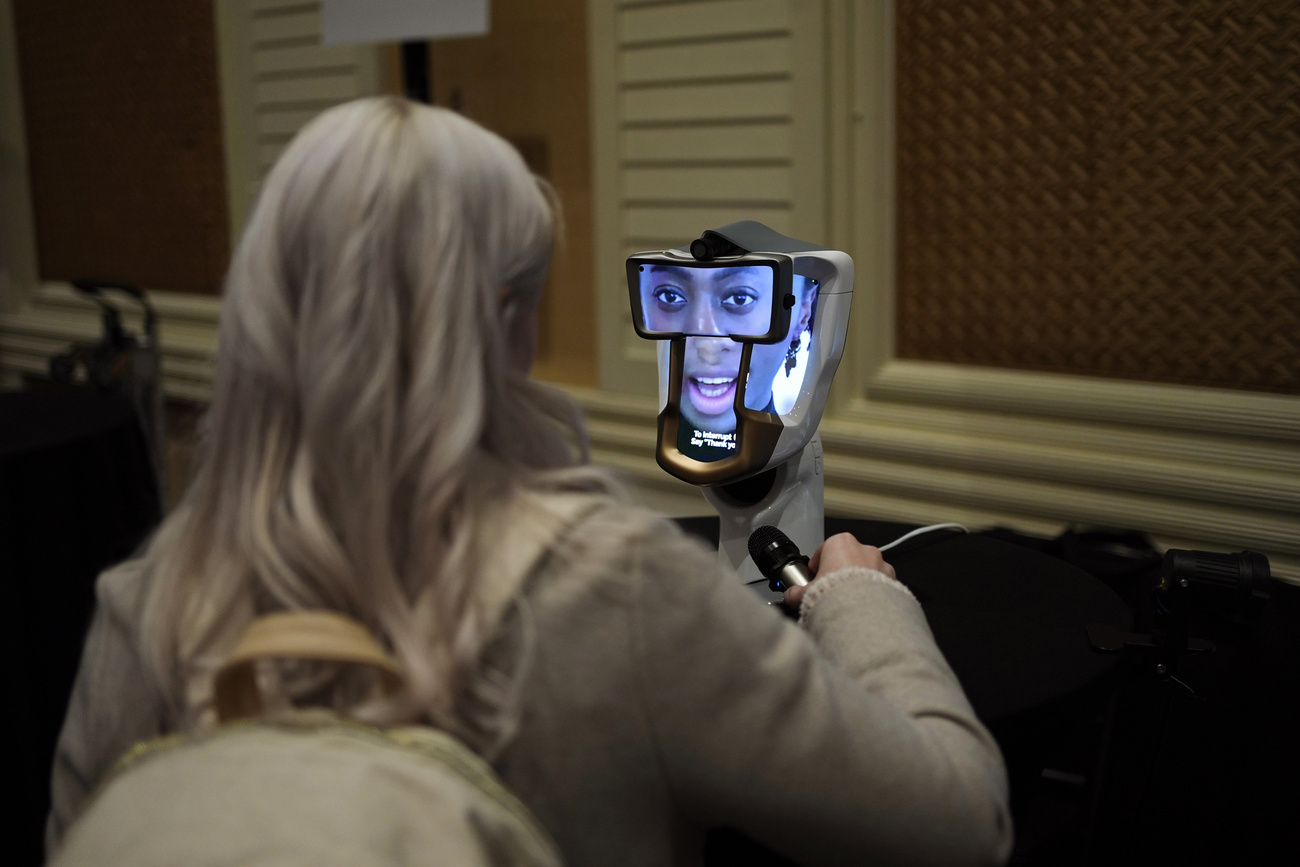
In the novel, the creature cannot be held legally responsible for its actions – a situation that, according to Marsh, closely resembles the current legal status of large language models. They could help diagnose diseases or encourage self-harm, but courts and regulators haven’t agreed who should bear the responsibility for how the tools are used.
“If you are dealing with a non-human entity like a chatbot and the chatbot hurts you. Who hurt you? The chatbot? The company that created it? Yourself? These are very live questions,” Marsh says.
These questions are likely to be debated in courts in 2026. Currently, several families have accused AI companies like OpenAI of driving their family members, including youthsExternal link, to suicide and even murderExternal link, but there are no legal decisions yet.
More
Switzerland aspires to build ‘human’ artificial intelligence
The unintended consequences of technologies
The full title of Shelley’s novel is Frankenstein, or the Modern Prometheus. It is a reference to the Titan of Greek mythology who created humans and was forever tortured for giving them fire.
As the novel progresses, Victor Frankenstein suffers from tortures inflicted both by the creature – who kills people close to him – and by his own guilty conscience. “I had been the author of unalterable evils; and I lived in daily fear, lest the monster whom I had created should perpetrate some new wickedness,” Frankenstein remarks.
The tale of a creature rebelling against its creator becomes the story of a scientist who unwittingly gives life to a destructive being.
“Often we scientists find ourselves solving problems without thinking about the effects. This novel gives us a chance to explore the unintended consequences of science’s actions,” Andy Bell, head of research and innovation at Sheffield University in the UK, tells Swissinfo.
The development of AI has happened so fast that unintended consequences are inevitable. Companies such as OpenAI are racing to address these unforeseen issues. Recently, the company said it would hire a person responsibleExternal link for anticipating AI risks.
But patching things up when the damage is done is difficult, as Shelley’s novel shows. Victor Frankenstein spends the years after his breakthrough consumed by remorse and failing to rectify his actions.
Part of the scientific community has taken Shelley’s lesson seriously. In 2017, the press of the Massachusetts Institute of Technology, one of the world’s leading technology research and development centres, publishedExternal link an annotated version of Frankenstein for ‘scientists, engineers and creators of all kinds’. The goal? Let inventors contemplate potential remorse before they put their new creations into the world.
Edited by Gabe Bullard/ds

In compliance with the JTI standards
More: SWI swissinfo.ch certified by the Journalism Trust Initiative

You can find an overview of ongoing debates with our journalists here . Please join us!
If you want to start a conversation about a topic raised in this article or want to report factual errors, email us at english@swissinfo.ch.