








Switzerland, EU sign package of agreements to strengthen ties

Swiss President Guy Parmelin and the president of the European Commission, Ursula von der Leyen, signed a package of accords in Brussels on Monday. The accords are meant to consolidate and strengthen relations between the two partners.
Select your language
Generated with artificial intelligence.
Listening:
Switzerland, EU sign package of agreements to strengthen ties
+ Get the most important news from Switzerland in your inbox
“This is an important day for the European Union and for Switzerland”, von der Leyen said before the signing of the agreements.
“From the [Swiss government’s] point of view, these agreements constitute a balanced, pragmatic and mutually beneficial package that will drive prosperity, employment and stability,” Parmelin said during a joint press conference. “They benefit our citizens, our economies and our societies as a whole.”
The Swiss president was received at the European Commission’s headquarters. The signing ceremony lasted around 30 minutes.
No fewer than 18 texts were initialled by the two officials, following lengthy negotiations that began in 2014 but were interrupted in 2021 and then resumed two years ago. Discussions held between 2014 and 2021 were meant to lead to one institutional framework agreement, but those talks failed.
Harmonising rules
The agreements signed on Monday cover, among other things, the free movement of persons, trade and transport between the two partners.

More
The Swiss-EU bilateral treaty updates, explained
As part of the deal, Switzerland will charge EU students the same tuition fees as local students at most of its public universities. The Alpine country will also pour €375 million (CHF341 million) into the EU’s social cohesion fund to benefit certain member states.
The accords also establish a “common food safety area”, harmonise rules and allow Switzerland to participate in the European internal electricity market.
Uncertainty over ratification
However, the agreements remain subject to the usual ratification processes, with considerable uncertainty surrounding the outcome of the procedure on the Swiss side. The federal government will have to convince parliament of the merits of strengthening ties with the EU and, above all, the people, who will have the final say in a referendum expected in 2027.
The Swiss are also set to vote in June on an initiative dubbed “No to a Switzerland of 10 million” and aimed at limiting immigration, which could complicate implementation of the agreements with the EU.
More
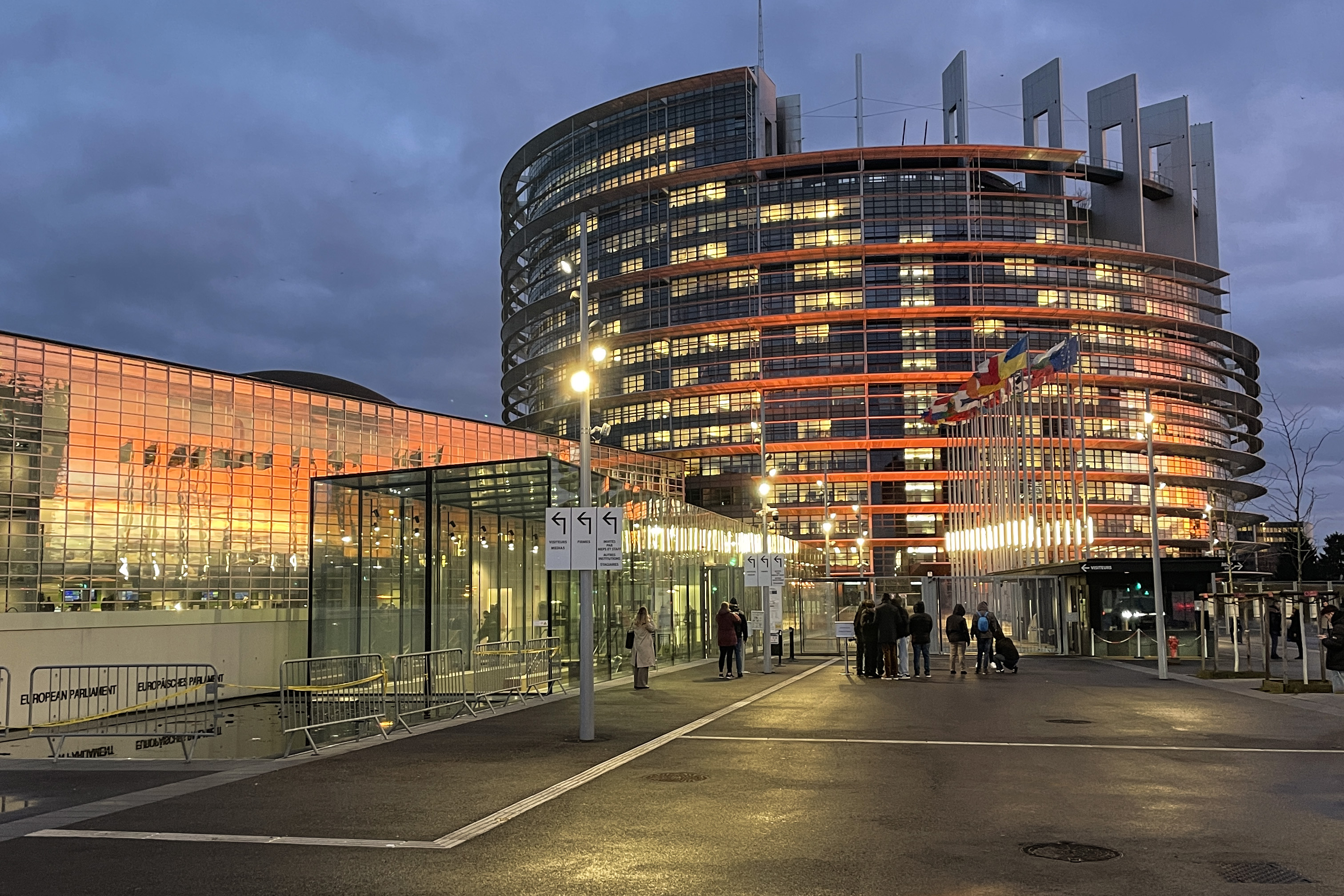
Swiss-EU accords have more support in Strasbourg than in Bern
When asked about the consequences of a “yes” vote to this initiative, Parmelin remained cautious, stressing that the proposal in question does not require the “immediate termination of the agreement on the free movement of persons” with the EU.
For her part, von der Leyen remained optimistic about the ratification process. “It is of enormous geostrategic importance, particularly in times like these, that we all work together in Europe, and I am therefore confident that we will achieve positive results,” she said.
Failed talks, cooled relations
Back in 2021, year when Parmelin also held the rotating Swiss presidency, the two partners admitted there remained major differences despite years of negotiations. Shortly afterwards, the Swiss government announced it was breaking off talks, a move that led to a temporary cooling of relations between Switzerland and the EU.
+ The rocky relationship between Switzerland and the European Union
Talks resumed in March 2022. These led to an agreement in October 2023, which served as the basis for the package signed on Monday.
Join the debate:
External Content
Adapted from French with AI/editing by gw
We select the most relevant news for an international audience and use automatic translation tools to translate them into English. A journalist then reviews the translation for clarity and accuracy before publication.
Providing you with automatically translated news gives us the time to write more in-depth articles. The news stories we select have been written and carefully fact-checked by an external editorial team from news agencies such as Bloomberg or Keystone.
If you have any questions about how we work, write to us at english@swissinfo.ch.
External Content

In compliance with the JTI standards
More: SWI swissinfo.ch certified by the Journalism Trust Initiative

You can find an overview of ongoing debates with our journalists here . Please join us!
If you want to start a conversation about a topic raised in this article or want to report factual errors, email us at english@swissinfo.ch.