








Swiss-EU accords have more support in Strasbourg than in Bern

In the European Parliament, a new package of agreements between Bern and Brussels is seen as cementing an essential partnership in the face of geopolitical tensions. Despite some criticism, the members of parliament involved see no alternative to this compromise.
Select your language
Generated with artificial intelligence.
Listening:
Swiss-EU accords have more support in Strasbourg than in Bern

“We won’t punish Switzerland if it rejects the agreements negotiated with the European Union, but it will punish itself. And if Europe says no, it will deprive itself of treaties that would have encouraged economic growth,” said Christophe Grudler, a French liberal member of the European Parliament and the rapporteur for relations with Switzerland.
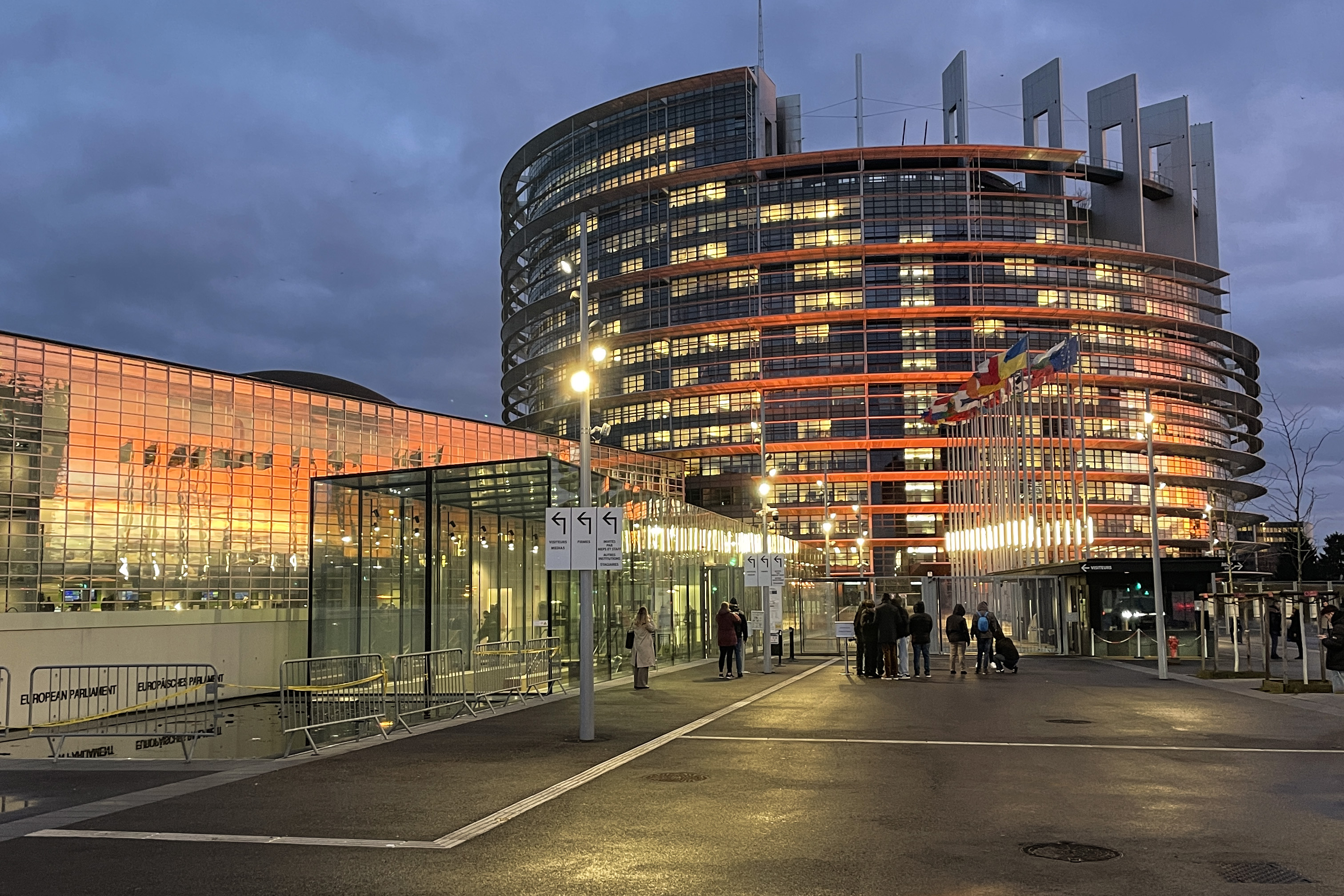
Based in Belfort, just a stone’s throw from Switzerland, Grudler is well acquainted with the country and its political system. This is an advantage, as it is his task to prepare the report that will be submitted to the European Parliament for approval of the new framework agreement governing Swiss–EU relations. Like their Swiss counterparts, members of the European Parliament will vote this year on the agreements concluded in 2024 to manage relations between Switzerland and the EU, known as Bilaterals IIIExternal link.
>> Switzerland is taking a more cautious approach in its negotiations with the EU than with the United States. What do MEPs think about this?
When we met him on the sidelines of a European Parliament plenary session last November, Grudler was about to chair the first meeting of MEPs tasked with examining the agreements. He struck an optimistic tone: “There are some criticisms, but today a majority of members want good, lasting relations with Switzerland.”
However, some concerns still need to be addressed. “A minority of colleagues feel we are wasting time negotiating with Switzerland after the collapse of the framework agreement in 2021. They believe there are other priorities,” Grudler said.
He mentioned another criticism: some EU countries with lower GDP levels believe Switzerland pays too little for its access to the European market. Switzerland has committed to contributing CHF130 million ($164 million) per year to cohesion funding until 2029, followed by CHF350 million per year for the period 2030-2036.

More
The Swiss-EU bilateral treaty updates, explained
Crisis of multilateralism encourages closer ties
After this initial review of the agreements, we met the Croatian Christian Democrat MEP Željana Zovko, whose country is among the EU’s smallest economies. She echoed this criticism: “Switzerland will have to demonstrate its willingness to contribute to the EU’s cohesion fund, as it will benefit from deeper integration into the single market.”
She nevertheless confirms that the overall tone of discussions in the European Parliament is positive – much more so than in the past. “Given the new global geopolitical situation, everyone understands that we need to move closer to partners who share the same values and set aside our minor disputes.”

In her view, the compromise reached is the best possible outcome for both sides: “There is simply no alternative. The biggest concessions were made to meet Switzerland’s expectations.”
Shock over 2021 failure has been absorbed
Since the shock caused by the Swiss government’s decision to abandon negotiations over the framework agreement in 2021, Switzerland appears to have restored its standing inside EU institutions. Grudler said the days when the country was accused of “cherry-picking” – selecting only what suits it from the EU – are over.
He said the dossier is now a priority, although he acknowledged that it took time to rebuild trust. “When Switzerland withdrew from the negotiations overnight, without warning, we were disappointed,” said Grudler. “Months of discussions had to be written off. For a while, people almost laughed in my face when I raised the issue.”

Andreas Schwab, president of the European Parliament’s delegation for relations with Switzerland, put this into perspective: “It’s wrong to think that the abandonment of the framework agreement was known to all 720 MEPs. Most were not even aware that a debate on the issue had taken place.”
According to the German Christian Democrat MEP, interest in relations with Switzerland remains limited. “Most of my colleagues are not interested in this package of agreements because they do not feel directly concerned. It is mainly Switzerland’s neighbouring countries that are following the issue closely,” he said.
‘Mutual trust is growing’
MEPs closely involved in the dossier noted that geopolitical upheavals have also changed Switzerland’s attitude towards the EU. Zovko, who took part in a visit by a foreign affairs parliamentary committee to Bern, said that for the first time, “the exchanges were encouraging and there was a sense of optimism.”
The former special rapporteur on Switzerland, the Austrian MEP Lukas Mandl, wrote a reportExternal link calling for greater transparency and mutual trust adopted by the European Parliament in 2023. Sitting in the MEPs’ café next to the chamber, he said he welcomes what he sees as growing trust. “I think relations between the EU and Switzerland are now taken more seriously than in the past. The geopolitical and economic situation has made both sides realise that it is better to move forward hand in hand,” said Mandl, who is a member of the Austrian People’s Party.
These impressions contrast with the lack of enthusiasm within Switzerland itself. While only the Swiss People’s Party continues to firmly oppose the package and describes it as a “submission treaty”, the other political camps support it, albeit with many caveats. “It’s a yes to the agreements, but everyone wants them tailor-made,” wrote the daily Le TempsExternal link when the consultation phase ended.
‘Switzerland is not going to disappear’
In response to criticism, the MEPs we spoke to stressed respect for Swiss sovereignty. “The diversity of opinions reflects a rigorous democratic process. The EU must under no circumstances lecture the Swiss, who will take a sovereign decision,” said David McAllister, chair of the European Parliament’s foreign affairs committee.

The German Christian Democrat MEP, who also holds British citizenship, is still marked by Brexit – which he describes as a “historic mistake”External link – and wants to avoid repeating past errors. Bern and Brussels have found “a good compromise, at the end of long and difficult negotiations,” he said. “Both sides went to the very limits of what was acceptable.”
Schwab downplayed the People’s Party opposition and the caution of other parties. “We are not asking the Swiss to be enthusiastic or pessimistic, but to make a serious calculation,” he said. He believes the debate focuses too much on identity issues rather than on the substance of the agreements. “Sometimes it feels as though these agreements mean Switzerland will disappear – but Switzerland will remain Switzerland,” he said. “Its sovereignty and its mountains are not going anywhere, and the snow will come back. We simply need to work more closely together in certain areas.”
No alternative
MEPs involved in Swiss–EU relations do not anticipate the package negotiated with Bern to fail. But they warn that a rejection could have serious consequences, especially for Switzerland. “A number of existing agreements could be called into question, starting with the free movement of persons,” Schwab said.
In that case, Swiss citizens abroad could be particularly affected. Mandl recalled the many challenges faced by British citizens living in the EU after Brexit. “Their residency status had to be redefined, even for people who had lived there for decades,” he said.

Beyond administrative issues, failure would weigh heavily on neighbourly relations, Mandl warned. “It would be ground zero for relations between Bern and Brussels – a freezing point, a non-relationship that would have to be completely redefined.”
“Without the planned updates, the existing agreements between Switzerland and the European Union would gradually lose their effectiveness,” McAllister added. He noted that this would affect not only economic exchanges, but also areas such as international mobility and research.
The final say will rest with the Swiss people, with a nationwide vote likely in 2027, if both the Swiss and European parliaments approve the agreements. “One thing is clear: a rejection would be a democratic decision that many would regret, but that would have to be respected,” McAllister said. “It takes two to tango.”
More

Edited by Samuel Jaberg. Adapted from French by Catherine Hickley/gw

In compliance with the JTI standards
More: SWI swissinfo.ch certified by the Journalism Trust Initiative

You can find an overview of ongoing debates with our journalists here . Please join us!
If you want to start a conversation about a topic raised in this article or want to report factual errors, email us at english@swissinfo.ch.