








Escalation of violence in Iran becomes test of character for Switzerland

The European Union has declared Iran’s Islamic Revolutionary Guard Corps a terrorist organisation. Should Switzerland, which has represented US interests in Iran for 40 years, follow suit? For former ambassador Tim Guldimann, the answer is clear.
Select your language
Generated with artificial intelligence.
Listening:
Escalation of violence in Iran becomes test of character for Switzerland
The latest protests in Iran have triggered a new wave of violence. Security forces and the Islamic Revolutionary Guard Corps (IRGC) responded to protesters in several cities with live ammunition, tear gas and mass arrests.
Human rights organisations and activists report several thousand injured and dead. The exact figures are almost impossible to verify, as the internet in Iran is largely blocked.
Switzerland is also concerned by the developments. Demonstrations against the Iranian regime have taken place in several cities, including Bern and Zurich, in recent weeks. Police intervened in front of the Iranian embassy in Bern after an unauthorised demonstration escalated.
The government had already harmonised the Iran sanctions in December and adapted them to previous international measures in order to prevent circumvention via Switzerland. A few weeks ago, parties such as the left-wing Social Democrats called on the government to harmonise the sanctions with those of the EU.
In mid-January, Switzerland summoned the Iranian ambassador to Bern to express its deepest concern about the violent repression in Iran. At the same time, the foreign ministry condemned on X the ongoing violence in Iran and called on the authorities to end the repression against demonstrators and to respect human rights.
Messenger between the US and Iran
Against this backdrop, Switzerland’s special role comes into focus: it has represented the interests of the US in Iran as a protecting power for over 40 years.
The protecting power mandate dates back to the hostage crisis of 1979: after the Islamic Republic was proclaimed in Iran, students occupied the US embassy in Tehran and took staff hostage. The US subsequently broke off all diplomatic relations with Iran.
A year later, Switzerland offered to represent the interests of the US in Iran. Since 1980, it has thus acted as a “messenger” between Washington and Tehran, taking on diplomatic and consular tasks.
Read more about Swiss-Iranian relations here:

More
The special relationship between Iran and Switzerland
The former Swiss ambassador in Tehran, Tim Guldimann, describes this role as pragmatic and unspectacular. “If the Iranian government wants to tell the American government something, it calls the Swiss embassy to the foreign ministry and hands it a written message, which it reads and forwards, with a comment if necessary.”
Good offices
Protecting foreign interests has a long tradition in Swiss foreign policy. Switzerland has been taking on protecting power mandates for over 100 years. During the Second World War, it had around 200 mandates for 35 countries at times. The prerequisite is always the consent of all parties involved.
Such mandates give Switzerland international weight and enable it to exert influence as a neutral mediator. The foreign ministry sees this activity as part of its so-called good offices. In addition to the mandate for the US in Iran, Switzerland currently fulfils seven other protecting power mandates.
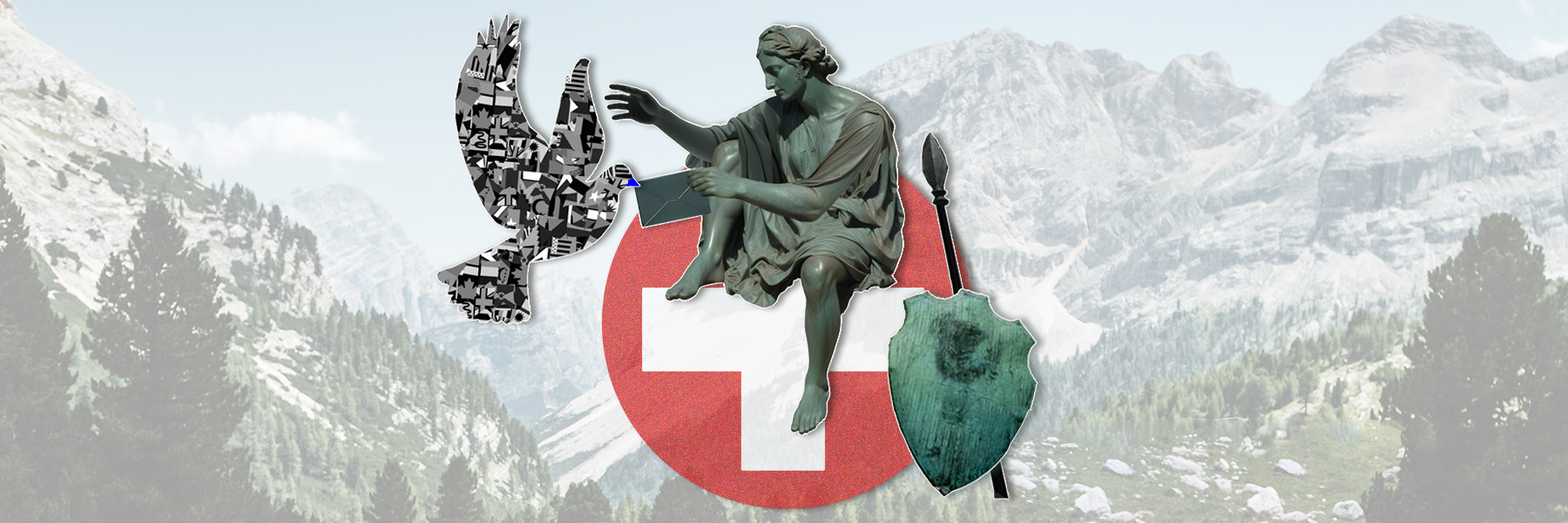
More
More than a messenger: how Swiss diplomacy tries to improve the world
Between neutrality and responsibility
The current violence in Iran increases the demands on this role. Switzerland is faced with the task of maintaining dialogue and at the same time taking a clear stance on human rights violations without undermining its role as an ambassador.
This balancing act is closely linked to the traditional policy of neutrality. Switzerland has historically relied on dialogue with all sides in order to keep channels of communication open even in tense situations.
Guldimann sees no fundamental moral problem in dialogue with authoritarian regimes. The decisive factor is not who you talk to, but whether you give up your own positions. Dialogue alone does not mean consent. “It would only become problematic if Switzerland, out of consideration for the mandate, no longer represents political positions that it would otherwise adopt,” he explains.
Abroad, however, this restraint is also viewed with scepticism. Ali Fathollah-Nejad, a German-Iranian political scientist and director of the Center for Middle East and Global Order, warns that Swiss neutrality in the current situation could be interpreted as taking sides with the wrong side.
“It is to be feared that Switzerland is still considered a safe haven for the interests of the Islamic Republic in some respects,” he said. This could not only damage Switzerland’s reputation, but also be detrimental to its interests, he said.

EU puts Revolutionary Guards on terror list
The tension is particularly evident in the discussion about a possible classification of the IRGC as a terrorist organisation. This decision was taken by the foreign ministers of the EU member states on January 29.
The IRGC are Iran’s elite armed forces and report directly to Supreme Leader Ayatollah Ali Khamenei. They play a key role in the suppression of protests.
Listing them formally puts them on a par with organisations such as al-Qaeda, Hamas or the Islamic State. Such a decision has been discussed in the EU for years, but no consensus has been reached.
Switzerland is also weighing up the political and diplomatic consequences of this decision. For former ambassador Tim Guldimann, this question should be assessed independently of the protecting power mandate.
If Switzerland is convinced that the categorisation is correct, it should take this step, Guldimann said. “If the mandate ends as a result, then so be it. Standing by your political convictions also means taking a risk,” he said.
Edited by Marc Leutenegger. Translated from German by AI/ts
This article was updated after publication with the more accurate name: Islamic Revolutionary Guard Corps (IRGC).
How we translate with AI
We use automatic translation tools, such as DeepL and Google Translate, for some content.
Each translated article is carefully reviewed by a journalist for accuracy. Using translation tools gives us the time for more in-depth articles.
Learn more here about how we work with AI.

More
Our newsletter on geopolitics

In compliance with the JTI standards
More: SWI swissinfo.ch certified by the Journalism Trust Initiative

You can find an overview of ongoing debates with our journalists here . Please join us!
If you want to start a conversation about a topic raised in this article or want to report factual errors, email us at english@swissinfo.ch.