








Swiss second home prices skyrocket
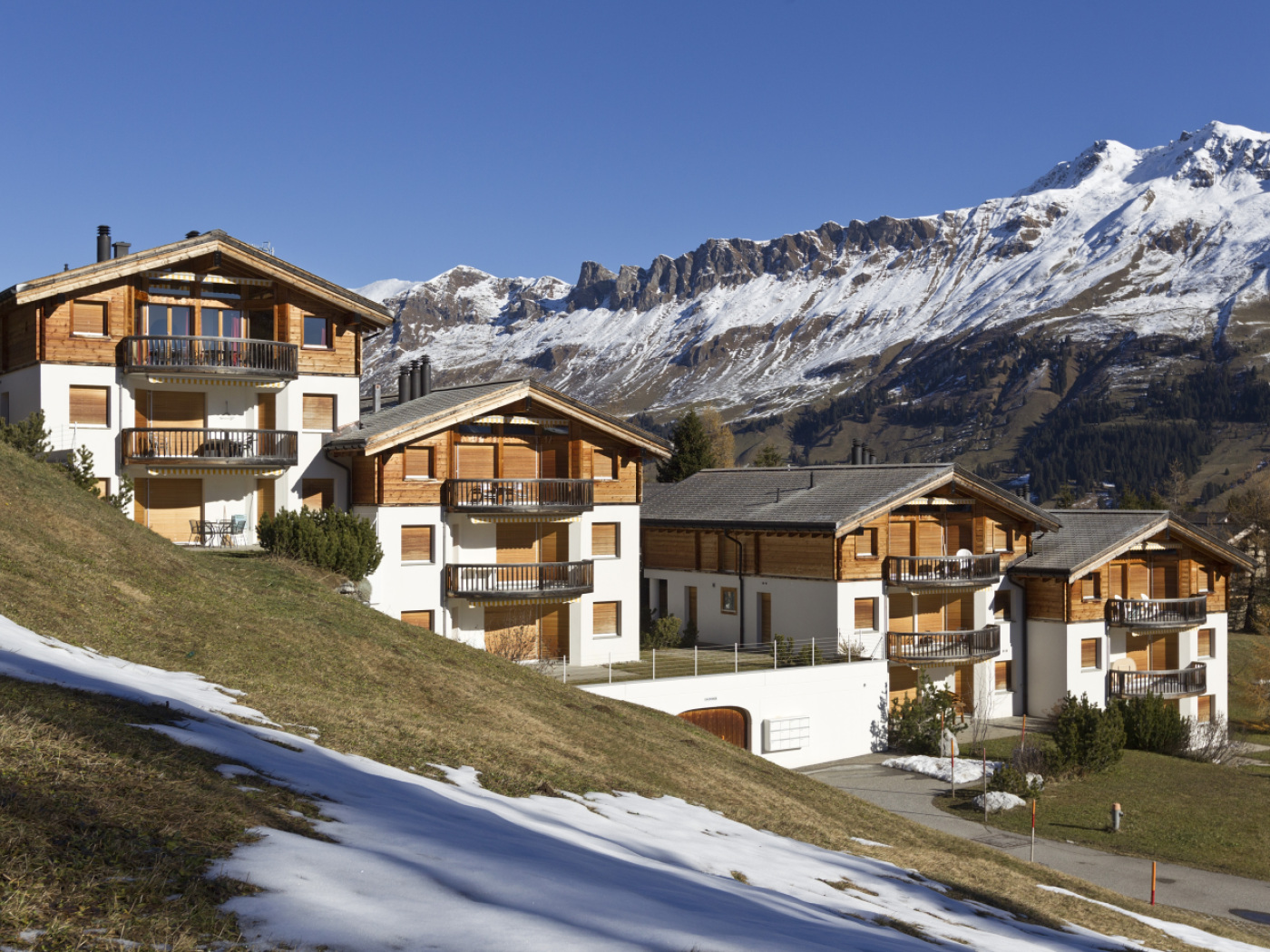
The demand for second homes in Swiss tourist regions remains very high, leading to more rapid price inflation than for primary housing.
Select your language
Generated with artificial intelligence.
Listening:
Swiss second home prices skyrocket
+ Get the most important news from Switzerland in your inbox
According to an analysis released today by the consulting firm Wüest Partner, the increase in real estate values for secondary residences was higher than that of the market for main residences.
+ Locals driven out by luxury homes in Swiss mountains
Since the beginning of 2020, prices for mid-range second homes in tourist regions have risen by an average of 46%. “This corresponds to an annual progression of 6.5%,” explain the experts from Wüest Partner. In the same period, owner-occupied flats used as main accommodation rose by 32%, or 4.6% annually.
In recent months, however, the market for holiday homes has shown signs of normalisation, moving closer to the dynamics of the primary housing market. According to estimates by Wüest Partner, prices for secondary residences will grow by an average of 4.3% in 2025, while flats for primary residences will increase by 4.5%.
On a regional level, the upward race shows significant differences. Graubünden and Central Switzerland are the best performers, with annual growth rates of 7.7% and 8.3% respectively from the beginning of 2020. Valais recently accelerated to 6.2%.
More
St Moritz: second homes, bane or blessing?
Ticino, on the other hand, has by far the weakest dynamic of the regions considered. Using the first quarter 2016 price level as a basis of 100, the southern canton is trailing at 105 in the fourth quarter of 2025, compared with 123 in French-speaking Switzerland, 133 in eastern Switzerland, 135 in Valais, 142 in Berne, 152 in Graubünden and 163 in Central Switzerland.
At a national level, several factors, some of a structural nature, explain the price surge. Firstly, the growing digital penetration reinforces trends such as teleworking and “workation” (combining work and holiday), analysts explain. Consequently, the demand for second homes increases, particularly in well-connected and scenically attractive destinations.
Join the debate:
External Content
Secondly, investments in infrastructure and the expansion of the annual tourist offer increase the attractiveness of locations. “Where destinations do not only experience seasonal peaks but are more frequented throughout the year, the willingness to keep a second home permanently or to pay higher prices at the time of purchase also increases,” the report states.
The third factor concerns supply, which can hardly be expanded. The revision of spatial planning and the Second Homes Act make it virtually impossible, in many municipalities, to create enough new capacity to keep up with demand. The result is a persistent excess of demand and consequent pressure on prices.
Meanwhile, the supply of owner-occupied flats in tourist areas has decreased significantly. Until the end of 2019, there was still a relatively large choice, thanks to an increase in new construction activity just before the second-home law change came into effect, leading to a general climate of uncertainty dampening the propensity to buy.
Since the start of the pandemic, the picture has changed dramatically. The tangible increase in demand has significantly reduced the number of offers. In many tourist regions – particularly in the canton of Graubünden – it is now more difficult to find a flat than in Switzerland’s urban centres.
For the coming quarters, experts expect prices to rise further, albeit at a decreasing rate. Indeed, there are currently no signs of a significant drop in demand.
The high willingness to pay should continue and be supported by the persistence of more flexible working and lifestyle patterns, as well as the continued attractiveness of many mountain destinations.
On the supply side, no additional impulses are discernible. A decisive factor is the restricted space at the regulatory level: in municipalities with a high proportion of second homes, the law and spatial planning actually limit new capacities to a few well-defined cases, such as building replacements in existing buildings, changes of use or specific usage patterns.
“The housing stock cannot therefore grow at the same rate as demand. Therefore, there remains an environment that supports excess demand and thus upward pressure on prices,” the specialists conclude.

More
Swiss voters back e-ID and abolish rental tax
Adapted from Italian by AI/mga
We select the most relevant news for an international audience and use automatic translation tools to translate them into English. A journalist then reviews the translation for clarity and accuracy before publication.
Providing you with automatically translated news gives us the time to write more in-depth articles. The news stories we select have been written and carefully fact-checked by an external editorial team from news agencies such as Bloomberg or Keystone.
If you have any questions about how we work, write to us at english@swissinfo.ch
External Content

In compliance with the JTI standards
More: SWI swissinfo.ch certified by the Journalism Trust Initiative

You can find an overview of ongoing debates with our journalists here . Please join us!
If you want to start a conversation about a topic raised in this article or want to report factual errors, email us at english@swissinfo.ch.