








Criminal court opens for business in Ticino
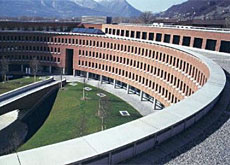
A federal court specialising in organised crime, white-collar crime and terrorism has started work in canton Ticino in southern Switzerland.
But experts are divided as to whether the new court will complicate or simplify the Swiss legal system.
The Federal Penal Court officially opened on April 1 in the city of Bellinzona in the Italian-speaking part of Switzerland.
Set up as part of sweeping justice reforms that came into force in 2002, the court is designed to ease the burden on the Federal Court in Lausanne, Switzerland’s highest court.
Prior to April, all major cases involving terrorism, organised crime and corruption were dealt with in Lausanne.
The court is being temporarily housed in building designed for the telecommunications company, Swisscom, by local star architect Mario Botta.
A new court building is due to be completed by 2009 at a cost of SFr30 million ($23.3 million). When finished it should have some 90 staff, including 35 judges – nine of them women.
Opponents
But the choice of Ticino was far from unanimous. During the parliamentary debate on the location of the new court in the summer of 2002, there was strong support for Aarau, the capital of the German-speaking canton of Aargau.
They argued that a court in Aarau in northern Switzerland would be cheaper and more efficient. Among them was the parliamentarian, lawyer and former judge, Erwin Jutzet.
“If someone is arrested on suspicion of organised crime or money laundering in Zurich or Geneva, the suspect then has to be summoned before a judge in Bellinzona,” he told swissinfo.
All the parties involved in the case, including federal prosecutors, examining magistrates, lawyers and witnesses, would also have to make their way to Ticino. Jutzet fears this will complicate the process.
“In a few years time, we’ll come to the conclusion that it just doesn’t work,” he said.
Supporters
But Geneva prosecutor Daniel Zappelli disagrees: “The new entity makes the division of labour between the government and the cantons much clearer.”
The Swiss legal system is multi-tiered: apart from the courts at Lausanne and Bellinzona, each of the country’s 26 cantons has its own court system and laws.
Zappelli says that if a crime is confined to a canton, it will still be dealt with there. But he admits that under the new system, cantons will lose jurisdiction over some cases.
“If the investigations into the Abacha money or the Borodin affair were opened today, it would be the Federal Penal Court in Bellinzona which would head the inquiry,” said Zappelli.
Abacha millions
Former Nigerian dictator Sani Abacha is believed to have siphoned off almost SFr4 billion of his country’s money and placed around SFr800 million in Swiss banks.
The Geneva authorities froze the funds in 1999, only releasing part of them in December last year.
The former Kremlin official, Pavel Borodin, was found guilty of corruption in Geneva in 2002.
Both these cases, which crossed cantonal and even international boundaries, would today be tried in Bellinzona.
However, cantons will be able to complete cases which are already underway.
Crimefighting
The Federal Court will remain the country’s supreme court, which means that decisions taken in Bellinzona can be contested.
Alex Staub, head of the Federal Penal Court, says he expects Bellinzona to handle more cases than Lausanne, which dealt with 117 cases in 2003.
This is because it will handle all international and inter-cantonal cases of organised crime, white-collar crime and terrorism.
Federal judge Hans Wiprächtiger believes the main advantage of setting up the new court will be to allow the Federal Court in Lausanne to concentrate on other important matters.
The Lausanne court deals with public and administrative cases, and arbitrates in disputes between the government and the cantons or between cantons.
“This court can now better carry out its proper duty: monitoring the application of the law in Switzerland,” he said.
swissinfo, Renat Künzi and Alexandra Richard
The Federal Penal Criminal Court in Bellinzona will handle major cases of terrorism, organised crime and white-collar crime.
These were previously dealt with by the Federal Court in Lausanne.
The Bellinzona court will eventually be housed in a new building due to be completed by 2009 at a cost of SFr30 million ($23.3 million).
Critics claim Ticino was a poor choice of location for the court, arguing it is out of the way.

In compliance with the JTI standards
More: SWI swissinfo.ch certified by the Journalism Trust Initiative

You can find an overview of ongoing debates with our journalists here . Please join us!
If you want to start a conversation about a topic raised in this article or want to report factual errors, email us at english@swissinfo.ch.