








Putsch: the most revolutionary Swiss-German word in the world
What links a bumper car to a coup d’état? The answer is one of the very few Swiss-German words to make the leap across Swiss borders and into foreign dictionaries: putsch. Buckle up for a fascinating – and often violent – etymological journey.
Select your language
Generated with artificial intelligence.
Listening:
Putsch: the most revolutionary Swiss-German word in the world

From angst to zeitgeist via schadenfreude and wanderlust, hundreds of German words appear in English dictionaries and (pretentious) conversations. When it comes to naming Swiss-German words, it’s a different story. Some English speakers might guess muesli – maybe rösti – but most don’t get further than that.
And you can’t blame them. Not all words are as hard on the throat as Chuchichäschtli (a kitchen cupboard), but Swiss-German can certainly be daunting. Nevertheless, one little word has successfully been exported around the world.
“It’s a parliamentary putsch by the bosses and the bigwigs against the working people of this country […]. It’s a putsch against the sovereignty of the cantons.” Cédric Wermuth wasn’t happy. The co-president of the left-wing Social Democratic Party was reacting in parliamentExternal link last year to a decision by the House of Representatives not to give precedence to cantonal minimum wages over collective labour agreements. “I can reassure you,” replied Philipp Matthias Bregy, president of the Centre Party. “There’s no putsching going on here today.”
A putsch and coup d’état are pretty much the same, but with subtle differences, depending on whom you ask. Neither is a revolution.
Russian-American philosopher Ayn Rand wrote an articleExternal link, published in The New York Times Magazine in 1970, asking “Are We in the Middle of the Second American Revolution?” “The New Left does not portend a revolution, as its press agents claim, but a Putsch. A revolution is the climax of a long philosophical development and expresses a nation’s profound discontent; a Putsch is a minority’s seizure of power. The goal of a revolution is to overthrow tyranny; the goal of a Putsch is to establish it.”
Twenty years later, also in the New York Times, William Safire in his column on the English languageExternal link turned to what was going on in the Soviet Union, namely the attempt of Communist hardliners to topple Soviet leader Mikhail Gorbachev. “Although ‘failed coup’ is not incorrect, there’s something wrong with it: why use a modifier to set straight a not-quite-right noun when the right noun is available?” Safire wrote. “The right word, used by Boris Yeltsin from the start, perhaps for its Nazi beer-hall associations, is putsch. The German word also means ‘blow, thrust’, same as the original French coup, but has the connotation of ‘attempt’ rather than ‘successful quick completion’. A rebellion is a revolution that failed; a putsch is a coup that did not come off.”
Does Safire have a point? Is a putsch a failed coup? Often, yes, but the Zuriputsch, for one, can be considered a qualified success.
For David Lane, a sociologist at the University of Cambridge writing in 2008External link, a putsch is led by an elite that is not currently close to power (such as the army), whereas a coup d’état involves one political faction replacing another. “These political processes are distinguished by relatively little public participation, either in the overthrow or in the defence of the incumbents, and they have by intention no significant social or economic effects,” Lane said.
The Chambers Dictionary (13th edition) defines a putsch as “a sudden revolutionary outbreak; a coup d’état” and a coup d’état as “a violent or subversive action resulting in a change of government or state policy”.
Modern Switzerland is renowned for its political stability, but things were very different 200 years ago. One of the main flashpoints was tension between conservative rural populations and progressive governments and residents in cities. In 1833, for example, political quarrels and armed conflict resulted in the historic canton of Basel splitting into two new cantons, Basel City and Basel Country.
Züriputsch
Things came to the boil in 1839, when a liberal German theologian, David Friedrich Strauss – whose view in a nutshell was that Jesus’s miracles were in fact myths used by the Church as PR – was appointed professor at the University of Zurich. This triggered such a storm that Strauss was pensioned off before even starting (he gave the money to the poor).
However, “the conservative, modernisation‑critical rural population was not satisfied with this outcome”, the Historical Dictionary of Switzerland explainsExternal link with considerable understatement. “They criticised the lack of religiosity in primary schools and the teacher-training seminary and demanded the abolition of the university.”
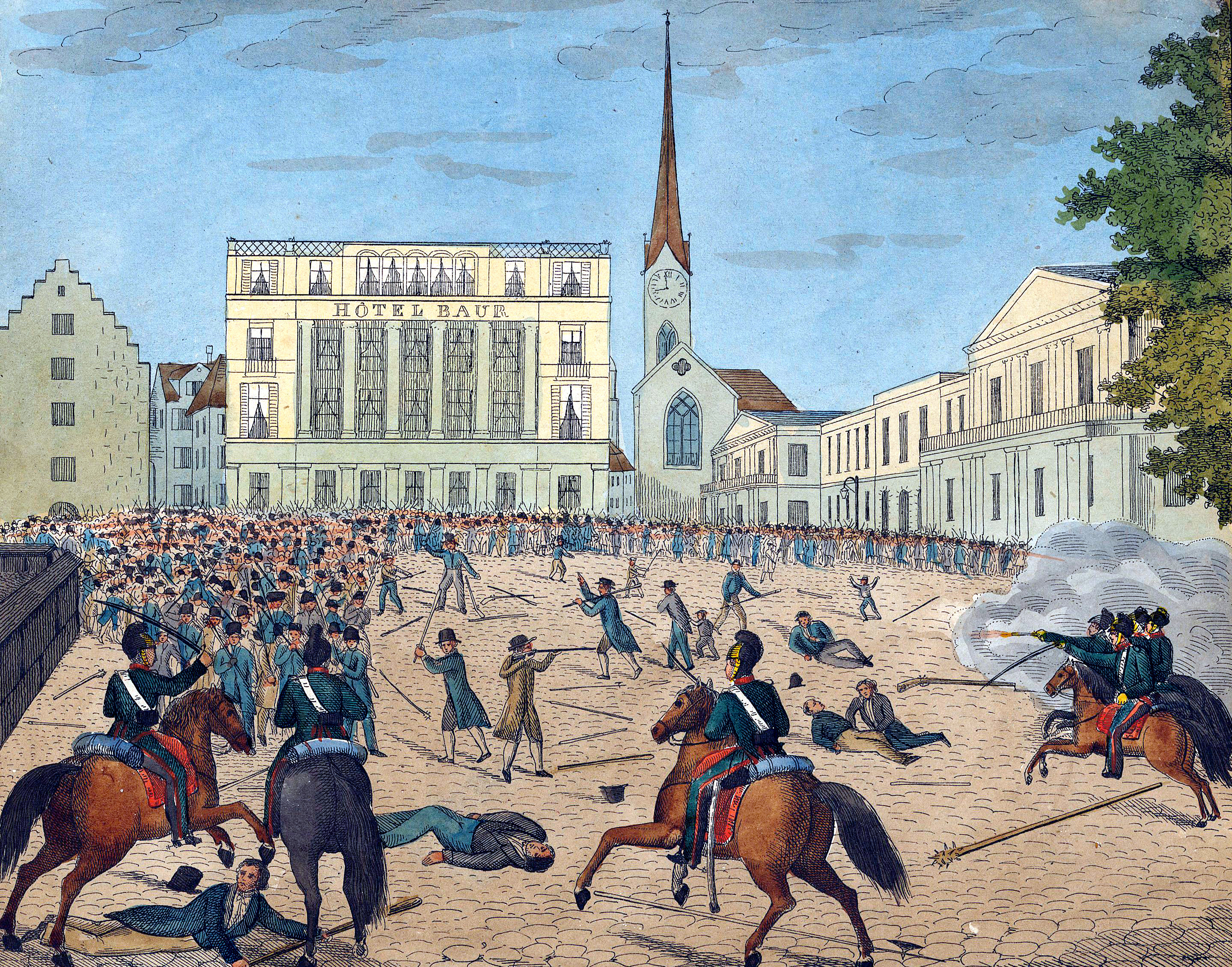
The Zurich authorities then banned assemblies convened by a conservative committee and deployed infantry to maintain public order. On September 5, Bernhard Hirzel, a pastor in Pfäffikon, a municipality outside Zurich, ordered the church bells to ring for four hours in the evening. Other communities followed suit. The following morning it all kicked off.
“At 7am, Zurich’s Paradeplatz was stormed by some 2,000 insurgents,” wrote newspaper BlickExternal link. “By this time, the cantonal government had already been holed up in the post office for hours. The mob, armed with pitchforks, scythes and halberds, had come to overthrow them.” Soldiers stepped in, and the subsequent fighting cost the lives of 14 protestors and a member of the cantonal government (who had tried to order a ceasefire). The government collapsed, and new elections were held three days later, resulting in victory for the conservatives.
“These events attracted a great deal of attention abroad,” Blick said. “German newspapers reported on the Züriputsch [Zurich Putsch]. In France and England, reports soon referred to ‘le putsch’ or ‘the putsch’ in Switzerland.”
Countless coup d’états and uprisings have occurred throughout history. Here are some that are generally known as putsches:
1830 – Freiämterputsch. Arguably the first mention of putsch in the political sense. A bloodless revolution by the rural population in canton Aargau, northern Switzerland, demanding changes to the cantonal constitution. While the government wasn’t overthrown, it agreed to a full revision of the constitution.
1839 – Zurich Putsch. See article.
1890 – Tessiner Putsch. Supporters of the Ticino Liberals rose up against the conservative cantonal government in Italian-speaking Switzerland. Following occupation of the armoury in Bellinzona, an armed mob stormed the government building in the centre of the city. Various officials and representatives of the Conservatives were arrested, and one politician was fatally shot. The insurgents set up a liberal transitional government, which was replaced later in the year by a government in which both main political groups were represented.
1920 – Kapp Putsch. An abortive coup d’état against the German national government in Berlin by parts of the armed forces, as well as nationalist and monarchist factions. Although the government was forced to flee the city, the coup failed after a few days, when large sections of the German population joined a general strike called by the government.
1923 – Beer Hall Putsch. Also known as the Munich Putsch. On November 8, Nazi Party leader Adolf Hitler and about 600 Sturmabteilung (SA) members headed to the Bürgerbräukeller, where the minister-president of Bavaria was delivering a speech. As the SA surrounded the hall, Hitler entered, fired a shot into the ceiling and claimed that the Bavarian government had been overthrown and that the national revolution had begun. A couple of days later Hitler was arrested, charged with treason and sentenced to five years in prison (he served nine months).
1934 – July Putsch. A failed coup d’état in Austria against the Fatherland Front government of Engelbert Dollfuss by Austrian Nazis. The Austrian government eventually suppressed the coup, with more than 200 people being killed in six days of fighting.
1961 – Algiers Putsch. Also known as the Putsch of the Generals. A failed coup d’état intended to force French President Charles de Gaulle not to abandon French Algeria, the resident European community and pro-French Algerians. It was organised in French Algeria by retired French Army generals and brought the nation to the brink of civil war.
1991 – August Putsch. A failed attempt by hardliners of the Communist Party of the Soviet Union (CPSU), including top military and civilian officials, to seize control of the country from Mikhail Gorbachev, who was Soviet president and General Secretary of the CPSU at the time.
2021 – ‘Presidential Putsch’. While a few commentatorsExternal link have referred to the storming of the US Capitol by supporters of Donald Trump as a putsch, others have pointed out that Trump was trying to hold onto power rather than seize it. They argue it was therefore a self-coup.
2023 – Wagner Group rebellion. The Wagner Group, a Russian private military company led by Russian oligarch Yevgeny Prigozhin, staged an uprising against the Russian government which seems to tick many of the putsch boxesExternal link. The march on Moscow lasted one day, and, to no one’s surprise, Prigozhin died in a plane crash a couple of months later.
Kapow! Putsch!
While this was not quite the first use of putsch in the recognisable modern sense of a coup d’état or a sudden violent attempt to remove a government by force (the Freiämterputsch in neighbouring Aargau had taken place nine years earlier), the word’s meaning has taken some surprising twists over the past 500 years. How did it end up in politics?
“Putsch is a so-called onomatopoeia. When two things collide, they go ‘putsch’,” wrote Christoph LandoltExternal link, a linguist at the Swiss Idiotikon, a Swiss-German dictionary. Landolt quoted 19th-century sources in which the verb putsche, butsche or pütsche referred to the noise made when someone threw a stone at something, fired a gun or gave someone a smack.
“Early on, the onomatopoeic description of the sound developed into the physical meaning of bumping or colliding,” Landolt said. In 1525 the Zurich Bible translation of Judges 19:22 reads: Do kamend die lüt der statt […] und umgabend das huß und putschtend an die tür und sprachen zuo dem […] hußwirt: bring den mann häruß, der in din huß kommen ist! (Then the people of the town came […] and surrounded the house and beat at the door and said to the […] landlord: “Bring out the man who has come into your house!”)
More sociably, it was also a synonym for clinking glasses and toasting people. Landolt then jumps into the present. “Who doesn’t enjoy riding the Putschauto at fairs, as bumper cars [dodgems] are commonly called in Switzerland?”

According to the Swiss Idiotikon, from this concrete, physical meaning, a more figurative one developed, specifically in canton Zurich, in the sense of “setting off in fits and starts; rushing towards”. Landolt quotes the sage advice: bim Hüraate mues me nüd driipütsche – which is basically “when it comes to marriage, only fools rush in”.
‘Foolish emotional impulse’
As for putsch the noun, this has also been a sound caused by a collision, impact, crash or shot – as well as a violent jolt or blow. Another meaning was a “special effort”. The Swiss Idiotikon notes that as early as 1555, the Bernese dramatist Hans von Rüte wrote in a piece on David’s slaying of Goliath that, despite defeating their enemies in one battle, “der putsch ist noch vorhanden (the struggle is not yet over).
“It’s interesting that the Swiss Idiotikon recognises the word Züriputsch in two meanings,” Landolt said. “On the one hand, in the specific sense referring to the 1839 uprising. And on the other, in a general and by no means flattering sense, namely ‘a sudden burst of enthusiasm that quickly fades; a rush towards an undertaking’.” He notes that “from there it’s not far to the meaning of ‘popular uprising, revolt’”.
The Swiss Idiotikon cited Anton Klingler, senior pastor at Zurich’s Grossmünster cathedral, who in 1702 wrote that many a respectable man “had been plunged into utter misery by a rash, frenzied Zurich-Putsch”.
This sense was popularised by Swiss author Gottfried Keller in his novel Der grüne Heinrich (Green Henry), published in 1855. “The word Putsch comes from the good city of Zurich,” Keller wrote, “where a sudden passing rain shower is called a Putsch, and accordingly the jealous neighbouring towns call every foolish emotional impulse, enthusiasm, anger, whim or fashion of the Zurich folk a Züriputsch.”
Heard around the world
When it comes to the use of “putsch” in English, Google’s NGram ViewerExternal link, which charts the frequency of words in printed sources between 1500 and 2022, shows a tiny blip in the 1830s but it doesn’t really take off until around 1915, with peaks during the Second World War and the so-called August Putsch in the Soviet Union in 1991.

Today, the Swiss-German word can be heard all around the world in languages including Spanish (el putsch), Portuguese (o putsch), Italian (il putsch), French (le putsch) and no doubt many more. Polish tweaks the spelling a bit (pucz), as does Esperanto (la puĉo).
But however you spell it, the good news is that, for the moment, there’s no putsching going on in Switzerland.
Edited by Samuel Jaberg/gw

More
English words in German: a linguistic cliffhanger
More


See more Swissinfo articles in your Google results. Learn more

In compliance with the JTI standards
More: SWI swissinfo.ch certified by the Journalism Trust Initiative

You can find an overview of ongoing debates with our journalists here . Please join us!
If you want to start a conversation about a topic raised in this article or want to report factual errors, email us at english@swissinfo.ch.