








How do autocracies and dictatorships come to an end?
In countries such as Nepal and Bangladesh, a democratic awakening is palpable. Meanwhile, Viktor Orbán recently lost the election in Hungary. Do these different local developments mean that a trend reversal and a democratic awakening could now be on the horizon elsewhere in the world? We hear from a protest researcher, a dictatorships expert, and a Swiss-Hungarian who lived through the 1956 uprising.
Select your language
Generated with artificial intelligence.
Listening:
How do autocracies and dictatorships come to an end?


Young people are bringing down governments in the name of democracy. This isn’t taking place in the hopeful post-Cold War era, but in the hard-edged 2020s, as strongmen like Donald Trump, Xi Jinping and Vladimir Putin dominate global politics.
Prathit Singh is observing such youth-led democratic movements in Nepal, Bangladesh and Sri Lanka. “My interest was piqued when it started in Bangladesh,” says Singh, programme officer youth and democracy at Interpeace, a Geneva-based peacebuilding organisation. He says this awakening is no longer just regional, but a global trend. “Similar movements started in East Africa and Latin America,” he notes.
Indeed, youth-led anti-government protests have shaken Kenya and Mozambique in recent years, while in South America, student-led protest movements in Chile and anti-establishment mobilisations in Colombia helped drive major political shifts.
For Singh, the South Asia protests differ from earlier democratic movements because those in power, such as Sheikh Hasina in Bangladesh, described themselves and their governments as democratic. Young protesters demanded that those in power adhere to their own standards.
>>When does a country cease to be a democracy? Read our article on this complex question:

More
When is a democracy no longer a democracy?
The 2024 protests in Bangladesh began as student-led demonstrations against a controversial public-sector job quota system, but quickly evolved into a broader anti-government movement driven by anger over corruption, economic hardship, authoritarianism and repression under former prime minister Sheikh Hasina.
“The different youth movements share the same frustration and the urge to reclaim the institutions,” Singh says. The momentum of protests in one country fuelled those in the next via social media, even though the movements are barely in direct contact with one another – at least not yet.
Democratic movements can succeed
The protests followed a similar pattern in each case, Singh explains. Early protests demanded accountability from the government, but the government responded with repression. This repression triggered an immediate and often much larger response from young people. Another common thread running through these various examples is that in these countries, many young people have limited economic prospects.
“There have been no movements of this magnitude since the Arab Spring. Unlike then, however, many of the new movements are successful,” says Singh, referencing a wave of pro-democracy protests and uprisings that swept across the Middle East and North Africa starting in late 2010.
In Bangladesh, protests helped usher in a democratic government in 2024. In Nepal, politicians who had proposed internet shutdowns modelled on China’s system were voted out of office in March 2026. And in Hungary, Viktor Orbán lost an election in April 2026 after years of reshaping the country into what he himself called an “illiberal democracy”. These cases suggest that democratic movements can still prevail in today’s political climate.
>> Our article on how Orbán used a form of referendum to achieve his goals:
More
How direct democracy became part of Orbán’s ‘illiberal’ toolkit in Hungary
Nevertheless, the number of dictatorships has been growing for over 20 years. In some places, military governments take over following a coup; in others, the institutions of once-democratic states are crumbling. Researchers speak of the third wave of autocratisation. Some date the start of this wave to the 2010 financial crisis, others as early as 1994.
According to the Democracy Report 2026External link by the Varieties of Democracy (V-Dem) Institute in Gothenburg, there is no end in sight to autocratisation: only 18 countries are currently becoming more democratic. Indeed, 44 countries, more than ever before, are moving in the opposite direction, and 3.4 billion people live in states that are becoming more autocratic.

Resilient autocracies
Many of today’s rulers are relatively old, and those frustrated by the political situation might like to think that the autocrats will die one day. But it is a fallacy to hope for more democracy on that basis. “The evidence suggests otherwise,” says political scientist Erica Frantz, a professor at Michigan State University. “In fact, in the vast majority of instances, when autocratic leaders die, the regime persists.”
According to Frantz, the chance of change occurring is slightly higher when power is heavily concentrated in a single individual. But even then, a regime usually survives the leader’s death. Frantz attributes this to the fact that the social elite in authoritarian states have incentives to support a successor, because many of them have been involved in “acts of repression, corruption and other bad behaviour”. The fear of prosecution in the event of regime change leads them to support the status quo.
The less violence, the more successful
In any case, attempts to fight fire with fire often fail, which is what Frantz’s research indicates: a coup rarely leads to a country becoming democratic.
The data shows that the less violent a democratic movement or popular uprising, the more successful it is. Equally, it can make sense for democratic movements to offer autocrats a way out into exile, as they are more likely to forgo violent repression if they themselves are not threatened with imprisonment or death.
In general, Frantz believes that non-violence is essential for democracy. “Peace has to be the path to power for the long-term health of a democracy,” she says. The data clearly supports this.


In Nepal and Bangladesh, Gen Z protests responded to repression by the security apparatus with violence. In Nepal, for example, the most important government building was set on fire. Despite this, they were successful. Singh, who is interested in young protest movements, also stresses that within the protests, key groups campaigned against this escalation and the use of violence.
“Gen Z groups, for example in Nepal, were strongly committed to non-violence. A key aspect of these movements is that young people acted as mediators. It wasn’t about their generation seizing power itself, but rather about conveying and amplifying the demands of young people,” explains Singh. In any case, he says it would be wrong to view the protests simply as a generational conflict, recalling how the Gen Z movement in Nepal used the online platform Discord to proclaim a 73-year-old woman as interim head of government.
>> Before the protests, Nepal’s political landscape was shaped by figures who had played a role in the peace process following the civil war. Read our article on peace in Nepal:

More
How Switzerland supported Nepal in its long road to peace
More protests, but increasingly unsuccessful
Social media can be useful, yet there are reasons to doubt whether it serves as a driver of change. Frantz explains that there are more and more protests worldwide, yet they are failing with increasing frequency. “We think that this may be because of social media,” she suggests. While social media makes it easier to mobilise people, digital democratic movements are “less likely” to build a grassroots organisation, which is crucial for long-term success.
Frantz is of the impression that the “changing media environment may be facilitating the rise of personalist parties globally”. She cites Nayib Bukele’s party in El Salvador and Orbán’s party in Hungary as examples of the cult of personality.
For many, election day in Hungary represents hope for democratic change. Some have compared the situation to the end of communist Hungary in 1989. According to Frantz, there are parallels. “In both instances you had an authoritarian regime lose power via an election. When authoritarian regimes lose in elections, nearly always you have democracy subsequently.”
Elections are now the norm even in authoritarian states. As Frantz explains, most states today claim to be democratic. “There is really good evidence that in most places in the world, citizens prefer democratic governance,” she says, which is why it makes sense for autocratic leaders to simulate democracy. “The vast majority of dictatorships today have regular multi-party elections.”
However, she adds, these are not free and fair – and free, fair elections are what constitute democracies.
>> Find out how democracy in its most fundamental form – as a system that guarantees fair elections – has developed worldwide since 1946:
External Content

Frantz also sees a parallel between the first free elections in Hungary in 1990 and Orbán’s defeat in 2026. In both cases, she says, the “legacy of the past regime” is likely to be felt, and the damage to Hungarian society will not be repaired easily.
No culture of democracy in Hungary?
Ödön Szabó agrees, although the Swiss-Hungarian says he would like to be more optimistic. Democratic upheavals in Hungary have been a feature of his life: 70 years ago, in 1956, a democratic popular uprising took place in communist Hungary. In place of the one-party dictatorship appeared an interim government comprising representatives from various political camps. Within days, the country declared its neutrality and sought to withdraw from the Warsaw Pact. Shortly afterwards, the Soviet army marched in and quelled the popular uprising.
Szabó was 11 at the time and fled to Switzerland with his family. About 40 years ago, he gave a speech to a Hungarian association in Switzerland. “I said that communism and the global dominance of communism were coming to an end. A friend of my father’s came up to me and said: ‘You’re young. That will never happen.’ A few years later, it happened.”
>> Our article on the exodus of many Hungarians to Switzerland in 1956, in which Ödön Szabó also speaks:

More
Hungarians in Switzerland look at momentous past and Orbán’s present
After 1989, he worked and ran companies in Hungary, where he says he encountered a black-and-white way of thinking. “Under a communist regime, people have the tendency to see with a jaundiced eye or rose-tinted glasses, either for or against,” he recalls.
Those who opposed the regime did so silently, and after the fall of communism, he says, “it was not a proper democratic culture that emerged, but simply a capitalist system”. Consequently, he says people remained sceptical of state institutions in the 1990s and focused on getting rich.
This map shows the global spread of liberal democracy over the last 80 years:
External Content
Szabó has not been back to Hungary in recent years, having become increasingly frustrated by how Orbán was dismantling democracy. But what comes next? If Hungarians see a new force simply coming to power and dominating the institutions, Szabó fears this will not bode well.
“What’s crucial is whether we can level the balance of power. That is only possible if three or four genuinely grassroots parties can sustain themselves in the long term and party finances are transparently controlled by the state,” he says. He sees Swiss democracy as the ideal, with its inclusion of all political camps in government. Only then, he argues, can a broad democratic consciousness take root.
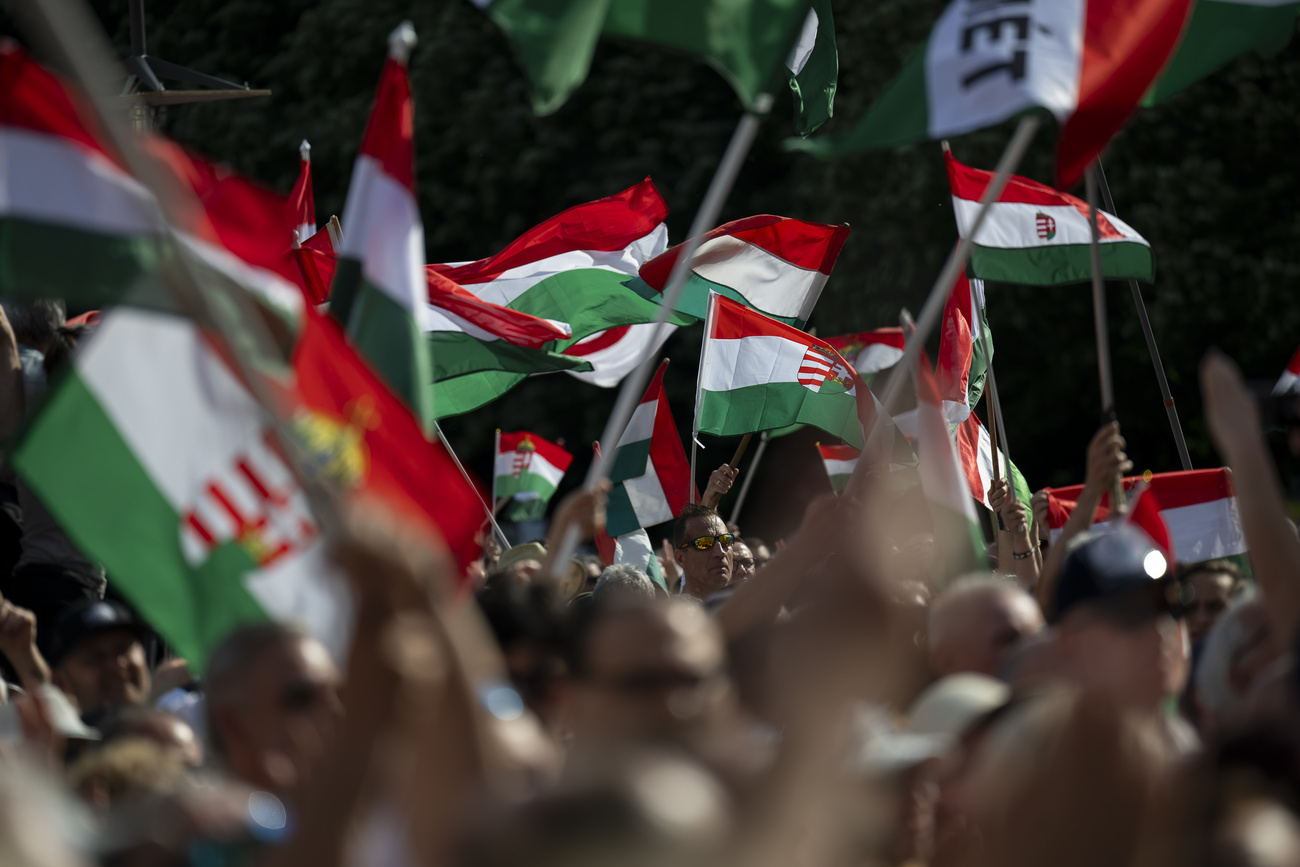
Hungary has one thing in common with the democratic movements watched by Prathit Singh in Asia, Africa and Latin America: on the night following Orbán’s defeat, celebrations were mainly driven by the young.
Edited by Reto Gysi von Wartburg. Adapted from German by Katherine Price/ds/ts
>> What do you think of the impact of social media: does it help or harm democracy? Let us know in the discussion:
More


In compliance with the JTI standards
More: SWI swissinfo.ch certified by the Journalism Trust Initiative

You can find an overview of ongoing debates with our journalists here . Please join us!
If you want to start a conversation about a topic raised in this article or want to report factual errors, email us at english@swissinfo.ch.