








Klee and his times
Klee spent a large part of his life in Germany, where he went to art school and worked as an artist and teacher.
There he lived through the First World War, the end of the Second Reich, the trials and errors of the Weimar Republic, the advent of Nazism and the rise of socialism in Europe.
His writings reveal that he kept a sceptical distance. Art historian Rosalina Battison explains that this was because “he wanted to be his own person and, above all, unconventional”.
Klee was a modern man and artist, a member of the avantgarde capable of reaching out to the people. The irony was that he mostly touched a certain elite.
The Great War
“I have carried this war in me for a long time. That is why it does not affect me as a person,” Klee wrote in his diary.
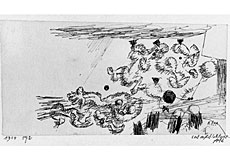
As fighting broke out in August 1914, he produced 12 works on the theme of war but his abstract and expressive art did not make him a political artist.
But he was not apolitical, claims Battison.
“He was interested in politics but he did not want his art to be defined as such,” she said.
Having believed like many liberals in a quick victory for the Germans, he soon became disillusioned. Klee was mobilised in 1916 and served first in a reserve regiment before being billeted at an aviation school in Gersthofen.
He was able to paint throughout the war and later learned that his father had pulled strings to prevent him from being sent to the front.
“He was lucky,” said Battison.
Socialism
Klee believed in universal principles of justice but did not identify with one single system, according to Battison.
“If socialism lets each person stay in the milieu which suits him, then I am a socialist… but I remain sceptical,” he wrote to his future wife, Lily Stumpf, who was trying to distance herself from her bourgeois milieu by mixing with Russian anarchists taking refuge in Munich.
A month before the fall of the Communist Republic of Munich (which lasted from November 1918 to May 1919), Klee entered the revolutionary action committee of artists.
“My work, my strength and my artistic knowledge are at your service!” he declared.
His alignment with the Left helped him gain a post at the Bauhaus in Weimar in 1920. Weimar gave its name to the Weimar Republic founded after the defeat and abdication of Kaiser Wilhelm II.
But Klee had difficulty in reconciling the aims of the movement with his own work and personal life. He left the Bauhaus for the Fine Arts Academy in Düsseldorf in 1931.
Advent of Nazism
The National Socialists swept to power on January 20, 1933, putting an end to the Weimar Republic.
During this time, Klee wrote to his wife: “I do not believe anymore that there is anything to be done. The people are too incompetent when it comes to reality, too stupid in this respect.”
An internationally renowned artist, he was at the apogee of his career and could not have foreseen what came next.
Dismissed from his post at the academy without notice, Klee went into exile in Bern on December 23.
In 1937 the Nazi regime organised an exhibition on “Degenerate Art” with more than 700 works of modern art. Seventeen of Klee’s pictures were among them. His works were also removed from public galleries in Germany.
Even though Klee’s last few years were marked by the collective catastrophe that was Nazism and, after 1935, by a personal battle with ill health, he still managed to keep a certain distance from what was happening in his life. His struggles were to continue on Swiss soil.
“He was discriminated against three times over in Switzerland – first as a Bolshevist artist, second as a German and then as a leftwing intellectual, which he never was,” said Battison.
Some historians have accused Klee of being gentrified.
However, Christine Hopfengart, curator of the Paul Klee Centre, believes Klee’s attitude during this period was mainly due to his analytical nature.
“Klee was not an actor but an observer,” Hopfengart said.
swissinfo, Isabelle Eichenberger
Paul Klee is born on December 18, 1879, in Münchenbuchsee, near Bern.
1898: He leaves for Munich to study art.
1906: He marries pianist Lily Stumpf.
1907: His son Felix is born.
1916: He is drafted into the German army.
1920: He gains a teaching post as “Meister” at the Bauhaus in Weimar.
1931: He goes to teach at the Fine Arts Academy in Düsseldorf.
1933: Persecuted by the Nazis, he returns to Switzerland.
He dies of scleroderma on June 29, 1940, in Locarno-Muralto.

In compliance with the JTI standards
More: SWI swissinfo.ch certified by the Journalism Trust Initiative

You can find an overview of ongoing debates with our journalists here . Please join us!
If you want to start a conversation about a topic raised in this article or want to report factual errors, email us at english@swissinfo.ch.