








Satellites may play crucial peacemaking role
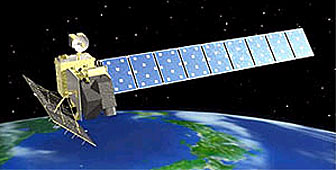
Satellites are an increasingly important tool for making war. A conference in Geneva shows world leaders that space technology also holds the key to building peace.
As the ongoing conflict in Afghanistan demonstrates, satellites play a crucial role in tracking the enemy and directing missiles. But the data provided from space can also help with locating mines, tracking the movement of refugees, anticipating natural disasters and rebuilding societies after conflict.
The two-day conference, entitled Peace-Building from Space: Use of satellite technologies for post-crisis development, was jointly organised by the European space promotion association Eurisy, the Swiss Federal Space Office and the Swiss Foreign Ministry. The conference concludes on Tuesday.
Common heritage
Many believe that space is a common heritage for humankind and that the knowledge it provides about our Earth should not be the exclusive preserve of a handful of countries that have the means to exploit it.
“Governments owning this satellite data don’t always want to give it up. We need to bring humanitarian pressure to bear on governments to unlock this information,” Cornelio Sommaruga, the former head of the International Committee of the Red Cross, told the conference.
“Maps can be easily updated from space. This is done regularly for armies. It should also be done for humanitarian agencies,” Sommaruga, now head of the Swiss Foundation for Moral Rearmament, added.
It is not only governments – and their armies – that control satellites. Much of the data provided by space technology is in private hands.
Rich potential
The vast majority of satellites put into orbit already have peaceful uses: telecommunications, television, and weather forecasting. They have, in fact, become such an integral part of everyday life that many people in the industrialised West take them for granted.
Aid agencies have slowly begun taking advantage of data from satellites, often in the wake of natural disasters. But they are only just starting to tap into the satellites’ rich potential.
It’s hoped that as a result of this conference, more humanitarian organisations will be able to incorporate satellite data into their work, and the space agencies will have a better idea of their requirements.
“The relationship between the providers and the users of this information can certainly be improved,” says Hubert Curien, the former French government minister who is now president of Eurisy.
“We would like to see a more open dialogue between the humanitarian agencies and the government organisations that deal with the (satellite) systems,” he told swissinfo.
Focused data
Since they are in orbit, satellites are not always in the right place at the right time for access. This makes it more difficult to extract data on a given situation and to provide the desired information
Nonetheless, the growing realisation that space technology has a big part to play in preventing or responding to disaster has led to a closer collaboration between the Swiss Space Office (SSO) and the Foreign Ministry.
“The awareness of this potential is growing, and our cooperation is increasing,” says Patrick Piffaretti, the deputy director of the SSO.
“Now that space technology can provide data for peace-building operations, this issue is on the table for both users and providers – not just at national level, but also at international level,” he told swissinfo.
Switzerland is a member of the European Space Agency, which is committed to the exclusively peaceful use of space.
Concrete recommendations
The conference is not an academic exercise. One of its key aims is to generate political support for the concept of peace-building from space. To this end it aims to come up with concrete recommendations for future action that can be taken up by governments.
Piffaretti says the first task is to make governments aware of the enormous potential the space sector has for helping to solve humanitarian problems. Next, they have to make the right information available.
“The discussion has to take place at government level too. They develop the peace-keeping and aid policies,” he says.
by Roy Probert

In compliance with the JTI standards
More: SWI swissinfo.ch certified by the Journalism Trust Initiative

You can find an overview of ongoing debates with our journalists here . Please join us!
If you want to start a conversation about a topic raised in this article or want to report factual errors, email us at english@swissinfo.ch.