








Swiss report sheds light on state of direct democracy worldwide

The Centre for Democracy Studies Aarau now produces an annual overview of referendums held in Switzerland and around the world. Political expert Mara Labud explains why this is important.

“Direct democracy is of great interest to us in and of itself,” says Mara Labud of the Centre for Democracy Studies Aarau (ZDA), a research institute in the northern Swiss canton of Aargau. After all, it is “the most direct way for people to decide what rules they want to live by”.
The expert is one of the authors of the 2025 World of Referendums report. The ZDA plans henceforth to publish a yearly overview of the global state of direct democracy. While Switzerland features prominently in the report – many of the world’s referendums take place there – the text also highlights how popular votes have been held in countries such as Ecuador and Slovenia.
No US military bases in Ecuador
In 2025, nine countries plus the Cayman Islands – a British Overseas Territory – held referendums. In Ecuador, for instance, a clear majority voted against United States military bases in the country; in Slovenia, a narrower majority rejected a law on assisted dying; and in the Cayman Islands, a majority of the population voted to decriminalise cannabis use. In Taiwan and Italy in 2025, referendums failed to reach the legal threshold of votes to be valid.
External Content
While referendums are often seen as a fair way to translate the will of the majority into policy, this is not always the case, the report also notes. It cites the “unofficial Voks 2025 consultation” in Hungary, whereby then-President Viktor Orbán sought to legitimise his political stance towards Ukraine, and the vote on a new draft constitution in Guinea, “put forward by the ruling military junta”.
Why military dictatorships need referendums
In 2025, “referendums were used in only two autocracies”, Labud explains. It is important, however, to distinguish between Hungary and Guinea. “Hungary has just voted Orbán out of office, whereas in Guinea, the leader of the 2021 military coup was elected president last year,” she says.
>>Read more about how direct democracy became part of Orbán’s ‘illiberal’ toolkit in Hungary:
More
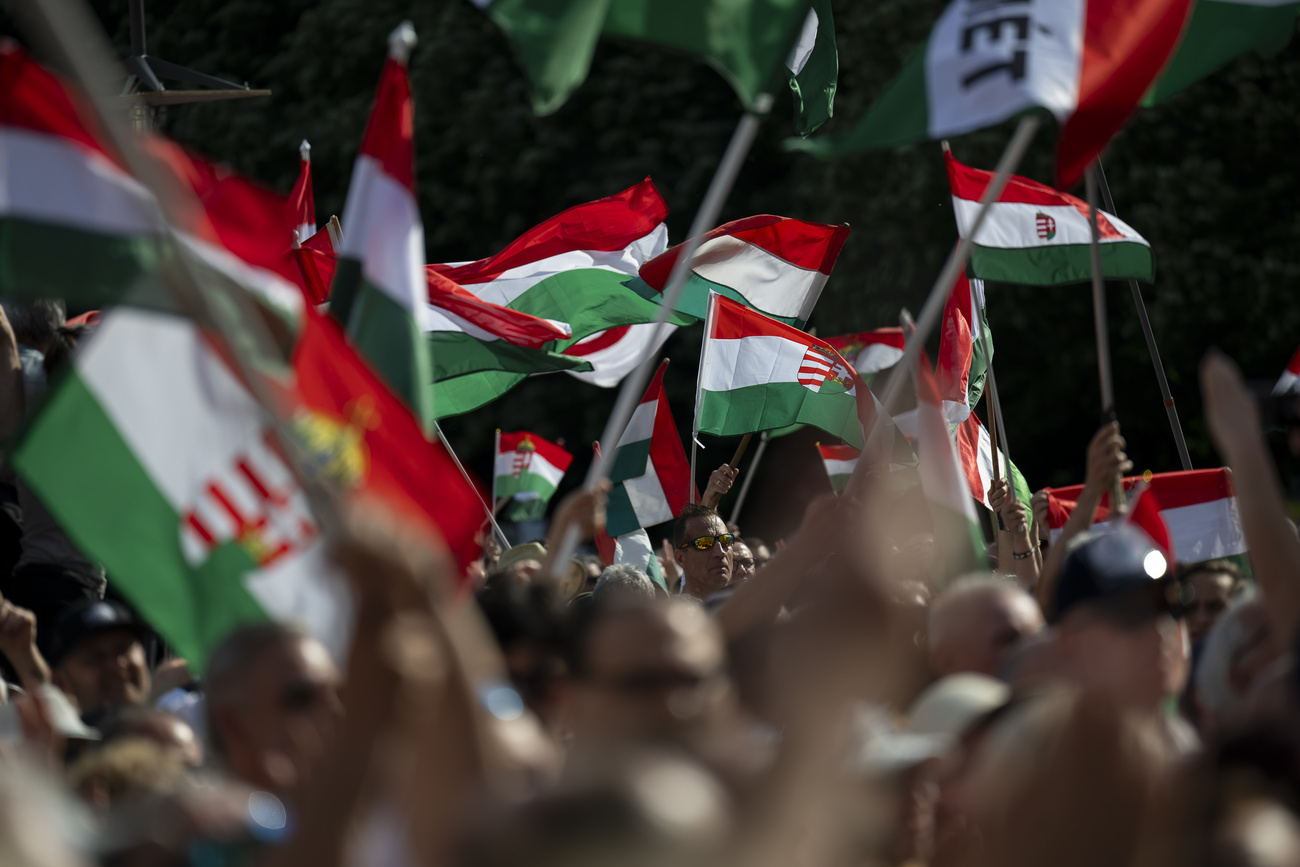
How direct democracy became part of Orbán’s ‘illiberal’ toolkit in Hungary
In Hungary, the decision helped to lay the groundwork for a political argument, while in Guinea it was about “effectively consolidating the president’s power”. A reported 90% of Guineans voted in favour. In both cases, Labud stresses, the results are not independently verifiable.
The referendum in Guinea fits neatly into “a tradition of referendums following military coups”, Labud says. With its 15 million inhabitants, Guinea is the fourth country in West Africa’s “so-called coup belt” to have held a referendum, after Mali, Chad and Gabon. “Because the military were never elected by the people, they need to legitimise their rule in other ways. Referendums are a tried and tested means of doing so,” she adds.
>>When is a democracy no longer a democracy – read our background article on this topic:

More
When is a democracy no longer a democracy?
Fewer referendums than in the past decade
Some 30 national referendums were held globally in 2025. This is “around 12 fewer” than in the previous year and less than the average over the past ten years, Labud explains.
Switzerland, too, held fewer national referendums in 2025 than the average. From a historical perspective, however, the number remains high.
External Content
According to Labud, it is only since the 1990s that so many referendums have been held globally: “Around three times as many referendums take place now as 70 years ago. We expect the number of national referendums worldwide to remain roughly at today’s level over the next few years.”
The 2025 World of ReferendumsExternal link report is the ZDA’s third referendum report, but its first annual report.
From now on, the ZDA team wants to publish an annual review of referendums in both democratic and less democratic countries. The reports, which are in English, are aimed at “anyone with an interest in direct democracy, both in Switzerland and abroad”, Labud says.
Filling a gap
While various other bodies already publish international reports on the state of democracy, the World of Referendums seeks to fill a gap by focusing on referendums and direct democracy. As Labud explains, “V-Dem, IDEA and Freedom House produce reports with a broader focus on democracy. Their work this year on the trend towards autocratisation is highly relevant.”
However, since even in direct democracy aspirations and reality do not always align, “the practice of direct democracy requires special and specific attention”.
The ZDA is particularly well placed to do this, Labud concludes. The research centre has documented all national referendums held worldwide since 1994.
>>Read this article about what it takes for a referendum to be considered fair:

More
What it takes for a referendum to be fair
Edited by Mark Livingston. Adapted from German by Julia Bassam/gw.

In compliance with the JTI standards
More: SWI swissinfo.ch certified by the Journalism Trust Initiative

You can find an overview of ongoing debates with our journalists here . Please join us!
If you want to start a conversation about a topic raised in this article or want to report factual errors, email us at english@swissinfo.ch.