








Beauty spots can survive wind energy expansion: Swiss research
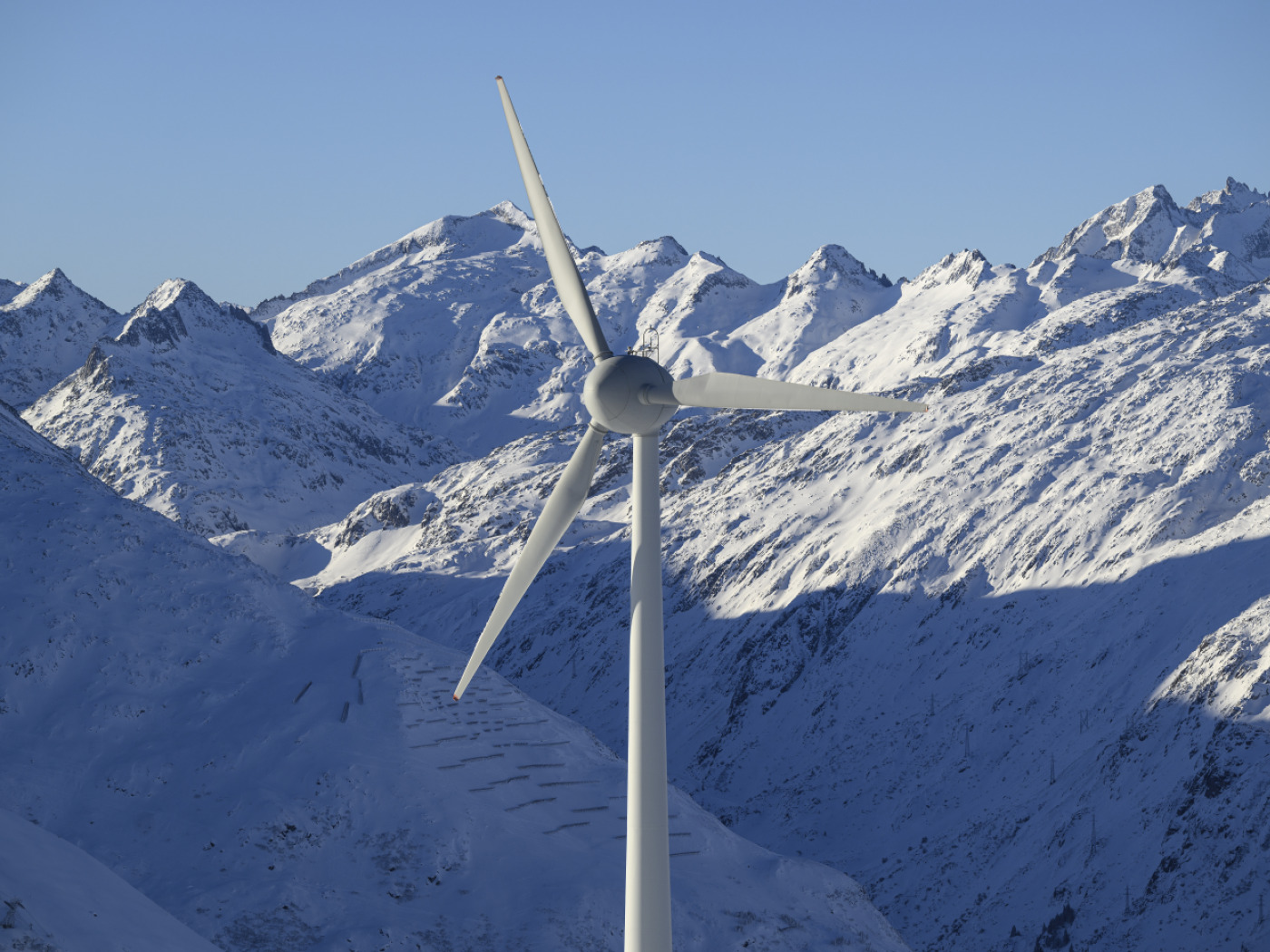
The expansion of wind energy in Europe would not necessarily come at the expense of beautiful landscapes, say Swiss researchers.
Select your language
Generated with artificial intelligence.
Listening:
Beauty spots can survive wind energy expansion: Swiss research
+ Get the most important news from Switzerland in your inbox
According to a study by the Swiss Federal Institute of Technology Zurich (ETH), electricity costs remain stable on average in Europe if wind turbines are kept away from picturesque areas.
+ Why do wind turbines windup so many emotions?
However, conflicts still exist at regional level, for example in the Alpine region, the study noted.
+ Alpine nimbyism freezes Swiss green energy dreams
The researchers used artificial intelligence to classify the beauty of the landscape in 29 European countries. The scientists trained a machine learning model with data from the UK. Over 200,000 landscape images rated by people served as the basis. The model learnt which features are perceived as beautiful.

More
Two initiatives on wind turbine construction launched in Switzerland
In the next step, the researchers linked this map with a wind energy model. Across Europe, the areas classified as particularly beautiful make up around 24% of the total area – almost 40% of which would in principle be suitable for wind energy, as the study published in the journal Energy and AI shows.
Overall, the potential for wind power would decrease by 43%, as the study shows.
+ Read more: Switzerland needs energy, but what kind?
However, the researchers’ analysis showed that the production costs for wind power would remain almost unchanged on average in Europe, even if the most beautiful landscapes were excluded for the construction of wind turbines.
This is because locations with strong and constant winds, which are well developed, are often located outside the areas rated as particularly beautiful. According to the researchers, a larger proportion of electricity production could take place there.
Conflicting objectives in the Alps
In mountainous regions such as the Alps or Norway, however, the effects are significantly greater, as the researchers showed in the study. There, good wind locations often coincide with areas of high landscape value.
+ Wind power could supply 6% of Swiss needs by 2035
According to ETH Zurich, this leads to a conflict of objectives. Where good locations are lost, the costs of generating electricity increase significantly, as the remaining locations are usually less efficient.
The study is a first attempt to predict the perceived landscape quality across Europe. The researchers conceded that the training data from the UK did not represent all European landscape types equally well.
However, the findings could already be utilised in the planning of other infrastructure projects such as alpine solar plants or grid expansion.

More
Record year for wind power in Switzerland in 2024
Translated from German by AI/mga
We select the most relevant news for an international audience and use automatic translation tools to translate them into English. A journalist then reviews the translation for clarity and accuracy before publication.
Providing you with automatically translated news gives us the time to write more in-depth articles. The news stories we select have been written and carefully fact-checked by an external editorial team from news agencies such as Bloomberg or Keystone.
If you have any questions about how we work, write to us at english@swissinfo.ch.
External Content

In compliance with the JTI standards
More: SWI swissinfo.ch certified by the Journalism Trust Initiative

You can find an overview of ongoing debates with our journalists here . Please join us!
If you want to start a conversation about a topic raised in this article or want to report factual errors, email us at english@swissinfo.ch.