








Swiss exhibition explores artistic dialogue between Kirchner and Picasso

In the Swiss mountain town of Davos, works by Pablo Picasso will be shown alongside pieces by Ernst Ludwig Kirchner for the first time. The director of the Kirchner Museum says it is one of the institution’s most ambitious exhibitions to date.
Select your language
Generated with artificial intelligence.
Listening:
Swiss exhibition explores artistic dialogue between Kirchner and Picasso
+ Get the most important news from Switzerland in your inbox
“People often say Picasso’s visual language is so dominant that everything else fades into the background,” the Kirchner Museum’s director, Katharina Beisiegel, told the Keystone‑SDA news agency at a press briefing on Friday. “With this exhibition, we show how striking and how equal this pairing can be.”
![The four-metre-long painting "Sonntag der Bergbauern" [Sunday of the Mountain Farmers, 1923-24/26] had to be removed by a crane from the German Chancellery in Berlin for the exhibition in Bern.](https://www.swissinfo.ch/content/wp-content/uploads/sites/13/2025/12/01_Pressebild_KirchnerxKirchner.jpg?ver=f9964473)
More
Ernst Ludwig Kirchner: a ‘true German artist’ who found peace in Switzerland
Around a hundred paintings, sculptures, drawings and prints by the two artists are on show at the museum. The director and curator stressed that the aim was not to determine which of the two was the greater artist. The idea for the exhibition goes back to a wish Ernst Ludwig Kirchner voiced in 1933, five years before his death, when he said he hoped for an international show “where Picasso and I would be shown side by side”.
Done and dusted? Not quite. It took 93 years for Kirchner’s vision to be realised. Three of those were spent securing the many loans, with works arriving from some of the world’s best‑known Picasso collections in Barcelona, Madrid, Paris and Berlin.
Parallels and contrasts
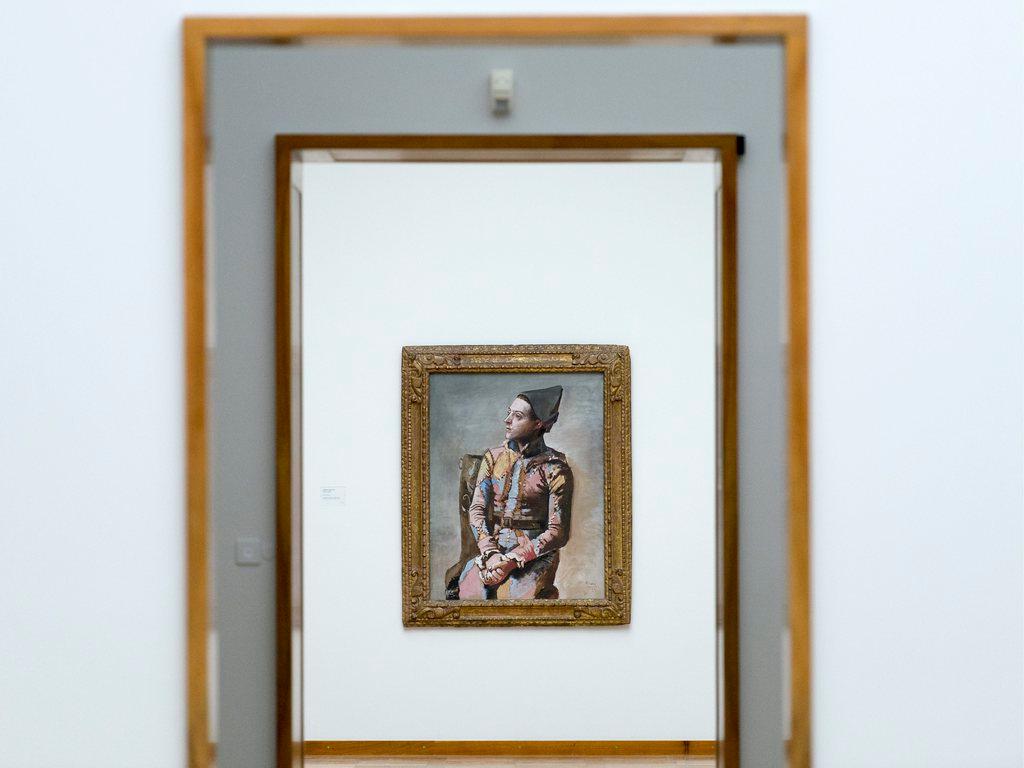
Only a year separates the two artists. Kirchner was born in Aschaffenburg, Germany, in 1880, and Picasso in Málaga, southern Spain, the following year. Both showed early artistic talent, and their parents encouraged them to pursue it. A selection of their childhood drawings are displayed together in one of the museum’s rooms, where the influence of Impressionism can already be seen in their work.
More
The miracle of Picasso in Basel
As their careers progressed, both artists developed distinctly personal visual languages. “Kirchner became highly expressive early on, working with intense, vibrant colours, while Picasso, during his Cubist period, relied on a far more restrained palette,” Beisiegel explained. After the First World War, their approaches converged again, with both turning to flatter, rounder and more organic forms.
The “Kirchner.Picasso” exhibition, which opens in Davos on Sunday, February 15 and runs until May 3, is also a significant art‑historical undertaking, the director said. “Both artists played a crucial role in the development of modern art and had a profound influence on the generations that followed. And now we’re able to show the full scope of their achievements side by side.”
Translated from German by AI/sp
We select the most relevant news for an international audience and use automatic translation tools to translate them into English. A journalist then reviews the translation for clarity and accuracy before publication.
Providing you with automatically translated news gives us the time to write more in-depth articles. The news stories we select have been written and carefully fact-checked by an external editorial team from news agencies such as Bloomberg or Keystone.
If you have any questions about how we work, write to us at english@swissinfo.ch
External Content

In compliance with the JTI standards
More: SWI swissinfo.ch certified by the Journalism Trust Initiative

You can find an overview of ongoing debates with our journalists here . Please join us!
If you want to start a conversation about a topic raised in this article or want to report factual errors, email us at english@swissinfo.ch.