








Nuclear power in Switzerland: ‘The most sensible policy is to keep the existing plants running’

The Swiss government and parliament are unanimous: the ban on building new power stations in Switzerland must be lifted. The final say will rest with the people. But what is the current situation regarding Switzerland’s power stations and the development of this technology? We discuss this with Professor Maurizio Barbato of the University of Applied Sciences and Arts of Southern Switzerland (SUPSI).
Select your language
Generated with artificial intelligence.
Listening:
Nuclear power in Switzerland: ‘The most sensible policy is to keep the existing plants running’
Fifteen years after the Fukushima disaster in Japan, the ban on new nuclear power stations in Switzerland is under greater threat than ever. Parliament has approved the government’s indirect counter-proposal to the popular initiative “Electricity for everyone, at all times”. The aim is to keep the nuclear option open in order to secure the country’s long-term energy supply.
The public – who in 2017 had voted to end nuclear power in Switzerland – will likely have the final say, as the Green Party has announced a referendum. The vote is expected to take place in February 2027.
To understand the current state of this much-debated energy source, we spoke* with Maurizio BarbatoExternal link, director of the Institute of Mechanical Engineering and Materials Technology at SUPSI.
What is the current state of nuclear power stations in Switzerland?

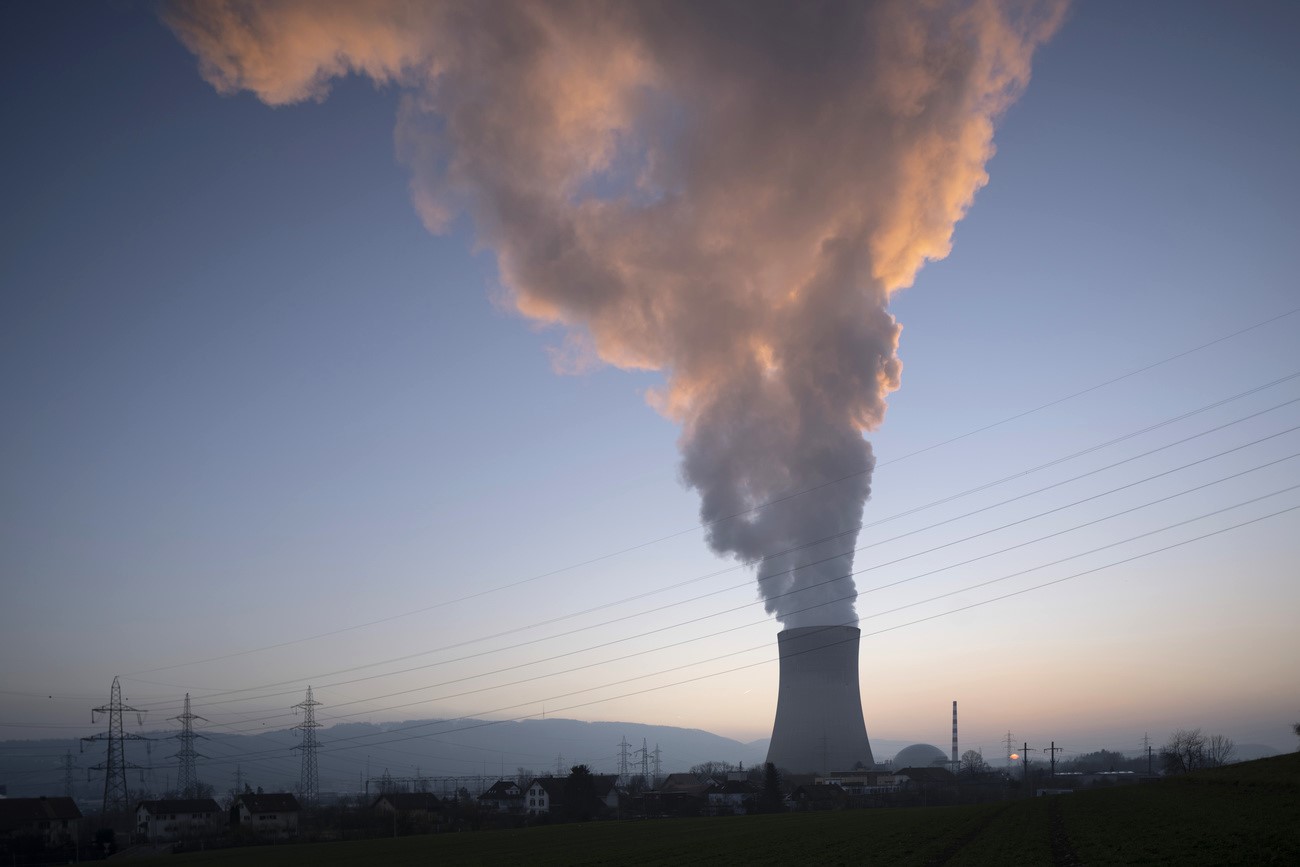
Maurizio Barbato: There are three nuclear power plants and four reactors in Switzerland: Leibstadt, which began commercial operation in 1984; Gösgen, in 1979; and Beznau 1 and 2. Beznau is home to the world’s oldest operating reactor: the first unit went into service in 1969. The safety status of Swiss plants is considered good, thanks in part to regular maintenance and ongoing upgrades. In nuclear power, what matters most is the actual condition of the components, inspections, investments in safety, and the regulatory authority’s ability to impose conditions on plant operations.
Regular maintenance and the presence of independent bodies that verify the condition of the plants and, if necessary, impose restrictions on their operation are fundamental requirements for this technology. From this perspective, we can say that the regulatory system in Switzerland is robust.
How long does it take, both in theory and in practice, to build a nuclear power station from scratch?
If we were to limit ourselves to the engineering work, technically it would be possible to build and connect a new plant to the grid within 5–7 years. Power stations have been built in China within this timeframe. The reality in Europe, however, is different. From the moment the decision is made to build a new plant, one must allow for a timeframe of more than 10 years: there is the design phase, the selection of the site, public acceptance, the entire bureaucratic process, and any potential objections and appeals.
One point must also be emphasised: nuclear power stations cannot be regarded merely as facilities for generating electricity. They are infrastructure designed to last for many decades, even between 60 and 80 years. This is precisely why they require long-term planning.
In Western countries, the total time taken to build them is often between 10 and 15 years, and the most recent European examples, such as Flamanville in France and Olkiluoto in Finland, have taken even longer.
In Switzerland, new nuclear power stations could be integrated into a net-zero emissions electricity system, but under current economic conditions they would not be profitable. This is the conclusion of a recent studyExternal link by the Swiss Federal Institute of Technology Zurich and the Paul Scherrer Institute, which found that new plants would only be competitive if nuclear energy – like renewable energy – were supported by the state and if the state were to assume part of the risks.
Even with new power stations, winter supply will remain a challenge: according to the study, Switzerland will not be able to do without electricity imports. In all the scenarios examined, extensive electricity trade with neighbouring countries would remain a key component of a secure and affordable energy supply.
To address the current challenges of the energy transition, which solution makes the most technical sense: building new power plants or continuing to operate existing ones, as indicated in a recent report by the Swiss government?
The most sensible policy is to keep existing power plants running. Countries that shut them down in a hurry likely acted on gut instinct, without much foresight. If we have sound facilities, let’s keep them running, provided they are constantly monitored and upgraded.
Talking about new construction today means looking ahead to at least 2040. And in the meantime, what do we do? Gösgen and Leibstadt can still have a long life ahead of them; Beznau is a bit older, but even in that case, we can determine how long it can operate. In my opinion, at this stage, if properly monitored, the current power plants can help us with the energy transition.
People often refer to “third-generation-plus” nuclear power: what does that mean, and what examples do we have in Europe?
Third-generation nuclear power is an evolution of earlier reactors. The technology remains based on fission, but compared to the second generation, significant progress has been made in safety, the standardisation of certain components, and the plants’ ability to respond even under critical conditions.
The third-generation-plus further strengthens these aspects. The goal is to reduce reliance on human intervention in emergency situations as much as possible and to increase the plant’s ability to contain any accidents.
In Europe, the best-known examples are Flamanville in France, and Olkiluoto in Finland. Both are EPRs, or European Pressurised Reactors. These plants have two separate circuits: one connected to the reactor core and one where heat is converted into steam to produce mechanical energy and then electricity.
These projects clearly demonstrate both the potential and the challenges of the new European nuclear sector. On the one hand, they offer high safety standards; on the other, they have required many years of design, construction, and commissioning, partly because they are complex plants and, in some respects, new to the European industrial sector.
There are other examples of advanced reactors in Russia and China as well, all sharing the goal of making systems safer and more standardised.
There is also talk of fourth-generation nuclear power. What are its characteristics, and how far along are we in its deployment?
The term ‘fourth generation’ refers to a family of technologies still in the development, demonstration, or prototype phase. It does not encompass a single type of reactor. For example, there are liquid-metal-cooled reactors using sodium or lead, gas-cooled reactors, molten-salt reactors, and supercritical-water reactors, all of which share, among other things, very high operating temperatures.
The idea is to have more efficient plants capable of using fuel more effectively and, in some cases, reducing some of the most problematic radioactive waste. This does not, however, mean eliminating waste entirely: the issue of radioactive waste management would still remain.
One of the most interesting aspects concerns temperatures. Fourth-generation reactors, operating at higher temperatures than current power plants, would not only allow for more efficient electricity production but also provide heat for industrial uses, such as chemical processes and hydrogen production.
At the moment, however, we are still far from large-scale commercial deployment. Some projects could reach the industrial demonstration phase in the coming years, but it would be premature to speak of true commercialisation before the mid-2030s.
More
Why climate change and wars are reviving interest in nuclear energy
Nuclear power does not produce greenhouse gases, but the issue of radioactive waste is a significant concern. What solutions are in place in Switzerland for managing this waste, and has a permanent solution been found?
In Switzerland today, there is the Zwilag interim storage facility in the canton of Aargau. It is used to store spent fuel and radioactive waste of various categories, originating from nuclear power plants as well as from medicine, industry, and research. It is a temporary solution, pending the development of a deep geological repository.
NAGRA, the company tasked with identifying a suitable location, has proposed the Nördlich Lägern site in northern Switzerland. The permitting process is still underway, and the final decision will also involve political approval, with the possibility of a referendum.
Internationally, the most advanced project is Onkalo in Finland. It is a deep geological repository designed to isolate spent fuel for extremely long periods. The containers are placed at a depth of over 400 meters, within a stable rock formation, with multiple protective barriers: the metal container, bentonite clay, and the rock itself.
* The interview was first published on the SUPSI websiteExternal link on June 9, 2026.
More


In compliance with the JTI standards
More: SWI swissinfo.ch certified by the Journalism Trust Initiative

You can find an overview of ongoing debates with our journalists here . Please join us!
If you want to start a conversation about a topic raised in this article or want to report factual errors, email us at english@swissinfo.ch.