








Shooting in Switzerland: when a tradition leaves its mark

Shooting is one of Switzerland’s most deeply rooted traditions. For generations, shooting ranges have been an integral part of Swiss municipalities, almost on a par with churches and schools. Today, many disused shooting ranges have left behind a costly legacy: thousands of contaminated sites that need to be dealt with.
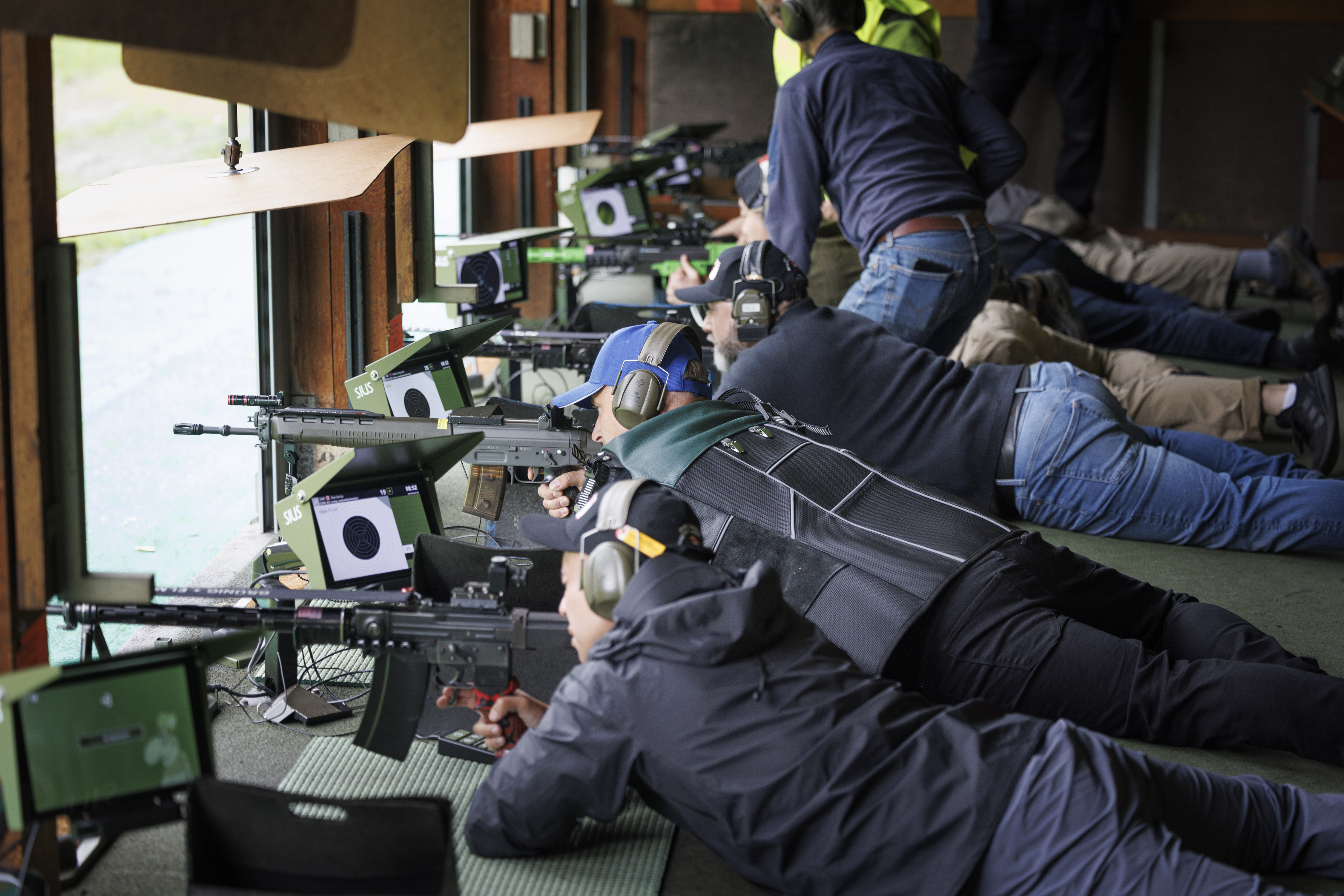
Sunday afternoon. Everyone is ready at the shooting range. The first shots break the silence and echo among the surrounding mountains. In a tunnel, sheltered by an earth embankment, a few youngsters lower the targets, look for the bullet hole, mark it with a sticker and raise the targets again, pointing out the point of impact to the shooter with a small paddle. It is the 1990s, in Valposchiavo, an Italian-speaking valley in Graubünden, southeastern Switzerland.
Back then, it was customary to attend the 10am mass. At 1pm everyone would meet at the shooting range. As in many Swiss villages, Sundays were devoted to prayer and the defence of the country. The adults practised shooting, just as they had learnt during their military service. Those too young to handle a rifle kept score, earning a few francs, which they might spend on filling up the moped on which they whizzed about the valley’s roads.
A tradition unique in Europe
That Sunday gathering was not just a pastime. “Shooting is deeply rooted in Swiss history,” explains historian Cedric Zbinden. “The strength of this tradition lies in its two facets: on the one hand, there are the shooting clubs, which serve as meeting places and centres of social life. On the other, there is the militia, which for decades supported this practice and helped to establish it in almost every corner of the country.”
More
Keeping a Swiss shooting tradition alive abroad
The Swiss tradition is unique in Europe. “Shooting clubs also exist in Germany, the Netherlands and Austria, but in none of these countries do they have the same deep-rooted social presence,” Zbinden points out. In Germany, for example, after the Second World War the Allies banned both shooting clubs and the possession of firearms. It was only after the establishment of the Federal Republic that they were authorised once again.
“In the Netherlands,” continues Zbinden, the research assistant at the Swiss Shooting Museum, “clubs are less widespread and gun legislation is more restrictive: shooting is therefore not such a deeply rooted custom”.
The citizen-soldier
In 1848, with the establishment of the federal state and compulsory military service, shooting took on great importance in Swiss society.
“Three of the first seven Federal Councillors had been presidents of the then Swiss Riflemen’s Society, founded in 1824,” Zbinden says. “For a long time, that position was one of the most prestigious in the country.”
The obligation to practise shooting outside military service, however, dates back to 1874. At the start of the 20th century, the Federal Military Department stipulated that every soldier must be an active member of a shooting club.
“From that moment on, shooting was no longer merely a pastime and a social activity but became an integral part of military training – a link that, in this form, lasted for almost a century and was reinforced by the sense of threat that hung over the Swiss population during the two world wars,” Zbinden says.

People are still shooting, but less and less
In 1986, membership of shooting clubs peaked at almost 590,000, just under a tenth of the Swiss population. From the 1970s and 1980s onwards, the almost unshakeable image of the citizen-soldier began to show its first cracks.
“With the end of the Cold War, many people no longer saw shooting as an integral part of national defence,” Zbinden says. This shift in society was also reflected in the membership figures of shooting clubs.
Following the government’s decision in 1996 to abolish the compulsory membership of a shooting club, the number of active members has been steadily declining. In 1997, there were just under 230,000; last year, the figure stood at around 130,000, spread across some 2,500 clubs affiliated to the Swiss Shooting Sports Federation.
According to Zbinden, this trend also reflects changing leisure habits, particularly among the younger generations, and, more generally, the decline in the central role played by club activities in everyday life.
Unwanted and costly legacy
Over time, shooting ranges were built almost everywhere in Switzerland. With social changes and new legal requirements regarding safety, noise emissions and environmental protection, many ranges have been decommissioned. This has also been the case in Valposchiavo, where, until the mid-1990s, there were four ranges for 300-metre shooting. As with many Swiss municipalities, this widespread network of shooting ranges has become a costly and unwanted legacy for the municipality of Poschiavo.
The main problem lies with the bullet traps and the surrounding land. Decades of shooting activity have left heavy metals in the soil, mainly lead and, to a lesser extent, antimony.
“The potential for contamination can run to several tonnes per site,” explains Lars Schudel, a geographer and project manager specialising in contaminated sites at Ecosens. “Remediating these sites is a complex and financially burdensome operation: for a single shooting range, the costs can run to several hundred thousand francs.”

What does this mean in practical terms? The remediation of a site in the municipality of Poschiavo cost around CHF430,000 ($530,000), of which CHF290,000 was covered by the canton and the government. The remaining CHF140,000 was borne by the municipal coffers.
“The remediation work consists primarily of removing the contaminated soil,” Schudel explains. “The soil is removed in layers until the concentrations of lead and antimony fall within the prescribed limits. The objective of the remediation varies depending on soil protection requirements, proximity to groundwater, watercourses or other sensitive features, as well as the intended use of the site after remediation.”
According to the cantonal registers of contaminated sites, around 4,000 areas where shooting took place in the past are contaminated. By 2025, 1,200 sites had been remediated. Work must be completed by the end of 2045, not least because federal subsidies for remediation will then expire.
In Poschiavo, those Sunday afternoon gunshots no longer echo through the mountains. Their echo remains in the ground and tells the other side of a quintessentially Swiss tradition: an environmental problem.
Reviving a centuries-old tradition
To attract new recruits, the Swiss Shooting Federation is seeking to revitalise the sport of shooting. It is focusing on more dynamic formats, such as the Target Sprint: a combination of a medium-distance run, usually 400 metres, and rapid-fire shooting with an air rifle. According to the government, this discipline can make shooting more appealing to children, teenagers and young adults.
The federation has also launched the Swiss Shooting Roadshow: a trailer equipped with four laser ranges which visited ten Swiss cities in 2024 and 2025. In busy public spaces, young people and adults were able to try their hand at sport shooting in a safe environment, without live ammunition and under the guidance of experts.
Edited by Zeno Zoccatelli. Translated from Italian, sub-edited by ts
More


In compliance with the JTI standards
More: SWI swissinfo.ch certified by the Journalism Trust Initiative

You can find an overview of ongoing debates with our journalists here . Please join us!
If you want to start a conversation about a topic raised in this article or want to report factual errors, email us at english@swissinfo.ch.