








Explainer: Why Europe is bringing back conscription

Europe’s shortage of professional soldiers, amid mounting concerns over Russian military ambitions, is forcing countries to revisit the idea of conscription. Switzerland is no exception, with debate intensifying ahead of a key vote on civic duty.
Select your language
Generated with artificial intelligence.
Listening:
Explainer: Why Europe is bringing back conscription

The Russian threat to Europe is at its highest level since the Cold War. Russian drones and airplanes have repeatedly violated the airspace of members of NATO, forcing the military defence alliance to scramble fighter jets in response.
Despite Moscow’s denials, European intelligence agencies also warn of increasing Russian-led espionage, cyberattacks and sabotage targeting critical infrastructure.
Governments across Europe have responded by ramping up spending on weapons. The real struggle, though, is finding enough soldiers to wield them, prompting some nations to turn to conscription or at least consider the possibility.
Here’s an overview of how various European countries have responded and what’s at stake in the next Swiss vote on conscription.
External Content
How did Europe move from disarmament to rearmament?
It’s a remarkable reversal after decades of decline in European soldiering.
After the end of the Cold War, apparent changes in security needs prompted many European countries to curb military spending and end conscription. In a European Organisation of Military Associations (EUROMIL) surveyExternal link of member associations from 15 nations, overall troop numbers were reduced in around two-thirds of countries. The cuts for all survey respondents averaged 16% between 2010 and 2020.
Those declines started during a period when European nations felt secure enough following the collapse of communism in Russia and Eastern Europe to scale back military spending and redirect funds towards public services and social welfare, a benefit to citizens that became known as the peace dividend.
But faced again with Russian aggression, beginning with its 2014 invasion of Ukraine and annexation of Crimea, countries such as Lithuania (in 2015), Sweden (in 2018) and Latvia have restored or expanded conscription.
US pressure for Europe to fund more of its own defence has added momentum. At a summit in June, NATO re-emphasised its push to expand armed forces by setting a goal for member states to boost defence spending to 5% of economic output by 2035. Europe would require at least 300,000 more troops without US support, estimate the Brussels-based Bruegel research institute and the Kiel Institute for the World Economy.
The European Parliament’s research arm wroteExternal link that conscription has once again become an important option for boosting numbers and strengthening military readiness.
Which countries have revived conscription recently?
Croatia, Germany and Denmark are already adapting recruitment policies. Switzerland, which has maintained conscription since the modern federal state was founded in the 19th century, is debating whether to limit citizens’ ability to opt for civilian service rather than the military.
In October, Croatia’s parliament voted to revive compulsory service after a gap of 17 years. The new law requires men who turn 18 to undergo medical evaluations by year-end, with two months of basic training scheduled from next year. The country will seek to enlist about 18,000 men annually. Conscientious objectors may opt for civilian service instead, while women remain exempt.
More
Drafting women into the army the Norwegian way
Germany starts a new military service model next year combining voluntary enlistment with the option to trigger compulsory service if volunteer targets are not met. All 18-year-old men will be required to complete a questionnaire covering their skills, health and willingness to serve. Germany aims to increase its armed forces by 80,000 troops to a total of 260,000 by 2035 to meet NATO commitments.
Denmark began including women in the military this summer, equalising requirements for all those aged 18.
The trend of shrinking militaries goes beyond the European Union. The British Army is predicted to dip below 70,000 personnel for the first time since the early 1800s. Australia relaxed its recruitment standards in 2024 to attract more volunteers, including eligible foreign nationals.
Demographic shifts are creating further challenges. In South Korea, a plummeting birth rate has slashed military ranks by 110,000 over six years, sparking debate about conscripting women. Japan’s Self-Defense Forces have a deficit of about 23,000 personnel out of 247,000 authorised posts, with 2023 seeing recruitment at just 51% of the target, the lowest on record.
Ukraine, now in its fourth year of war, faces acute shortages, expanding eligibility to those over 60. Russian casualties have reportedly surpassed one million, highlighting the immense challenge of maintaining troop levels while conducting its invasion.
Is Switzerland’s conscription system as secure as it looks?
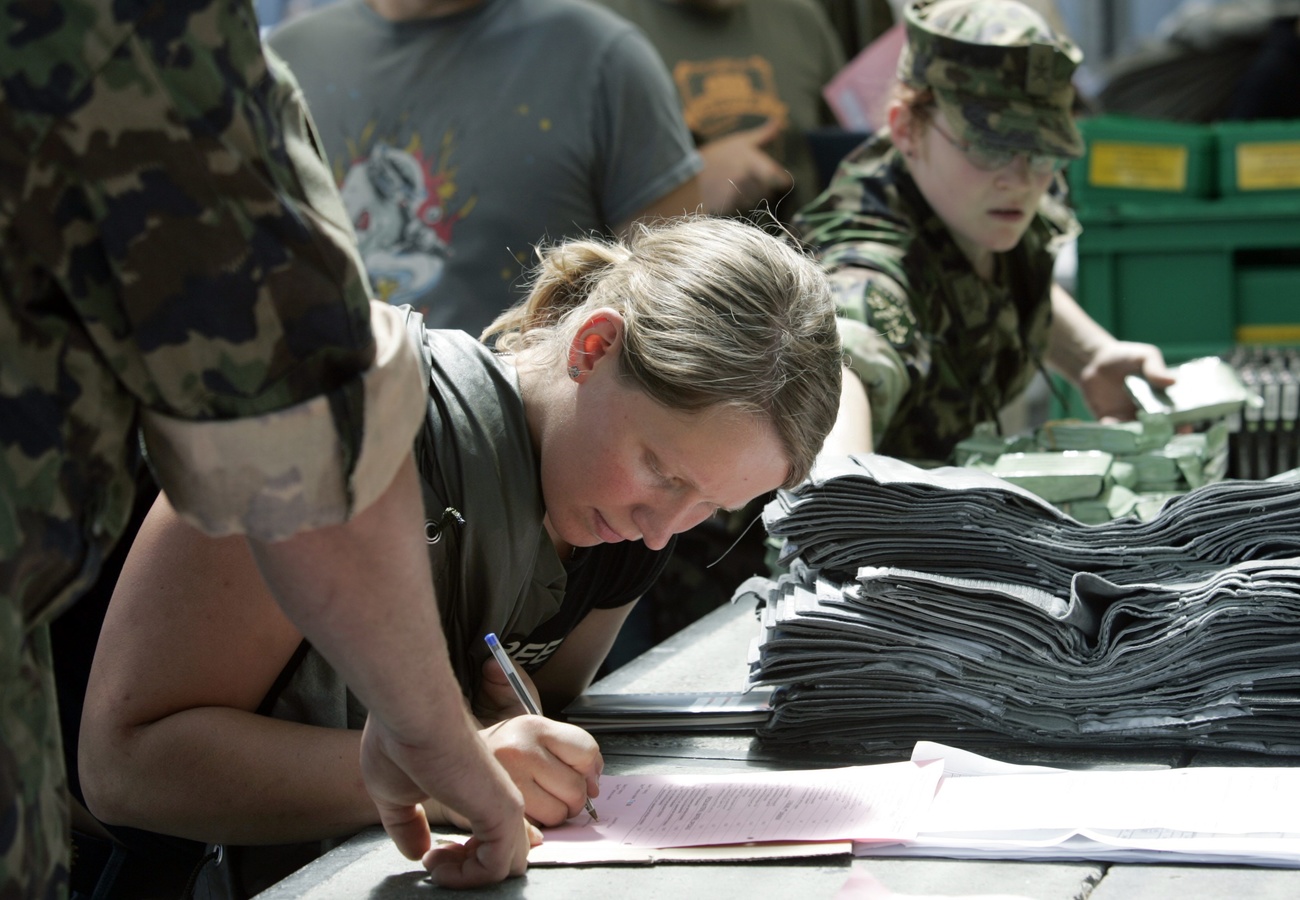
Switzerland has maintained conscription since the creation of its 1848 federal constitution. All adult men are required to serve, completing about five months of recruit school followed by periodic refresher courses until around the age of 35. Women can serve if they want to.
The Swiss Armed Forces target a strength of 100,000, with an “effective strength” – including those who are in training or still liable for mobilisation – legally capped at 140,000. In 2024 the actual number reached nearly 147,000, an “oversupply”, according to the defence ministry. Yet the ministry also warns of an impending drop.
Following a cut in the service obligation from 12 to ten years in 2018, effective strength is estimated to fall below the maximum after 2028 and may not recover until the mid-2030s.
External Content
How does today’s draft model work?
Modern service is a different beast from the military drafts of old. Most European governments now favour selective or lottery-based systems that combine volunteer enlistment with limited conscription. In Sweden and Lithuania, only a small proportion of eligible youth are called up each year.
All EU member states with active conscription recognise the rights of conscientious objectors and offer the option to enrol in alternative service, usually civil or unarmed, according to European Parliament researchers.
Switzerland also has its civilian service, which allows objectors to deploy in areas such as social welfare, education or environmental protection. Though longer than military service, it is considered an equivalent civic contribution.
>>Read more about the Swiss militia system:

More
How the Swiss militia system strengthens civic identity – and favours the privileged
However, the number of Swiss youth choosing civil service has increased, prompting fears of declining military participation. The government and parliament are now advancing reforms to restrict such transitions.
External Content
Is conscription less effective than a professional army?
While conscription can quickly bolster troop numbers, professional armies are generally better trained and more politically acceptable in democracies. Supporters of conscription argue that compulsory service offers benefits beyond the battlefield, helping to strengthen social cohesion and reinforce national resilience.
However, political scientist Julian Rossmann of the University of Vienna says conscription is the wrong answer. “The debate on conscription highlights a worrying pattern in modern European politics: the responsibility for social challenges is always being shifted onto younger generations,” he told Swissinfo.
Critics also warn that removing working-age citizens from the labour market could slow growth in already ageing societies. With public debt mounting and bond yields climbing, additional defence spending in the face of social welfare cuts is politically sensitive.
Germany’s ifo Institute estimatesExternal link that reintroducing conscription could see tens of billions of euros of economic losses for the country. Its study suggests that increasing volunteer enlistment through higher salaries would be more cost-effective.
But failing to maintain adequate armed forces carries its own risks. Weak European defences could embolden Russian ambitions, threatening stability in Eastern Europe and beyond, and undermine NATO’s collective security.
Alongside the revival of conscription, the EU is working to boost defence capabilities across the bloc. The European Commission has proposed “flagship” projects aimed at enhancing drone defence, border monitoring, and coordinated procurement, signalling a broader effort to build an integrated, collective European defence system. Ukraine’s innovative use of low-cost drones has also inspired parts of this shift. Today, modern warfare increasingly prizes mobility and disruptive power over sheer troop numbers.
Should all Swiss citizens be required to serve?
On November 30, Swiss voters will decide whether national service should be required for all citizens, military or civil, regardless of gender. The government and parliament recommend rejecting the initiative, citing enormous financial costs.
>>Read more about the upcoming Swiss vote on the civic duty initiative:

More
Explainer: the upcoming Swiss vote on compulsory civic duty for all
Edited by Tony Barrett/vm/ts

In compliance with the JTI standards
More: SWI swissinfo.ch certified by the Journalism Trust Initiative

You can find an overview of ongoing debates with our journalists here . Please join us!
If you want to start a conversation about a topic raised in this article or want to report factual errors, email us at english@swissinfo.ch.