








Artificial intelligence in Switzerland: what’s new in 2026

Improvements to Swiss AI model Apertus, generative AI in hospitals and prioritising technological sovereignty: in 2026, artificial intelligence will continue to transform Switzerland.
Select your language
Generated with artificial intelligence.
Listening:
Artificial intelligence in Switzerland: what’s new in 2026

In the new year, generative AI will spread into new domains in Switzerland, from hospitals and public institutions to small- and medium-sized businesses. The government will attempt to limit the risks of algorithmic discrimination. And as more nations reach for technological sovereignty, Switzerland could act as a mediator for international discussions on the governance of artificial intelligence.
We talk with Thilo Stadelmann, professor of AI and machine learning at the Zurich University of Applied Sciences, to get an idea of five big developments coming to the field of AI in Switzerland in 2026.
1. An AI model ‘made in Switzerland’ closer to users
The biggest story about AI in Switzerland in 2025 was Apertus – the country’s first large, multilingual, fully open-source public language model (LLM), which was launched in September.

More
Fact and fiction about the Swiss AI model Apertus
The LLM was developed as part of the Swiss AI Initiative, financed by the Swiss government to the tune of CHF20 million until 2028. It will remain in the spotlight in 2026 with technical improvements and new concrete applications.
“For the first time, AI is truly open, from training scripts to every single token [fragments of words], and this not only strengthens open source but also allows thousands of engineers in Switzerland to learn how to build basic AI models, a skill that has so far only been accessible to a few labs in the US and China,” Stadelmann says.
Designed primarily for companies and research centres, Apertus has already exceeded one million downloads since launch. In 2026, the development team will focus on the most relevant user features. “We want to create an entire ecosystem around Apertus – that’s what will have a really profound impact,” explains Alexander Ilic, head of the Centre for AI at the Swiss Federal Institute of Technology Zurich (ETHZ).
According to Stadelmann, however, the biggest economic impact of AI in Switzerland will come not so much from the big flagship projects, but from the hundreds of initiatives involving small- and medium-sized companies and research institutes that rarely make headlines. Stadelmann mentions a Zurich startup that wants to use AI for livestreaming cultural events – a sort of ‘Netflix of the performing arts’ that, if successful, could give rise to a new Swiss media platform. “It is projects like these that have the greatest potential for creating value and jobs,” he says.
2. Swiss hospitals test generative AI with patients
In 2026, the focus of the Swiss AI Initiative will also shift to specialised models, using Apertus as a base, particularly in the medical field. In May, the Lausanne University Hospital (CHUV) will begin testing Meditron, a Swiss medical LLM designed to support healthcare staff in clinical decision-making, starting in the emergency room.
More than 300 health professionals evaluated Meditron in 2025 using hypothetical clinical cases. “This participation says a lot about the strong interest in this technology, but also about the scepticism towards the results it provides,” explains Noémie Blanco Boillat, a doctor and researcher collaborating with the Biomedical Data Science Center, which coordinates AI implementation projects at CHUV.
According to Mary-Anne Hartley, a professor at the Swiss Federal Institute of Technology in Lausanne (EPFL) and project coordinator for Meditron, many commercial LLMs used in medicine have proven to be unreliable because, for privacy reasons, they cannot be trained with sensitive patient data. Yet more than 70% of doctors in countries involved in the Meditron project said they already use tools such as ChatGPT in clinical practice.
The main advantage of open-source models is that they can be tailored to hospitals’ specific needs and run locally, allowing the use of sensitive patient data without sending it to external servers. “Open models allow us to provide much more contextual information and increase the quality of responses without violating privacy,” Hartley says.
3. Technological sovereignty at the heart of the agenda
Technological sovereignty moved from niche topic to political priority in Switzerland and Europe in 2025, driven by an increasingly unstable geopolitical environment and the unpredictability of the Trump administration in the United States.
“The government has recognised that it is not a good idea to depend on other countries for the operation of basic infrastructure,” Stadelmann says, referring to the fact that most digital tools are operated by companies based in other countries.
In 2026, the Swiss government will workExternal link to identify security and foreign policy risks and propose safety measures. Meanwhile, the federal administration will have to follow new guidelinesExternal link to reduce dependence on individual suppliers (often from the US) and work to strengthen control over digital infrastructure and data.

More
Switzerland’s uphill climb to AI sovereignty
Projects such as Apertus fit into this long-term strategy, but clear contradictions remain. “On the one hand we talk about technological sovereignty, on the other hand we continue to rely on a few large foreign players,” Stadelmann says.
Over the next two years, the Swiss government will spend CHF 140 million renewing Microsoft licences. A change of supplier is considered ‘too risky and costly’External link, but the government is evaluating better alternatives.
4. More safeguards against AI discrimination
After some hesitation about the approach, Switzerland has decided not to pursue a general AI law similar to the EU’s AI Act, which imposes strict requirements on high-risk AI systems that could harm individuals. Instead, the government will ratify the Council of Europe’s AI Convention and adapt national law accordingly. By the end of 2026External link, authorities will develop measures, binding and non-binding, in sensitive areas such as healthcare and autonomous transport.

More
AI-driven discrimination: protection in Switzerland is weak
With the increasing use of AI in areas such as recruitment or access to credit, the risk of algorithmic discrimination is increasing. This happens when AI models produce biased or unfair outcomes that systematically disadvantage certain individuals or groups. In the coming year, Switzerland is committed to doing more to protect the Swiss population from AI discrimination, Interior Minister Elisabeth Baume-Schneider told Swissinfo.
Stadelmann believes that every innovation that brings about major changes in society should be regulated. However, he believes that laws should regulate business models above all. “The biggest risk to society is not the technology itself, but the profit models that use AI to maximise attention and create addiction. We already see the consequences on young people,” he says, referring to the effects of social media using AI algorithms to keep young people hooked on their platforms.
5. Working towards the AI Summit in Geneva in 2027
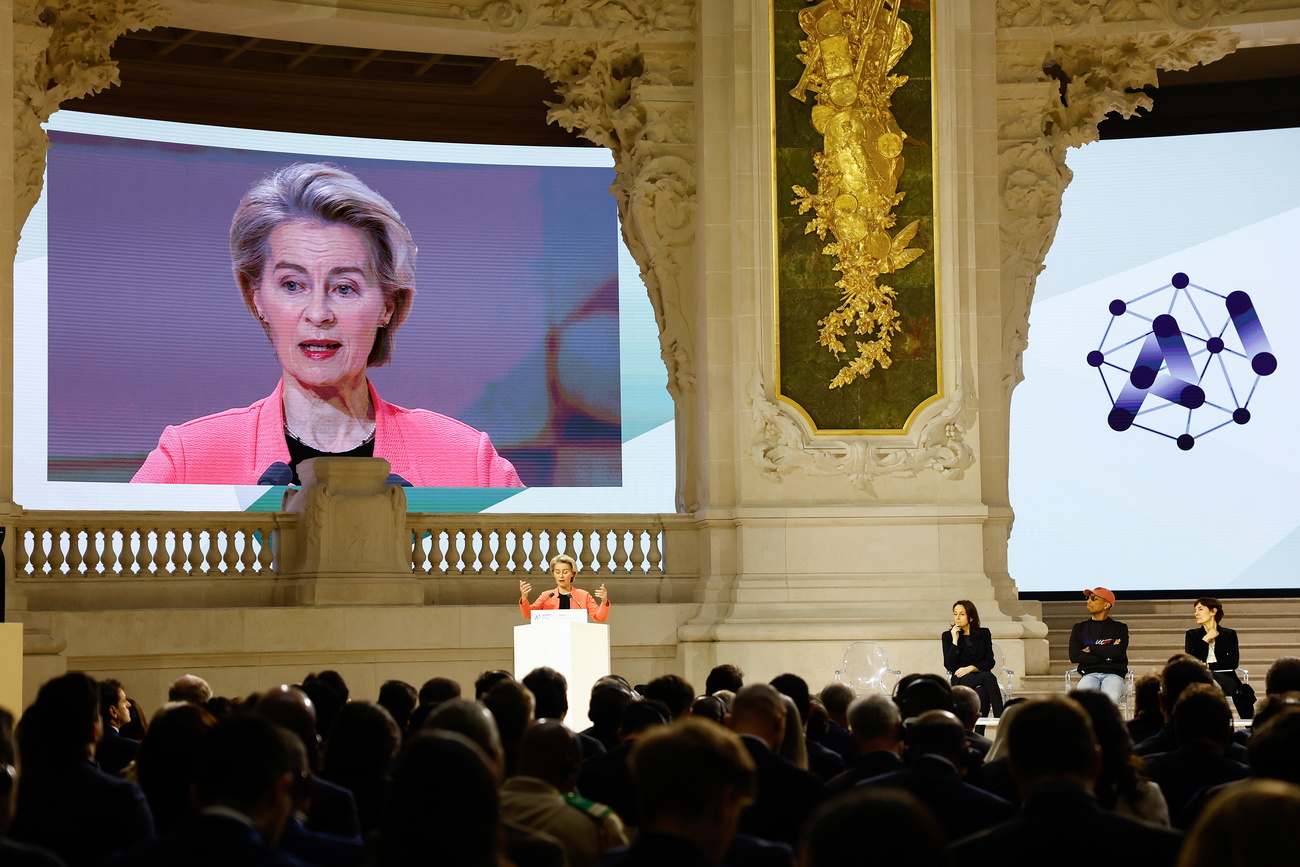
In 2027, Switzerland will host the global AI Action Summit in GenevaExternal link, an event that reinforces the country’s ambition to position itself as a leader in the field of technology governance. The choice of host city is no coincidence: Geneva is home to numerous international organisations and has long been a global mediation centre. “I’m persuaded that Switzerland must show how it can contribute to the world,” cabinet minister Albert Rösti said when proposing the AI summit in Geneva.
Preparatory work will begin in early 2026, when the costs will also be announced. In the meantime, Switzerland is already cooperating with India on the 2026 summit in New Delhi in late February.
More
Switzerland risks exclusion from Europe’s ‘CERN for AI’
For Stadelmann, the Geneva summit is an opportunity to go beyond technical regulation and promote a global framework that focuses on the preservation of human dignity, autonomy and quality social connections in the AI era. “Thanks to its neutrality and humanitarian tradition, Switzerland could bring together different actors, just as happened with the Geneva Conventions,” he concludes.
Edited by Gabe Bullard/ac

In compliance with the JTI standards
More: SWI swissinfo.ch certified by the Journalism Trust Initiative

You can find an overview of ongoing debates with our journalists here . Please join us!
If you want to start a conversation about a topic raised in this article or want to report factual errors, email us at english@swissinfo.ch.