








As UN jobs disappear, foreign graduates struggle to stay in Geneva

Geneva’s standing as a multilateral hub is being tested as budget cuts reduce employment prospects for international students pursuing careers in the humanitarian sector in the city. For students who come from around the world to study here, the door is quietly closing.
Select your language
Generated with artificial intelligence.
Listening:
As UN jobs disappear, foreign graduates struggle to stay in Geneva
Over the past year, the United Nations and international organisations with a special status in Geneva have lost about 3,500 jobs as they restructure and face funding cuts from major contributors. This represents a 13-15% reduction of their staff in the city, according to Yannick Roulin, executive director of the Geneva International Welcome Centre (CAGI). Just in November the International Labour Organization (ILO) said it was considering relocating its headquarters. The same month UNICEF said most of its workforce was moving to Rome.
At the forefront of those cuts are non-EU graduates, who cannot stay in Switzerland without a work permit. For many of those students, UN institutions were the only job market realistically open to them; their main motivation for studying in Geneva was often the hope of starting their career in the UN system.
Many schools in Geneva cater to this demand such as the Graduate Institute, the University of Geneva, the International Institute, the Geneva School of Diplomacy or the Geneva Academy. They offer courses in international relations, advocacy, diplomacy, international law and human rights, or humanitarian action.
At the International Institute in Geneva, which offers BA courses in International Relations and Communication among others, non-EU students represent 30-40% of the student body, according to the president, Eric Willumsen. For them, in Geneva “outside the UN system, job options are very rare”, he says. Under Swiss law, private employers must first prove they were unable to hire a Swiss or EU candidate – a process most employers avoid entirely.
Julia Pion Da Rocha Paranhos, a psychologist and counsellor at the University of Geneva’s career centre, feels the impact of the UN budget cuts in daily conversations with students. She describes rising anxiety, shrinking entry-level opportunities, and non-EU graduates’ frustration at receiving either no responses or no offers at all.
The numbers behind the struggle
Data from Adrien Guillod, a statistician at the University of Geneva (UNIGE), shows just how wide the aspiration-to-reality gap already was, even before the budget cuts. In the first semester of 2025, the university had 3,211 students from third countries, accounting for 17.7% of the total student body.
According to surveys he conducted between 2018 and 2024, 83% of non-EU Master’s graduates of the UNIGE wanted to remain in Geneva after completing their degree, but one year later, only 26.8% succeeded – excluding students with long-term permits and those who remain as PhD candidates or postdocs.
A 2019 Swiss-wide study by the business federation economiesuisse was even more conservative, estimating that only 15% of third-country students remain in Switzerland after their studies.

More
Ripple effect of aid freeze becomes real in Geneva
A recent study showed that graduates of Swiss universities are valued in the job market around the world, with Geneva University ranked in the top 250 universities for the employability of its graduates. But Switzerland still struggles to retain a significant share of those who would like to stay and work in the country.
Switzerland’s rules favouring Swiss and EU/EFTA citizens on the job market make it much harder for non-EU graduates to find a job in the six months they are allowed to stay in the country after their studies. Countries such as Germany, France, Belgium, Spain, Austria or the Netherlands now offer dedicated post-study residence permits that allow non-EU graduates to stay for 12 to 24 months to look for work or start a business, often without the same level of labour-market hurdles.

Getting married for a permit
David*, a British graduate of the Graduate Institute, which specialises in international affairs and development, is still looking for a humanitarian job in Geneva two years after graduating. “Since last year’s budget cuts to the UN, there are a lot of candidates and very few positions available,” he says.
His six months UN internship paid CHF1,000 ($1,260) a month, in a city where the legal minimum salary is CHF4,200. After a short-term consultancy contract with the UN, he has still been unable to secure a job in Geneva. Many of his non-EU friends, he says, eventually left the country. Ultimately, David stayed in Switzerland only because he married his partner, an EU citizen living in Geneva. “We did it discreetly, just so I could stay,” he says.
Jessica, a Mexican student of international law, recalls a teacher telling her: “If you are not European, the only way you can stay here is to marry someone.”
She says the system is structurally stacked against students from outside Europe. “If your family cannot support you, it’s impossible to stay. People who manage are usually from privileged backgrounds.” Her UN internship paid CHF1,200, not enough to live on. After her consultancy contract was not renewed due to budget cuts, she was forced to leave Switzerland.
Listen to our Inside Geneva episode on the impact of UN budget cuts on humanitarian aid
More
Inside Geneva: women, girls and cuts to humanitarian aid
Internships and unpaid roles
At the Geneva Academy of International Humanitarian Law and Human Rights, the coordinator of professionalising activities, Gregory Pasche, notes that students are “definitely more worried than before”. Many extend their permits after graduating, relying on a patchwork of post-graduation internships or the UN Volunteers scheme – which offers only a limited living stipend. “The financial realities of living in Geneva come into play,” Pasche says. “Many eventually have to return home.”
Despite the turbulence, Willumsen from the International Institute in Geneva, remains confident that internships will continue to lead to entry-level jobs. In this spirit, the Institute has developed partnerships with UN bodies and NGOs linked to the UN to place students as interns. For non-EU students, who would struggle to get hired elsewhere, the stakes of these internships are high.
But Pasche warns that internships rarely directly translate into employment at the UN. “In the UN system, internships often do not count fully towards work experience,” he explains, “meaning graduates must often leave Geneva, gain the required professional background elsewhere, and only then return with a profile deemed eligible for hiring.”
David agrees. “Geneva is not a place to start a career”, he says. “It was never easy to find an entry-level job here, but it is becoming near impossible.” The British national is now looking to leave Geneva for opportunities elsewhere with the hope he can return one day and settle in the city.
*name has been changed.
Edited by Virginie Mangin/ts
More
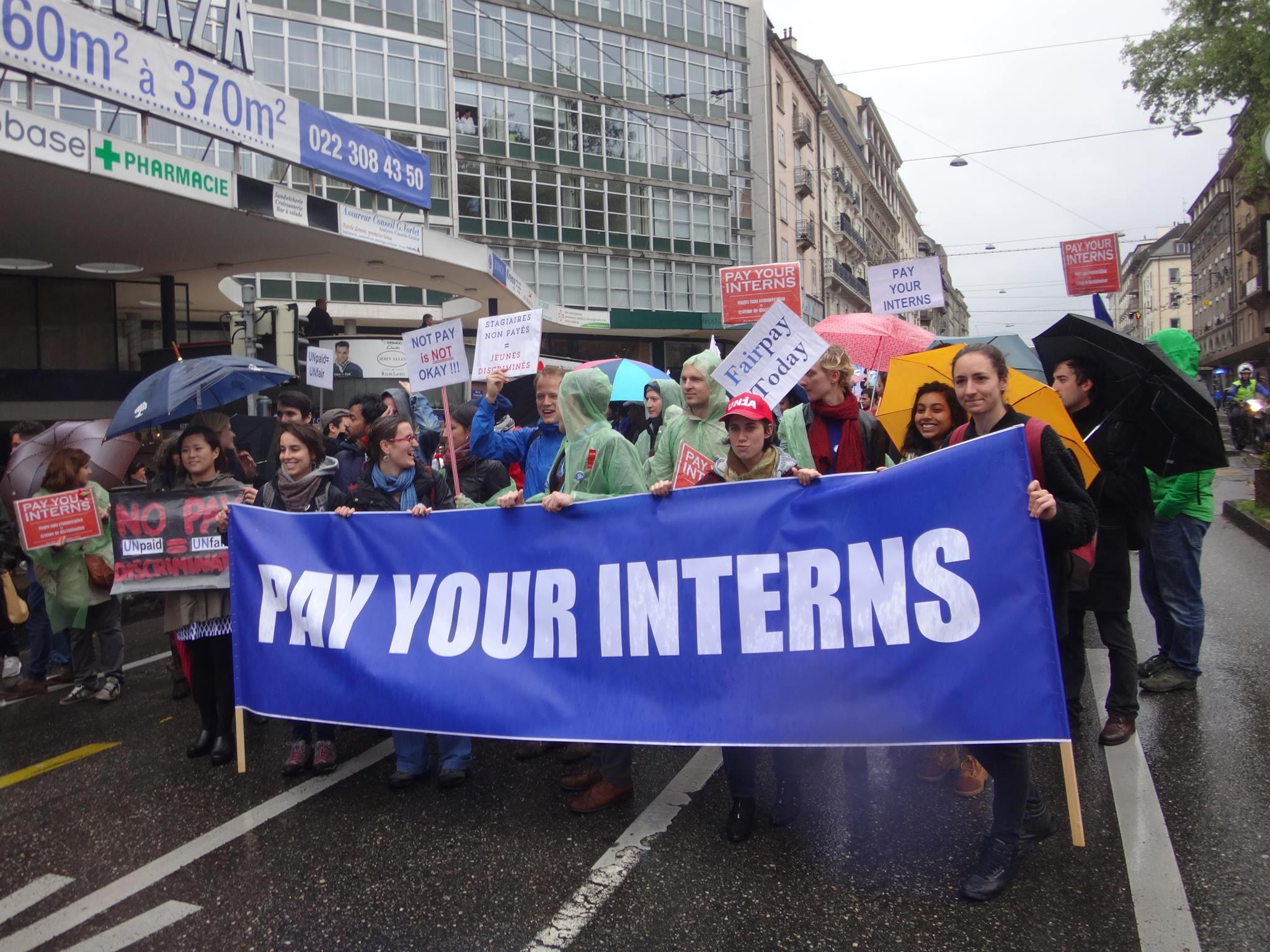
Interns face uphill struggle in Geneva

In compliance with the JTI standards
More: SWI swissinfo.ch certified by the Journalism Trust Initiative

You can find an overview of ongoing debates with our journalists here . Please join us!
If you want to start a conversation about a topic raised in this article or want to report factual errors, email us at english@swissinfo.ch.