








Can the UN survive?

The world held its breath this weekend, as the United States and Iran met in Islamabad in what were billed as “peace” talks aimed at ending a conflict which threatens to inflict pain and economic hardship on all of us.

But those of us who covered the lengthy and painstaking negotiations of the JCPOA (the agreement hammered out in 2015 by the EU, the US, Russia, and Iran, with backing by the United Nations, to limit Tehran’s nuclear ambitions) may not be entirely surprised by the lack of any result. I was personally somewhat amused to see US media calling the meeting in Islamabad a “marathon”, with Vice-President JD Vance complaining “we’ve been at it 21 hours”. This speaks to a vast lack of experience and understanding about how such agreements are reached. They are complicated, subtle, and it’s very possible the current US administration does not understand this.
The JCPOA was the result of years of negotiations, with patient, experienced diplomats investing huge amounts of time on them. When it was finally concluded, as with most such agreements, no one got absolutely everything they wanted, but Iran agreed to reduce its nuclear centrifuges by two-thirds, cap uranium enrichment at 3.67%, and convert or close certain facilities. Iran agreed to inspections by the International Atomic Energy Agency to confirm this. For their part, the UN, US, and European Union agreed to lift some economic sanctions on Iran.
In 2018, during his first term, Donald Trump abandoned the JCPOA, despite entreaties from his counterparts in Europe not to leave a deal most analysts said was working. The agreement fell apart. Iran saw less and less reason to comply, and hawks in America and Israel – it seems the “no more foreign wars” US President is a hawk as well – have chosen the military option, which has so far been spectacularly unsuccessful, and enormously damaging.
Listen to this week’s podcast:
More
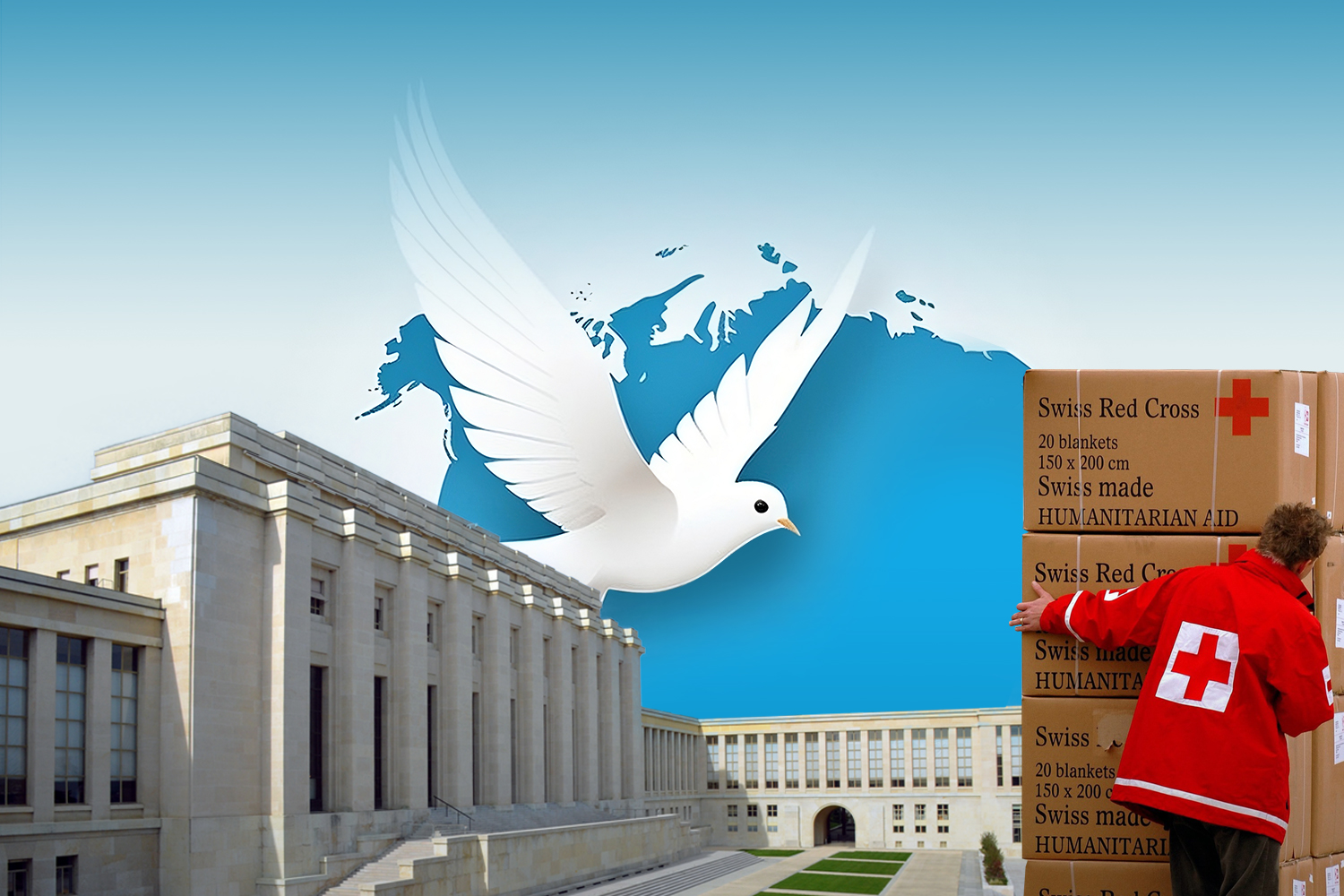
Inside Geneva: can the UN survive?
And where is the UN in this crisis? Its key role, after all, is promoting and maintaining peace, and preventing conflict. But the UN is nowhere, its conflict resolution role completely sidelined, while its aid agencies find themselves struggling to ease the pain of more and more civilians, caught up in more and more violence, with less and less money.
Almost unnoticed in the midst of these crises, the race to choose a new UN secretary general has begun. But can anyone return relevance to a UN which is increasingly marginalised, financially challenged, and, many fear, possibly incapable of surviving?
On this week’s Inside Geneva we talk to two seasoned UN watchers, and ask them for their prognosis. As you might expect, neither are able to give the UN an entirely clean bill of health. Norway’s foreign minister, Espen Barth Eide, wanted to remind listeners that “on many fronts the UN is doing indispensable work every day, bring bringing food to hungry people and ensuring practical standards for how we cooperate on the planet.”
More
Inside Geneva: Are we throwing away international law?
Most countries, Eide said, still believed in multilateralism, and followed the principles laid out in the UN Charter on a daily basis. But, he added, we should not expect perfection, “Dag Hammarskjöld {former UN secretary general} said that the UN was not made to take us to heaven, but to prevent us from going to hell.”
What Eide does want to see though, is a reformed “leaner and more effective” UN. He hints that perhaps there are too many UN agencies, that efficiencies could be made. That view may not, I suggested to him, find favour with aid agencies who are facing huge cutbacks already, even as more conflicts erupt and humanitarian needs escalate.
“There are too many states who are not respecting the core principles and violating some of the essential foundations of the UN,” Eide agreed. “And that creates costs.”
Nevertheless, reducing costs is certainly on the UN agenda, and a reformed, leaner UN is part of Antonio Guterres’ UN80 plan. Some, however, think that plan is just not ambitious enough to restore the UN’s global relevance. Heba Aly, our second guest on the podcast, is a longstanding UN watcher, and now director of the organisation “Article 109”, which is campaigning for a renewed UN Charter.
Article 109 is, she explained, a little known but very important provision in the UN Charter, which allows for the Charter to be re-opened, reviewed, and updated. The original idea, back in 1945, was that article 109 could be invoked every 10 years or so to check on the fitness of the UN for whatever challenges or new situations it faced. But article 109, Aly told Inside Geneva, has never, in the entire eight decades of the UN’s history, been invoked.
“When the UN charter was adopted in 1945, fifty countries were present at the table, and today there are 193 member states,” she told me. “So almost three quarters of the UN’s membership has not had a say in the rules of the game that they are now bound by, and are very frustrated by that lack of voice and representation.”
It is, when you think about it, quite astonishing that such a big organisation has been unwilling to carry out the kind of regular audit of strategy, policy, or finance that is expected of most businesses. What Aly is campaigning for now is for article 109 to finally be used, so that all UN member states can get together and work on a really meaningful revision of the organisation, to make it fairer, more reflective of all 193 members, and robust enough to fulfil its original principles – peace, humanity, equality – in the 21st century.
It’s not a process that can happen fast though, and unfortunately everything else in the world does seem to be happening fast, and not in a positive way. Both Eide and Aly voiced the fear that, in order for us to understand why we need a relevant, influential UN, we may have to make the same terrible mistakes that led to the UN’s founding in 1945.
“History shows that after every severe crisis we come together, and try to make a better system, which is what happened after the two world wars,” said Eide. “I hope we don’t need to relearn this through a third World War.”
“For the UN overall, I think it’s going to go through a very difficult and dark period,” said Aly. “You know sometimes you just have to hit rock bottom. I hope that coming out of that we can emerge with a new global social contract. And if that difficult period leads us to something better, than that is something worth fighting for.”
It’s an in-depth and fascinating discussion, listen in full on Inside Geneva, and tell us what you think!
vm

In compliance with the JTI standards
More: SWI swissinfo.ch certified by the Journalism Trust Initiative

You can find an overview of ongoing debates with our journalists here . Please join us!
If you want to start a conversation about a topic raised in this article or want to report factual errors, email us at english@swissinfo.ch.