








Swiss camera will help monitor the close flyby of asteroid Apophis
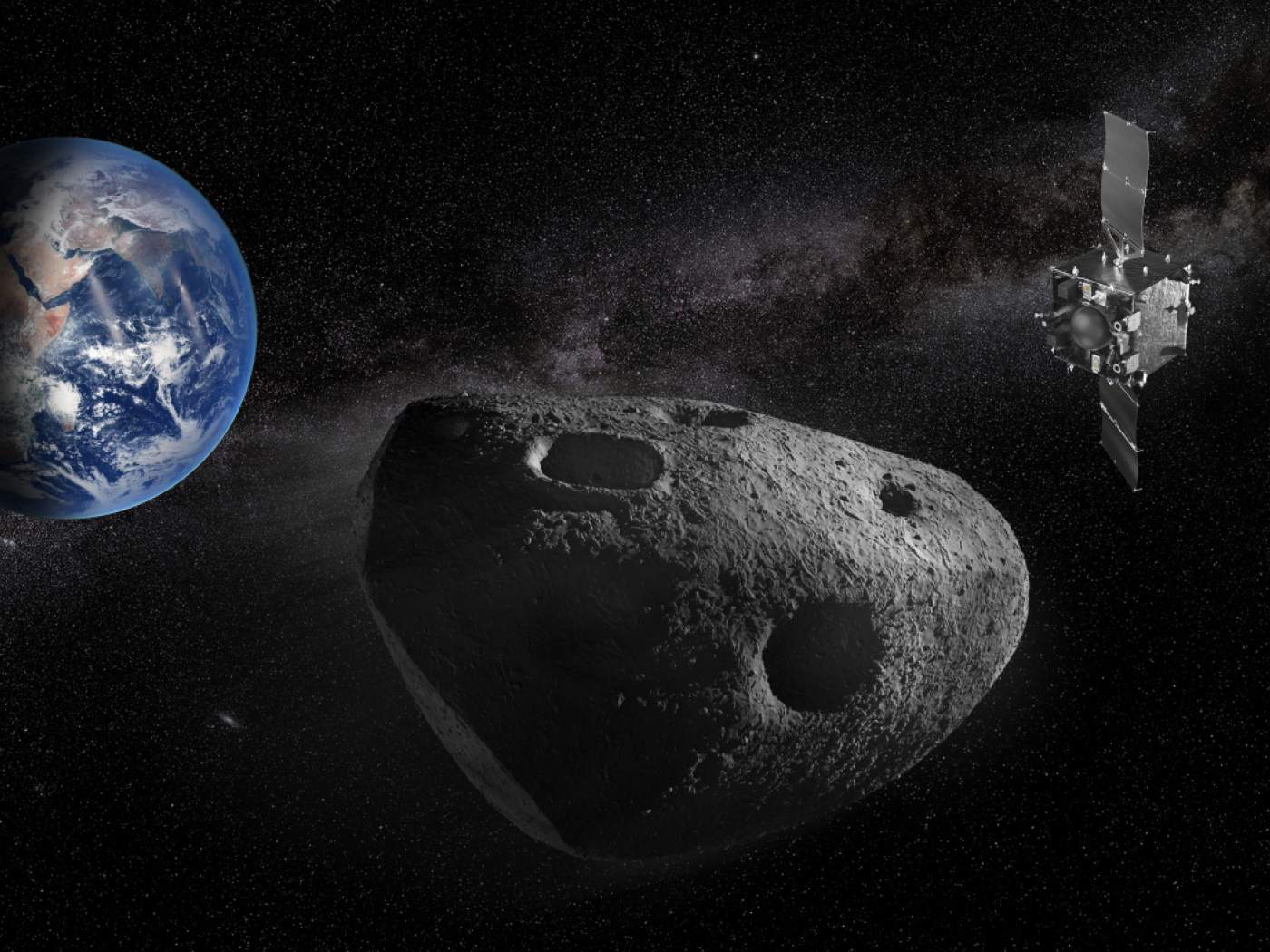
In April 2029, a camera from the University of Bern will help to analyse the asteroid Apophis which will pass close to Earth. The information obtained should help to improve measures against asteroid impacts.
Select your language
Generated with artificial intelligence.
Listening:
Swiss camera will help monitor the close flyby of asteroid Apophis
On April 13, 2029, Apophis will pass the Earth at a distance of just 32,000 kilometres. The Earth’s gravitational pull will slightly deform the asteroid and influence its rotation. It is possible that small debris avalanches will be triggered, bringing material from the interior to the surface, as the University of Bern announced on Monday.
+Get the most important news from Switzerland in your inbox
This extremely rare event offers scientists the opportunity to study the physical properties and potential changes on the asteroid’s surface in detail.
The University of Bern will make a significant contribution to the RAMSES mission with the development of the CHANCES instrument (Color High-resolution Apophis Narrow-angle CamEra System).
“Our instrument will take detailed images of the surface of Apophis and will be able to detect subtle changes caused by the Earth’s gravitational pull,” explains Antoine Pommerol who is leading the development of CHANCES at the Physics Institute at the University of Bern.

More
In space exploration, Switzerland punches above its weight
The construction of instruments for space missions has a long tradition at the University of Bern. Numerous industrial and academic partners throughout Switzerland are involved in the project. International partners in France, Canada and Austria are also supplying components.
The European Space Agency (ESA) recently approved the RAMSES mission carried out jointly with the Japanese Space Agency (JAXA) at its Ministerial Council meeting.
Adapted from German by DeepL/ac
We select the most relevant news for an international audience and use automatic translation tools to translate them into English. A journalist then reviews the translation for clarity and accuracy before publication.
Providing you with automatically translated news gives us the time to write more in-depth articles. The news stories we select have been written and carefully fact-checked by an external editorial team from news agencies such as Bloomberg or Keystone.
If you have any questions about how we work, write to us at english@swissinfo.ch
External Content

In compliance with the JTI standards
More: SWI swissinfo.ch certified by the Journalism Trust Initiative

You can find an overview of ongoing debates with our journalists here . Please join us!
If you want to start a conversation about a topic raised in this article or want to report factual errors, email us at english@swissinfo.ch.