








Individual taxation receives massive support from Swiss Abroad
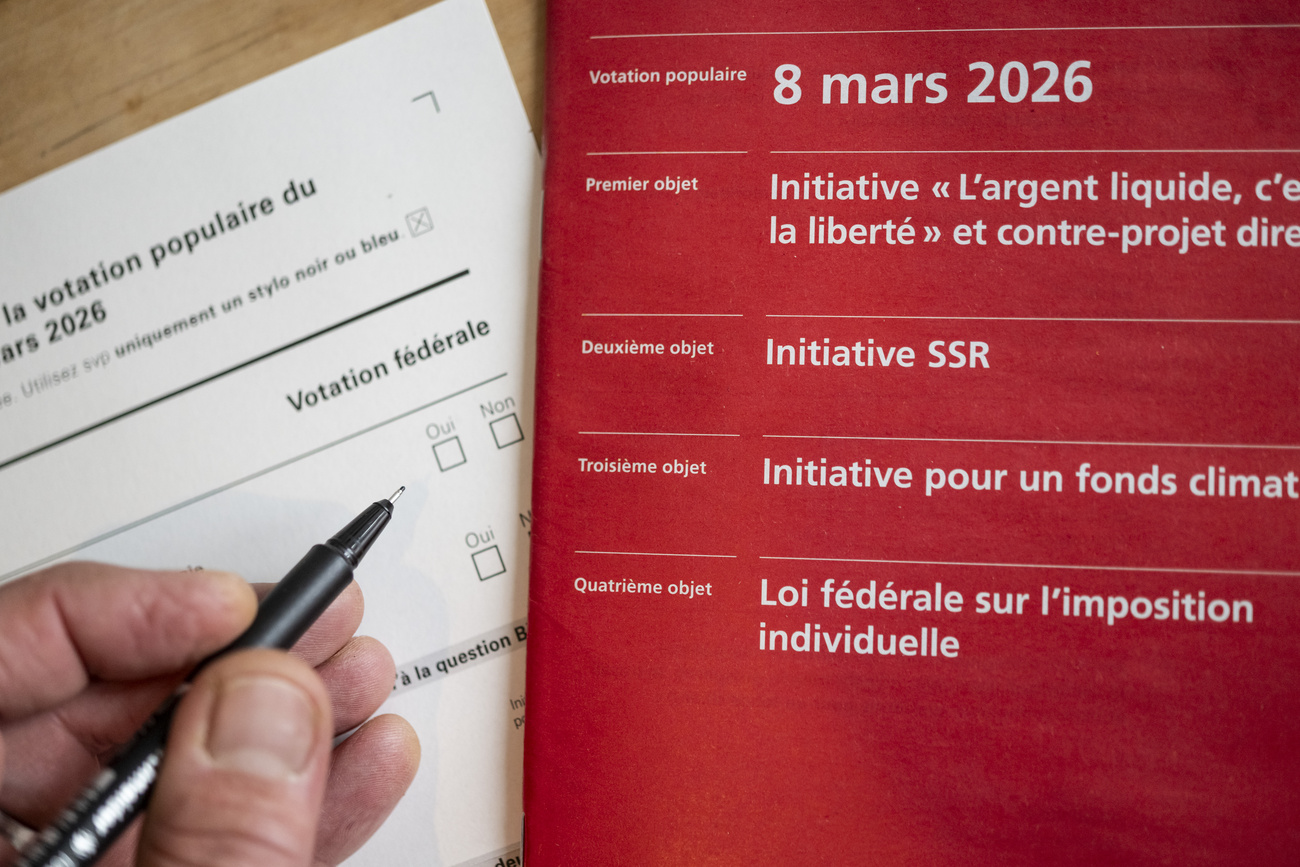
The results of Sunday’s vote from the Swiss Abroad are in line with the national results, with two nuances: the diaspora were much more in favour of the law on individual taxation and the creation of a climate fund than voters in Switzerland.

On Sunday, 54% of the Swiss electorate supported the reform of the taxation of married couples. In future, all couples in Switzerland will be taxed individually, regardless of their marital status.
Individual taxation received even clearer support from the Swiss Abroad. Over 68% of the 12 cantons that provide detailed statistics on how their expat citizens voted backed the proposal drawn up by the authorities. With the exception of canton Uri (57%), the yes vote was well over 60% in each of these cantons. More than 72% of Genevans abroad ticked a yes in their ballot envelope.
External Content
This could be explained by the fact that the Swiss Abroad were sensitive to the gender equality argument, and that a large proportion of them already have a form of individual taxation in their host country.
Moreover, expatriates had less reason to fear the concrete consequences of the reform on their own tax situation – although these questions helped to advance the no camp in Switzerland throughout the campaign.
Respectable result for the climate fund
While the climate fund initiative suffered a resounding defeat – attracting just 29% approval nationwide – the diaspora handed it a more honourable defeat, with over 42% in favour. This figure rises to 46.5% and 46% respectively in cantons Fribourg and Geneva.
External Content
>> Read this article to find out why the climate fund initiative was rejected:
More
Climate is a concern in Switzerland but no longer a priority
Typical Swiss Abroad voting behaviour
The results on these two issues represent an almost archetypal scenario for the voting behaviour of the Swiss Abroad, notes gfs.bern political scientist Martina Mousson. She points out that the diaspora, which is mainly urban, tends to vote more progressively and in favour of ecology than the rest of the population.
Their results are often close to those recorded in Switzerland’s major cities, and this is particularly true this time on individual taxation and the climate fund. On a national scale, “the reform of taxation for married couples received a 64% yes vote in the major urban centres – close to the score for Swiss Abroad – compared with just 44% in the countryside”, Mousson said.
The percentage of approval for the climate fund among the Swiss Abroad is also close to that observed in the cities, where the initiative achieved its best scores. Lausanne, Fribourg and Bern were virtually the only municipalities in Switzerland to accept the initiative. The initiative won 49% of votes in Zurich and Geneva, and 47% in Basel.
>> Read Martina Mousson’s analysis of the March 8 results:

More
‘Today liberal-progressive Switzerland triumphed over conservative Switzerland’
The diaspora rejected the SBC initiative
On other issues, the vote of the Swiss Abroad was no different from that of the country as a whole. The diaspora rejected the SBC initiative, which sought to reduce the radio and television licence fee, slightly more clearly than the electorate as a whole.
This disapproval can be seen in the 12 cantons for which statistics are available. The strongest rejection came from Zurich expatriates, with a majority of almost 70% saying no.
External Content
For Mousson, there are certainly several explanations for this strong support. “The more left-wing and urban vote partly explain it, but I also think that the Swiss Abroad are even more attached to the SBC and to the information about Switzerland that is available for free abroad,” she said.
>> Read our analysis of the results of the SBC initiative:

More
Six takeaways from Switzerland’s media licence fee battle
Support for the cash counterproposal
The diaspora vote on cash, both on the popular initiative and on the government’s direct counterproposal, is an almost mirror image of the vote in the country as a whole. Like their compatriots, the Swiss Abroad wanted to enshrine cash in the constitution and, like their compatriots, they preferred the route proposed by parliament’s counterproposal (approved by almost three-quarters of the electorate).
External Content
The diaspora, like the rest of the population, rejected the popular initiative by over 54%.
External Content
For Martina Mousson, this similarity in the results proves that “the fear of seeing cash disappear one day and the idea that it must be protected is also shared abroad”.
>> This is also what South African anthropologist and activist Brett Scott says in this article:

More
Cash in the constitution: a Swiss decision on an international issue
No particular mobilisation of the diaspora
Nationally, turnout was higher than average. Over 55% of the electorate voted, compared with an average of 49% over the past five years. Turnout was particularly high for the SBC initiative and individual taxation.
These two issues concerned broad swathes of the population and served as a driving force for the others.
However, turnout among the Swiss Abroad who are registered to vote remained average, at just over 23%, which is not surprising for Mousson. “Turnout among the Swiss abroad is generally stable – it’s probably a base of people who have a well-established habit of taking part in ballots – and only increases significantly when there is a direct link with the Swiss Abroad.”
External Content
It should also be noted that in canton Basel City, a technical problem prevented more than 2,000 electronic votes cast by Swiss citizens abroad from being taken into account.
We’d like to hear your opinion: has this incident had an impact on your confidence in electronic voting? If so, why?
More

Edited by Katy Romy. Translated from French by AI/ts
How we translate with AI
We use automatic translation tools, such as DeepL and Google Translate, for some content.
Each translated article is carefully reviewed by a journalist for accuracy. Using translation tools gives us the time for more in-depth articles.
Learn more here about how we work with AI.

In compliance with the JTI standards
More: SWI swissinfo.ch certified by the Journalism Trust Initiative

You can find an overview of ongoing debates with our journalists here . Please join us!
If you want to start a conversation about a topic raised in this article or want to report factual errors, email us at english@swissinfo.ch.