








Swiss neutrality: government faces difficult decision over Mideast conflict

The Swiss government could soon face a delicate decision: if the conflict involving Iran drags on, Switzerland may have to apply its law of neutrality. This could restrict military overflights and arms exports to the United States. This is not without potential consequences for the Swiss defence industry.
Select your language
Generated with artificial intelligence.
Listening:
Swiss neutrality: government faces difficult decision over Mideast conflict
The recent US attack on Iran may raise sensitive questions for Bern about its relations with Washington, particularly at a time when the two countries are negotiating a trade agreement and bilateral relations had recently improved.
If the conflict in the Middle East continues or escalates, Switzerland could be required to apply the law of neutrality to the United States.
“This could mean, for example, that our airspace would be closed to US military aircraft,” said Foreign Minister Ignazio Cassis.
According to the Swiss foreign ministry, the key factors in determining whether neutrality law applies are the duration and intensity of the conflict. “At present, it is not yet possible to assess whether the escalation in the Middle East meets the conditions for applying the law of neutrality,” the ministry said. Cassis also noted that it is unclear when such a threshold would be reached.
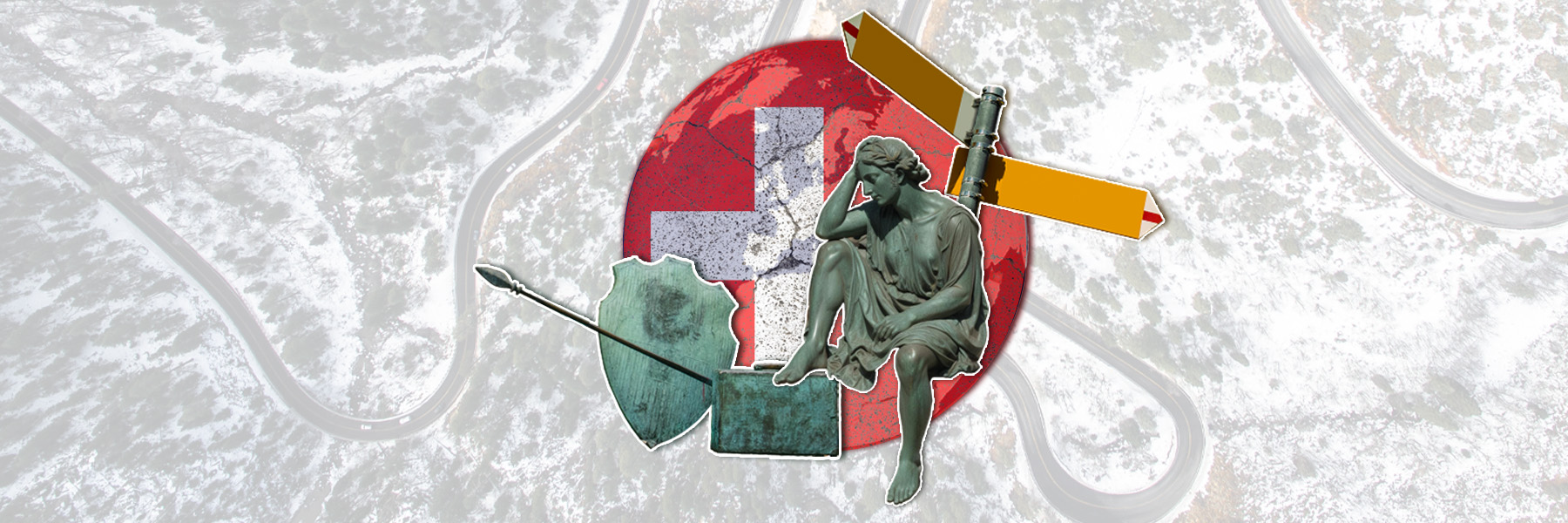
Read our overview on Swiss neutrality here:
More
What does the future hold for Swiss neutrality?
Previous cases: Kosovo and Iraq
Switzerland last applied neutrality law to the United States during the Kosovo war in 1999 and the invasion of Iraq in 2003. On both occasions, the government banned US military overflights of Swiss airspace.
Only to Germany does Switzerland export more war material than to the US. In the first three quarters of last year, Swiss defence companies delivered war material worth around CHF74 million ($94.87 million) to the US.
When it comes to the purchase of dual-use goods – i.e. industrial goods that can be used for both military and civilian purposes – the US, like most European and Western-oriented countries, is privileged: It can purchase certain goods in Switzerland without specific controls by SECO. The Swiss federal government regularly determines the countries to which exports can be made without further controls on the basis of an ordinary general export licence.
Restrictions were also imposed on exports of war materiel to the United States.
This issue is causing concern in the Swiss parliament because the US is not only a supplier but also a major customer for the Swiss defence industry. After Germany, it is the sector’s second most important export market. Exports of dual-use goods – items with both civilian and military applications – are also significant.
The Swiss defence industry is already struggling in Europe:

More
Switzerland eases arms export rules as its industry is shunned by Europe
The State Secretariat for Economic Affairs (SECO), which oversees export licences, appears to have already taken a cautious approach.
“The Swiss authorities are already showing restraint in areas relevant to maintaining neutrality,” SECO said in response to an enquiry from Swiss public broadcaster SRF. The office did not specify where this restraint was being applied.

More
Our newsletter on geopolitics
A decision with political consequences
Laurent Goetschel, professor of political science at the University of Basel and director of the Swiss Peace Foundation, believes the government could be forced to apply neutrality law if the conflict continues for several weeks, as suggested by US President Donald Trump.
“Whatever the Swiss government decides will have consequences,” Goetschel said. If neutrality law is not applied, it could signal that Switzerland is downgrading its neutrality. If it is applied, the decision is also likely to attract criticism.
“At the same time, it would show that Switzerland intends to act as it has in the past,” he added.
For now, after only a few days of conflict, the Swiss government still sees room for manoeuvre before taking a decision. Much is at stake – both for the Swiss defence industry and for relations between Switzerland and the United States.
More

Translated from French using AI/amva
How we translate with AI
We use automatic translation tools, such as DeepL and Google Translate, for some content.
Each translated article is carefully reviewed by a journalist for accuracy. Using translation tools gives us the time for more in-depth articles.
Learn more here about how we work with AI.
External Content

In compliance with the JTI standards
More: SWI swissinfo.ch certified by the Journalism Trust Initiative

You can find an overview of ongoing debates with our journalists here . Please join us!
If you want to start a conversation about a topic raised in this article or want to report factual errors, email us at english@swissinfo.ch.