This content was published on
Exclusive to the Italian-speaking canton of Ticino, the League was founded in 1991 by businessman Giuliano Bignasca. It has gathered support by denouncing the vested interests and patronage system of the traditional parties. Left-leaning on some social issues, extremely rightwing on issues of international policy and immigration, the League was highly successful in the early…
This content was published on
The first section of the Green Party in Switzerland was established in 1971 in canton Neuchâtel to oppose plans for a new motorway. They won their first parliamentary seat in 1979, when the present mayor of Lausanne, Daniel Brélaz, was elected. In 1983, a number of groups joined forces to form the Federation of Swiss…
This content was published on
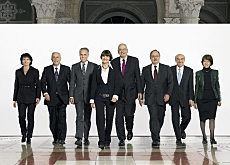
The Swiss government consists of a cabinet (also known as the Federal Council) made up of seven ministers (federal councillors), each of whom heads a ministry. The members are elected by a joint session of parliament for a four-year term. Cabinet ministers take turns at being Swiss president for a period of one calendar year.…
This content was published on
This is a term used to describe initiatives taken by a third party to stop litigation or make contact easier between two conflicting parties. More generally it refers to any initiative or contribution that encourages peace and international cooperation. As a neutral country, Switzerland has made good offices one of the pillars of its foreign…
This content was published on
The research institutes gfs.bern and gfs.zurich were founded in 1959 as the “Swiss Society for Practical Social Research”. They are now independent companies mainly active in research by surveys. gfs.bern does applied research in the areas of politics, communications and society. The institute is commissioned by the Swiss Broadcasting Corporation to provide surveys, first trends…
This content was published on
Federalism is a system which gives both the national government as well as defined regions within the country the power to pass laws. In Switzerland, the cantons decide their own laws regarding taxation and education, for example. Federalism differs from the centralised state model, where local authorities have only an administrative competence. Switzerland has been…
This content was published on
A report published last week noted that while more land was cleared of mines in 2005 than ever before, the number of victims rose by 11 per cent to more than 7,300. “A lot has been achieved but there is still much more to do. It’s certainly not the moment to give up,” said Ambassador…
This content was published on
Each one of the seven governmental ministries is made up of a number of specialised administrative offices. Their job is to develop projects, as well as prepare and execute policies relating to their area of expertise.
This content was published on
In 1999 Swiss voters approved a new constitution which effectively ended the statutory gold backing of the Swiss franc. As a result the Swiss National Bank decided to sell off half of its gold reserves of 1,300 tons over a number of years. Proceeds have been distributed from the 2004 annual result, with one third…
This content was published on
The term describes a political system in which the people exert power directly. It differs from representative democracy in which the people delegate this power to elected representatives. The two main instruments of direct democracy in Switzerland are the people’s initiative and the optional referendum. Switzerland is referred to as a semi-direct democracy because its…