








Switzerland’s worst-case climate scenario now more likely, say scientists

Research from Switzerland and Germany suggests the world is on track for more warming than official projections assume – with major implications for climate planning.
Select your language
Generated with artificial intelligence.
Listening:
Switzerland’s worst-case climate scenario now more likely, say scientists

Last year, MeteoSwiss and the federal technology institute ETH Zurich published Climate CH2025, a report on what the country would look like as the planet warms. There were three scenarios: one in which the world is 1.5°C warmer than pre-industrial times, one where warming is 2°C, and a more severe example where the planet is 3°C warmer. The latter was the outer limit of what the scientific models could describe with any confidence.
New research from ETH Zurich and Leipzig University suggests that most severe scenario is now the most likely outcome. On current policies, the study’s lead author calculates, global warming could reach 3.25°C by 2100 – far beyond what most countries have planned for, and more than twice the limit set in the 2015 Paris Climate Agreement.
“For any emission trajectory without immediate and drastic emission cuts, we expect warming to be 25% higher,” says Gergana Gyuleva, a doctoral researcher in the climate physics group at ETH Zurich and lead author of the study published in the journal Earth’s Future in August. “What happens in a 3°C world isn’t changed by our results. Our results only change how soon or how likely this 3°C world becomes.”
And 3°C is no longer an outlying expectation among many scientists. In a 2024 survey of 211 IPCC authors, 42% said they expected warming of 3°C or more by the end of the century.
For the average person in Switzerland, extreme heat has become a reality. This summer was the hottest ever recorded, with long stretches of extreme temperatures and severe drought in much of the country.
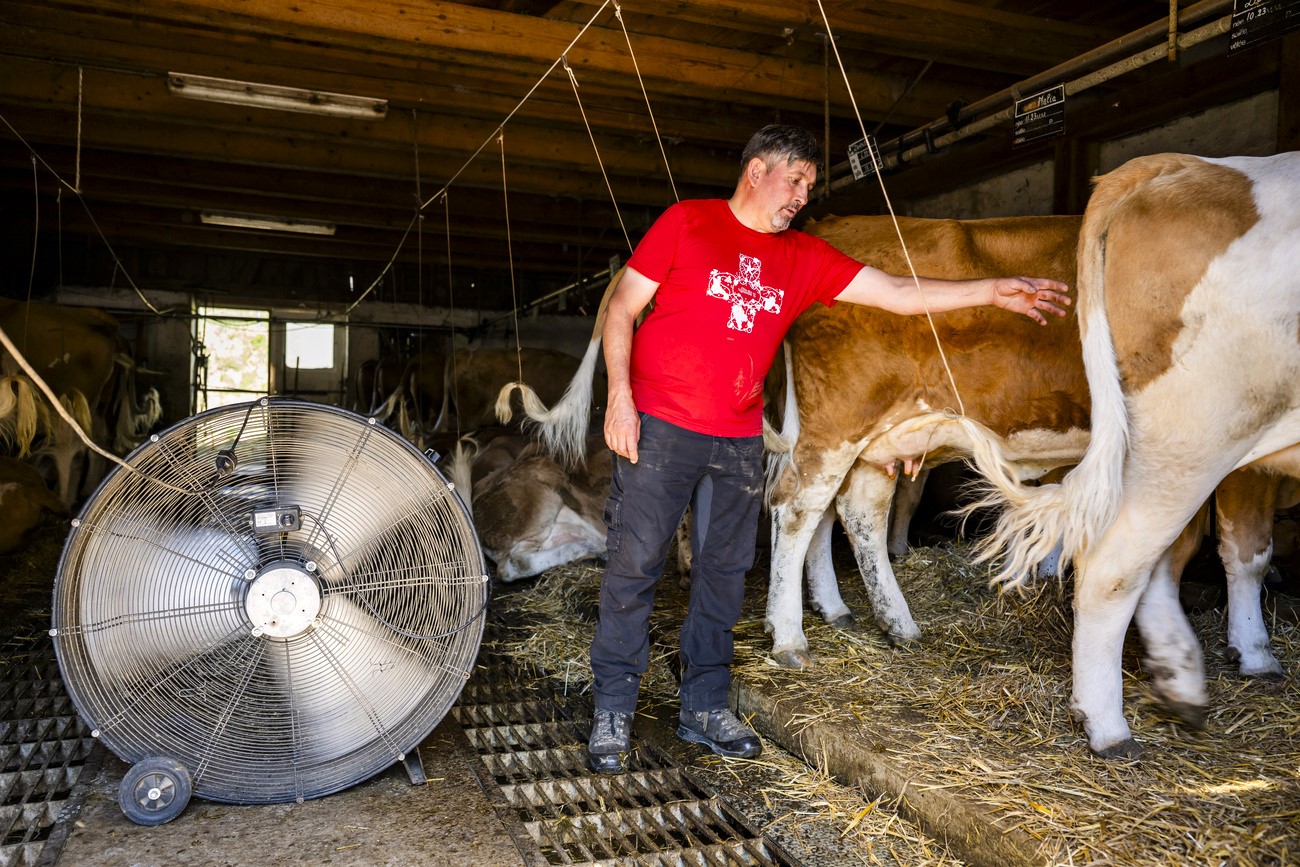
More
Switzerland’s record-breaking summer by numbers
And Switzerland warms faster than the global average, which means a 3°C warmer world would increase local temperatures by about 4.9°C.
How researchers underestimated global warming
The ETH study’s more dire prediction is based on a revision to climate modelling. Typically, predictions are based on a look at the past – how much the planet has warmed based on increases in carbon dioxide in the atmosphere.
But researchers say the climate’s own natural swings – such as La Niña, the recurring Pacific cooling pattern – meant the world warmed more slowly during those years than it otherwise would have.
“We were actually statistically unlucky for having caught a period where variability produced less warming in the real world,” Gyuleva says.
The research removes such incidents. It also relies on another source of data: satellite measurements of how much sunlight the planet absorbs and how much heat it radiates back to space. The gap between light absorbed and heat released has more than doubled since 2000, suggesting that the amount of heat trapped in Earth’s atmosphere is growing faster than previously thought.
External Content
“The major upward revision comes from including the energy imbalance,” Gyuleva says. It lifts the bottom of the range in particular: low-warming futures are not compatible with what the satellites see.
Gyuleva is candid that this is the weakest part of the research. The satellite record goes back only 25 years, so it’s difficult to know how the trend compares to past eras. Models do a better job predicting the outgoing heat than the incoming sunlight, which depends on clouds and ice. So she ran it again using only the outgoing heat, the half the models handle well. The result came out the same. That, she says, is why she trusts it.
What 3°C feels like
If 3°C is where the world is now heading, what does that look like on the ground?
Switzerland just had a preview. When assessing this summer, the most relevant comparison point is the summer of 2003, when heat killed an estimated 70,000 people across Europe and around 1,000 in Switzerland. That summer has since served as the benchmark for what extreme heat looks like in the country. This year beat it on almost every measurement.

More
Switzerland feels cost of record summer heat
Basel recorded 58 days above 30°C, against 41 in 2003; Bern had 46 against 29, Zurich 38 against 27. Basel-Binningen set an all-time record of 39.7°C and went 20 consecutive days above 30°C; Locarno managed 24, a national record. Rainfall in Basel over the three summer months came to 82.8 millimetres, roughly half what fell in 2003.
The scenarios published by MeteoSwiss and ETH Zurich last November project about 30 heat days above 30°C for the Zurich area in a typical summer in a 3°C world. This year produced 38.
Sonia Seneviratne, who heads the Institute for Atmospheric and Climate Science at ETH Zurich and is a co-author of the national scenarios, says the intensity of this summer was not surprising. Before 2003, heatwaves in Switzerland were rare. Since 2018 they have become a recurring feature of the summer, and the summer itself is lengthening at both ends, now lasting from June through September.
How to prevent the worst case
Most of the warming ahead can still be prevented. If emissions were reduced severely, it would cut the warming scenarios in half, according to researchers.
Scientists track this with something called the global carbon budget: the total amount of CO₂ the world can still release before it passes a given temperature.
Gyuleva’s study attributes more warming to each tonne of CO₂ than previous models. With this revision, the remaining budget shrinks by about a fifth. There’s less room for error, but still time to act.
“Our results point to the need for faster mitigation for a given temperature target,” she says.
What that means in practice is that global emissions must be halved by around 2030 and brought to zero by 2050 at the latest. This requires eliminating reliance on oil, gas and coal. In Switzerland specifically, according to Seneviratne, that means replacing petrol cars with electric ones and replacing oil and gas heating with heat pumps or geothermal, then building out solar, wind and hydropower to supply the extra electricity.
Those substitutions cover most of the problem. Transport and buildings together account for more than half of Swiss greenhouse gas emissions.
Switzerland has committed to halving emissions by 2030 against 1990 levels and reaching net zero by 2050. It has cut them by just over a quarter so far. In August, Environment Minister Albert Rösti said Switzerland would probably miss its 2030 target.
Still a choice
In the CH2025 report, the authors also note that alarming narratives about the climate are counterproductive, and that it helps to set out possible courses of action alongside them.
“What’s missing in the political landscape for me in terms of climate change mitigation are positive narratives,” Gyuleva says.
Asked what a positive narrative would look like, she gives Swiss examples built on side benefits. Electric cars plugged in overnight become storage for the grid, and cities get quieter with cleaner air as the number of gas-powered cars diminishes – without anyone being told they cannot drive. Producing and eating less meat and dairy, rather than none, would improve food quality, cut imported animal feed, reduce nitrate in groundwater and improve animal welfare. An energy system that does not depend on imported fossil fuels is less exposed to geopolitical shocks.
A newly released UNEP report makes a version of the same point in numbers. Under the policies governments have actually adopted, it projects about 2.6°C of warming by 2100. If every national pledge and net-zero commitment were delivered in full, that falls to around 1.8°C.
“Society needs positive storylines, positive visions of the future that are doable,” Gyuleva says. “And they are.”
The ETH’s newest climate study shows that 3°C of warming is a very possible, but not inevitable, scenario. What the future holds will depend on today’s policymaking, narratives and actions, say its authors.
Join the debate:
External Content

In compliance with the JTI standards
More: SWI swissinfo.ch certified by the Journalism Trust Initiative

You can find an overview of ongoing debates with our journalists here . Please join us!
If you want to start a conversation about a topic raised in this article or want to report factual errors, email us at english@swissinfo.ch.