








Crans-Montana: Switzerland ‘a single grieving family’, says Swiss president
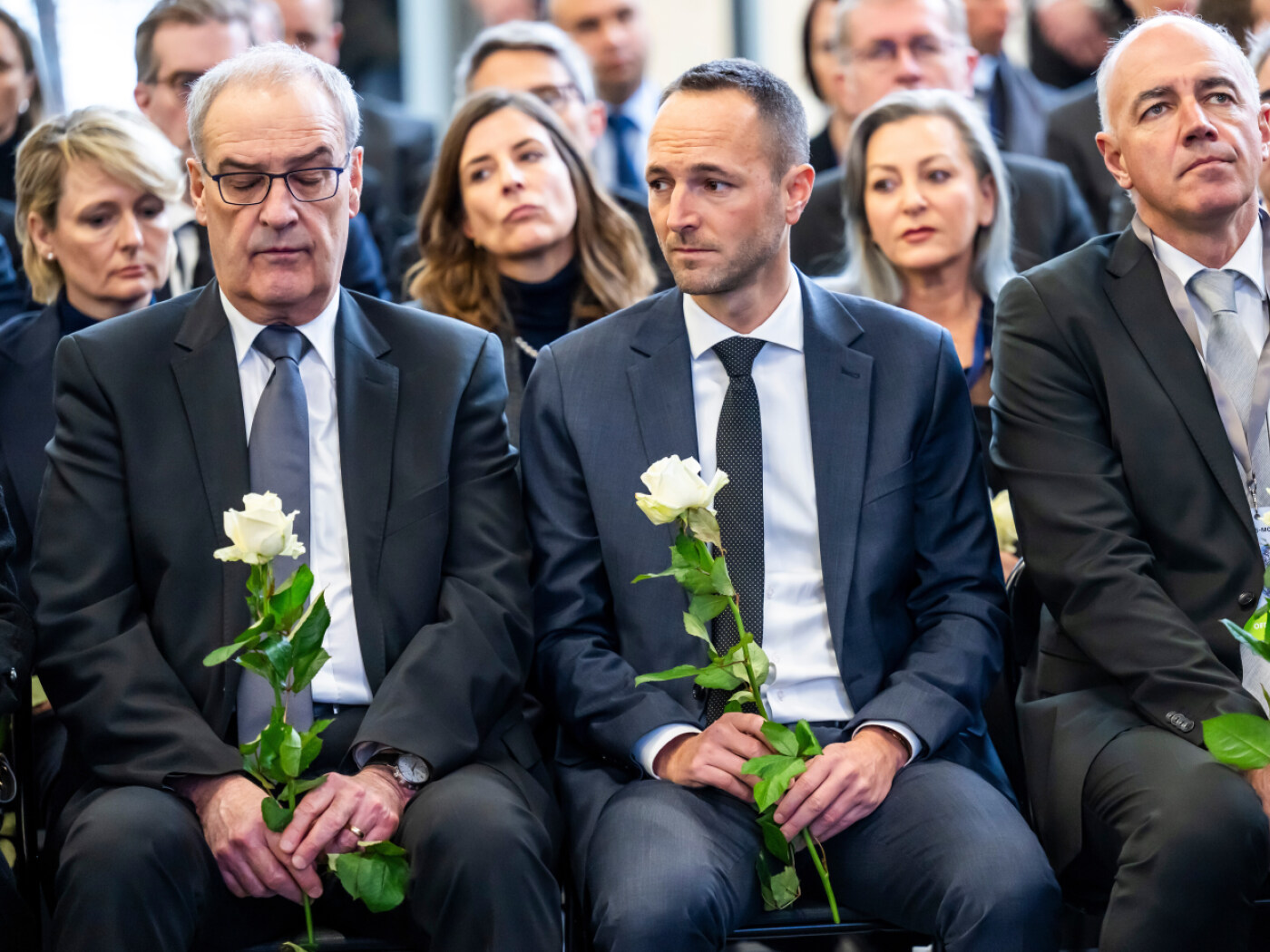
The fire disaster in Crans-Montana has turned Switzerland into "a single grieving family", said Swiss President Guy Parmelin in his speech at the memorial ceremony in Martigny on Friday.
Select your language
Generated with artificial intelligence.
Listening:
Crans-Montana: Switzerland ‘a single grieving family’, says Swiss president
+Get the most important news from Switzerland in your inbox
On January 9, all those who lost their lives or suffered serious injuries on New Year’s Day are remembered. Parmelin said. It is a day of remembrance and love – especially for the parents, siblings, relatives and friends of the victims, but also for the population who shared in the tragedy in Crans-Montana.
Watch our video for footage from the memorial service, provided by Swiss public broadcasters RTS and SRF.
“On New Year’s Day, we were struck by an unimaginable disaster, a disaster that – I would like to emphasise – has united the whole of Switzerland in grief,” he said. He could speak on behalf of the whole country when he said that people had come together on this day to bear the burden of this disaster together. “It will not become any lighter, but if this day can contribute even a little to alleviating our infinite grief, then it has already fulfilled its purpose.”
+ Politician apologises at Crans-Montana memorial ceremony
Abrupt end to young lives
When people remember this terrible night, they think above all of the 156 victims and how happy and carefree they had been just a moment ago, he said. Many of these young people were on holiday. “And here, of all places, their lives, which had just been characterised by peaceful and relaxed togetherness, came to an abrupt end.”
This tragedy has caused deep consternation in Switzerland, he said. “Switzerland bows to those who are no longer with us and stands by those who have a long and arduous recovery ahead of them.”
Switzerland will continue to stand by all families at home and abroad whose lives have been so brutally and irrevocably changed by this catastrophe. he said. “We are deeply grateful for the countless signs of sympathy and the great medical support we have received at home and abroad.”
+ Crans-Montana tragedy: ‘Our hearts go out to you’, say Swiss Abroad
Parmelin went on to say that this solidarity was touching. “We know today that we are not alone in this emergency.” Last but not least, we would like to thank “from the bottom of our hearts all those who have worked in whatever way to save lives, identify missing people and seek the truth.” After all, the relationship of trust between the institutions and the society they serve is based on this.
Justice should uncover misconduct
Hope will return – to a life that for some will be characterised by the infinite emptiness of loss and for others by the arduous, lengthy and uncertain process of recovery, he said. “It gives the strength to dry the tears. It is able to heal, even if it is not always tangible.”
Hope also arises from the certainty that the Swiss justice system is able to uncover and punish misdemeanours quickly and relentlessly, Parmelin said. “We not only have a state obligation, but also a moral responsibility.
More

However, the national day of mourning also obliges us to look ahead, he said. The responsible authorities and legislators must learn the necessary lessons from what happened to ensure that publicly accessible facilities meet the highest possible security standards in future.
+ Crans-Montana tragedy highlights limits of Swiss federal system
For Parmelin, the words “unthinkable, unspeakable, invisible” ultimately reflect the bewilderment “that we still feel in the face of this catastrophe”.
“Unthinkable, because a country in which thoroughness and reliability are as important as they are in ours must be able to recognise the risks that can lurk anywhere and at any time. Unspeakable, because words are not enough to describe or even measure the loss, grief and suffering. Despite everything, we are trying to find words today. We do well to do so. Because comfort is not only found in silence, as soothing as it may be. Invisible, after all, because so many of our children are no longer with us. They left us in a bar that was named after a constellation. From now on, they will continue to shine in our memories.”
Adapted from German by AI/ts
We select the most relevant news for an international audience and use automatic translation tools to translate them into English. A journalist then reviews the translation for clarity and accuracy before publication.
Providing you with automatically translated news gives us the time to write more in-depth articles. The news stories we select have been written and carefully fact-checked by an external editorial team from news agencies such as Bloomberg or Keystone.
If you have any questions about how we work, write to us at english@swissinfo.ch
External Content

In compliance with the JTI standards
More: SWI swissinfo.ch certified by the Journalism Trust Initiative

You can find an overview of ongoing debates with our journalists here . Please join us!
If you want to start a conversation about a topic raised in this article or want to report factual errors, email us at english@swissinfo.ch.