








August is for humanitarians

This month marks two important dates in the humanitarian calendar; August 30 is the Day of the Disappeared, and August 19 is World Humanitarian Day.

Those days are linked in a way, since it is primarily humanitarian organisations, from the International Committee of the Red Cross (ICRC), to the Committee on Enforced Disappearances at UN Human Rights, who strive to protect the rights of the missing, and to reunite them with their families.

More
Inside Geneva: August is for humanitarians
On Inside Geneva this week, we revisit the ICRC’s Central Tracing Agency, which registers prisoners of war (POWs), takes enquiries from their families, and tries to reconnect them. Right now, the work is devoted to the war in Ukraine. Despite its mandate under the Geneva Conventions to visit all POWs, the ICRC does not, in spite of repeated requests, have access to all the prisoners from this conflict, but nevertheless receives hundreds of calls a day, and can, sometimes, bring an anxious family good news.
“When I tell them ‘I’m calling from the ICRC, I’m calling from Geneva: as of last week he was a POW, now he is safe and well. People are so grateful,” says the agency’s Anastasia Kushleyko. “Especially the mothers.”
The ICRC continues to appeal for access to all POWs, and its work is of course not confined to Russia and Ukraine. Earlier this year the red cross facilitated a huge prisoner swap, in which more than 900 detainees from Yemen’s long civil conflict were returned home. Fabrizio Carboni, the ICRC’s regional director for the near and Middle East, tells Inside Geneva about the behind the scenes complexities that led up to the successful swap, and also gives us an insight into his own motivation for doing this kind of work.
“I look at my kids, I look at my family, and I say ‘imagine now there is a frontline between us and my son, my brother, my mother, my father, are captured and I can’t see them for a year, two, three, four.’’’
Empathy required
That kind of empathy is perhaps the most important prerequisite for a humanitarian worker. It’s not just about an idealistic goal to make the world a better place, it is, as UN aid worker Laura Dolci tells Inside Geneva, about making “sure that others suffer less”, and that means, as Carboni put it, imagining yourself “in their situation.”
Dolci marked World Humanitarian Day here in Geneva, with a ceremony at the Palais des Nations. As some readers may know, the day was introduced after the bombing of the UN headquarters in Baghdad in 2003, in which 22 people, most of them UN staff, were killed.
On Inside Geneva, she tells us why August 19 is such an important day for her. She and her husband, Jean-Selim Kanaan, met in Bosnia in 1997; they were dedicated to their work, and they became dedicated to each other. In 2003, recently married, they were expecting their first child. Dolci settled in Geneva, and had a new posting, to the UN mission in Iraq.
In July that year he returned for the birth of their son Matthia, and the new family spent three weeks together. But on August 17, Dolci took Kanaan to the airport for his flight back to Iraq. “He never came back.”
Like so many other UN staff, Kanaan was in Baghdad’s Canal Hotel when a suicide bomber drove a truck packed with explosives into the building. Dolci, in Geneva, saw the news flash up on her computer, and after trying to call her husband several times, “I knew he was dead.”
You can hear an extended interview with Dolci on Inside Geneva this week; she is open about her grief, and the painful memories that remaining in Geneva still brings her. “It took me many years to be able to use the same elevator in the airport where I last kissed him,” she confesses.
Serving humanity
But what shines through Dolci’s interview most of all is that empathy. She still works for the UN, and she is still dedicated the ideals of the UN Charter. “It is a noble profession, the UN flag means values, a moral compass, it’s a life choice”.
And, she adds, she does not think the increasing number of attacks on aid agencies (you can read more about that in my colleague Paual Dupraz-Dobias’s article) will deter the next generation of humanitarian workers.
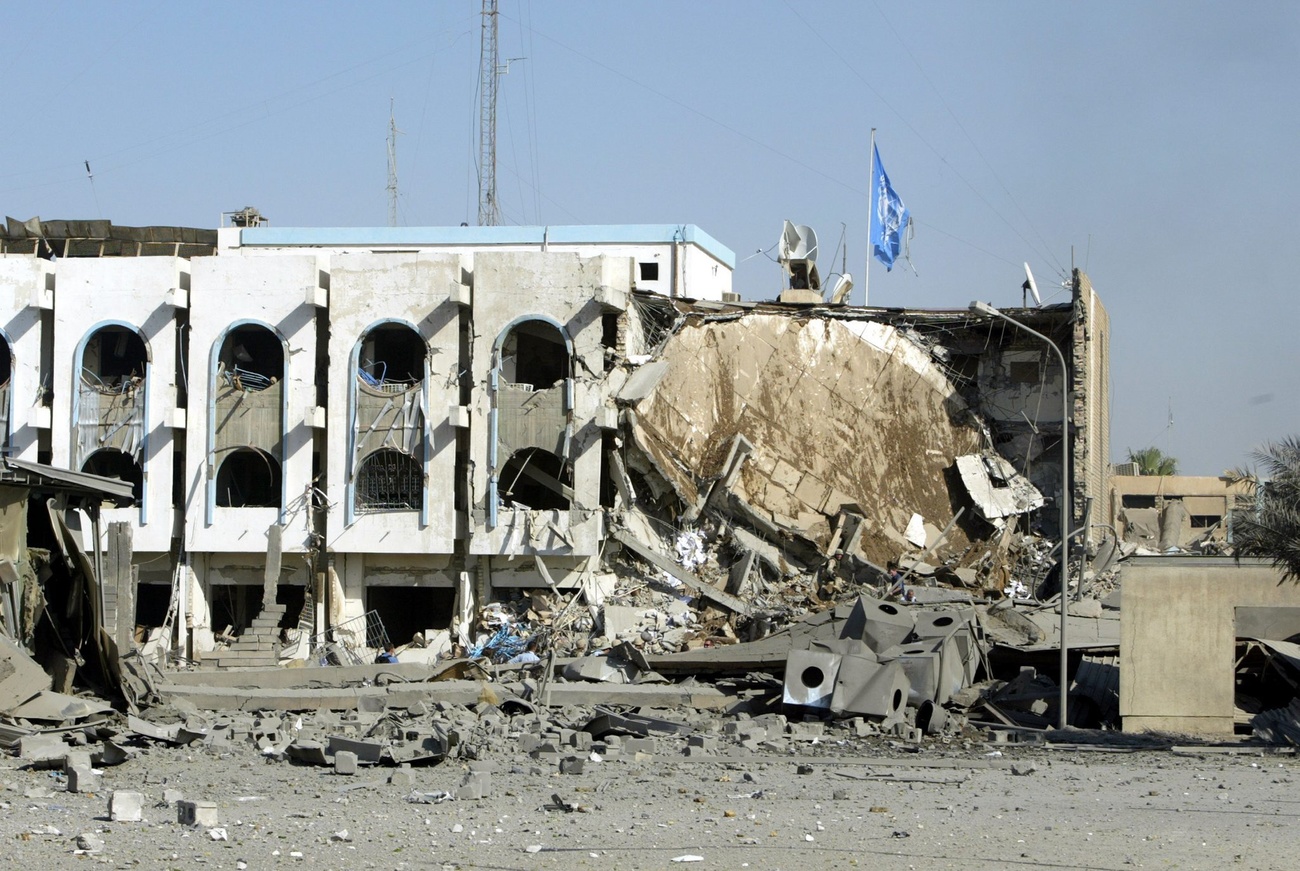
More
Baghdad UN bombing: 20 years on, aid workers face even more dangers
“There is this line up of young people,” she says. “They’re packing their bags to go. They’re putting their best years, their youth, their aspiration at the service of others.”

In compliance with the JTI standards
More: SWI swissinfo.ch certified by the Journalism Trust Initiative

You can find an overview of ongoing debates with our journalists here . Please join us!
If you want to start a conversation about a topic raised in this article or want to report factual errors, email us at english@swissinfo.ch.