








Living within planetary limits: Zurich’s 2,000-watt experiment
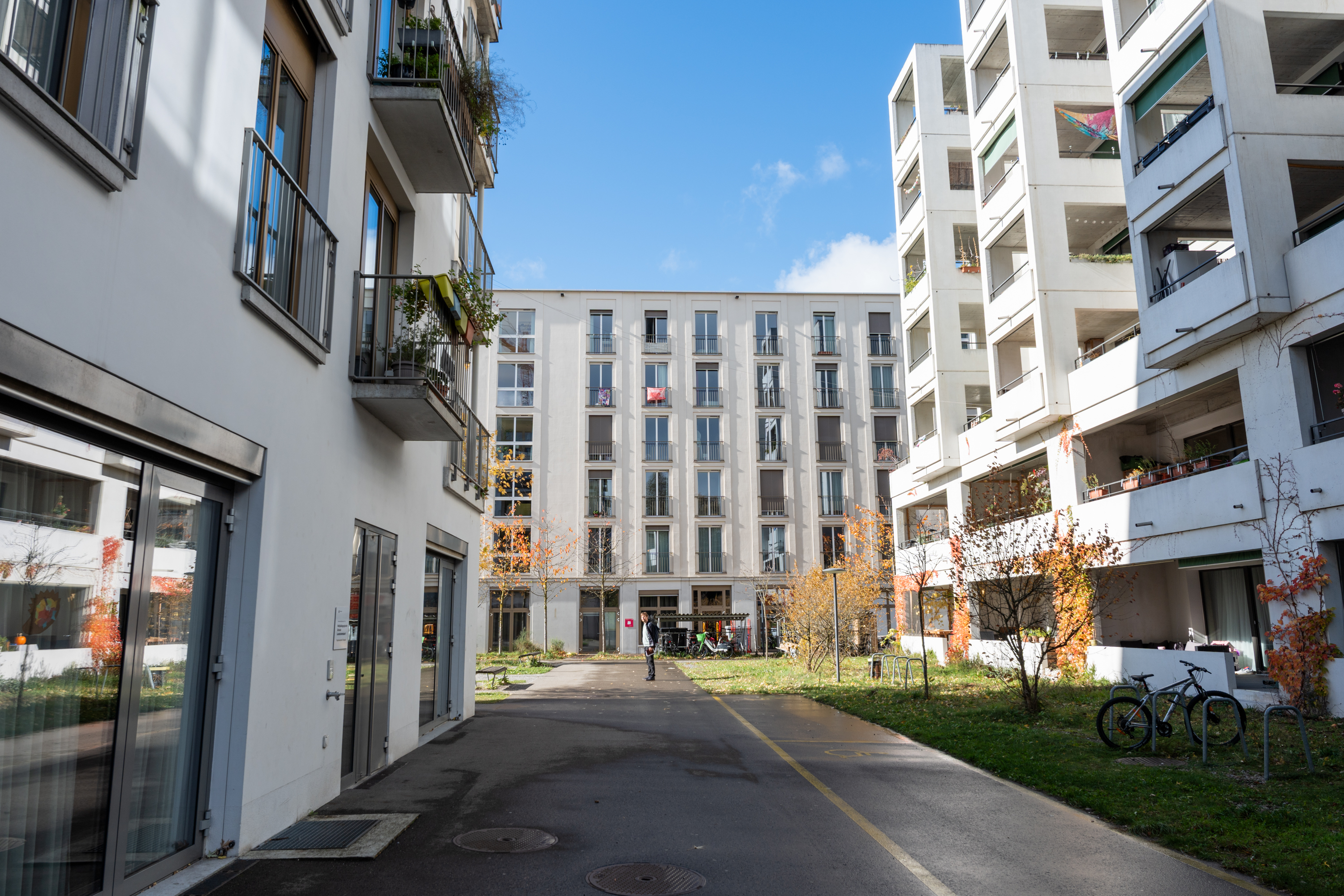
Zurich is home to a unique housing cooperative meant to model sustainable living. A decade on, some residents have found changing their habits to be more challenging than expected.
Select your language
Generated with artificial intelligence.
Listening:
Living within planetary limits: Zurich’s 2,000-watt experiment


Tucked into a neighbourhood on the northern edge of Zurich, the Hunziker Areal looks like an ordinary modern housing complex. But this is a closely watched experiment. And if it succeeds, it could be a model for how hundreds of thousands of people across the country might live in the future.
Built a decade ago by the cooperative mehr als wohnen (“more than living”), the complex was inspired by the 2,000-watt society, a framework first proposed by researchers at the federal technology institute ETH Zurich in the late 1990s and later adopted as part of Switzerland’s long-term energy and climate strategy. The idea: that every person should live well using no more than 2,000 watts of continuous energy — the equivalent of roughly 17,500 kilowatt-hours per year, about one-third of what the average Swiss consumes today. Reducing that number is considered key to achieving the country’s climate goals.
Hunziker Areal’s 13 buildings feature energy-efficient lighting and appliances, and its shared workshops and car-free courtyards are meant to prove that a comfortable urban life can also be a low-energy one. “If you want to live here, you give up your car,” says Werner Brühwiler, a founding member who has lived at Hunziker since it opened in 2015. “You can still drive but you can’t park outside your door.”
Want to hear more? We’ve also produced a podcast on this topic. Listen directly here or find it on your preferred podcast app:
Subscribe to
-
 Apple PodcastsExternal link
-
 SpotifyExternal link
-
 YouTubeExternal link
-
 Amazon MusicExternal link
-
 iHeartRadioExternal link
-
 Podcast IndexExternal link
-
 CastboxExternal link
-
 OvercastExternal link
-
 Pocket CastsExternal link
-
 Podcast AddictExternal link
-
 DeezerExternal link
-
 Listen NotesExternal link
-
 PodchaserExternal link
-
 Player FMExternal link
-
 CastroExternal link
-
 GoodpodsExternal link
-
 True FansExternal link
-
 PandoraExternal link
- Buzzsprout RSS Feed External link
External Content
Nearly ten years on, Hunziker has cut emissions and inspired similar projects across Switzerland. In simple terms, for every square metre of built space each year, Hunziker Areal emits about 16.6 kg of CO₂-equivalent during normal use, a figure that is 20% lower than the operational emission caps set by the 2000-watt certification. Its buildings also use around a quarter of the energy of an average Swiss residential building, thanks to efficient heating, hot water systems and ventilation.
Yet the neighbourhood also reveals how difficult it is to change habits built over a lifetime.
Residents have learned to live with less space, fewer cars and shared amenities – and also with the social frictions that come from redefining comfort and convenience around the planet’s boundaries. The project’s lessons reach far beyond Zurich: they show that sustainability is as much a social challenge as a technical one.

Forming new habits
On paper, the cooperative seems to be meeting its goals. It uses district heating supplied by Zurich’s waste incineration plant, along with solar thermal systems on the rooftops, keeping energy use per resident close to the 2,000-watt target.
Water use is lower than average thanks to efficient fixtures, shared laundry rooms and rainwater collection for gardens. Small design choices like these make sustainability part of daily life, without requiring many conscious lifestyle changes.
Numbers tell part of the story, but I wanted to see how small steps toward sustainability turn into daily routines for residents. Over the past few years, my family has been on its own quiet experiment in greener living: cycling instead of driving, taking trains instead of flying, and powering our countryside home with solar energy and a heat pump. Some adjustments are as simple as changing home hardware, while others, like cooking vegetarian food, take conscious decision-making every day.
In Hunziker Areal, ideals often collide with daily habits. Cutting back on meat, for example, is one of the most effective ways to reduce individual carbon use, yet the share of residents eating little or no meat has dipped slightly.
Brühwiler describes himself as a flexitarian, and involuntarily so due to health issues. “I was forced to eat less meat,” he says. “When I was told I had to [cut back], I went out for a sausage as a last meal. But my partner is the chef here and more vegetarian, so I’ve gotten used to it.”
External Content
I can relate to the change: I became a vegetarian three years ago, but it took years of experimenting and adjusting for it to seem like second nature.
Brühwiler’s partner Uschi Ringwald, says she reduced meat mostly for financial reasons. “I try to buy the best food I can, but as a pensioner, I shop at [the discount supermarket chain] Aldi”.
For Ringwald, the hardest change was giving up her car. Even though Zurich has one of the most efficient public transit systems in the world, the city still hosts 467 cars for every 1,000 residents well above cities like Copenhagen, Amsterdam or Paris which have brought ownership down to around 250.
This small change can pay off. According to its latest monitoring, emissions from private transport among residents of Hunziker Areal have fallen to just 0.13 tonnes of CO₂ per person per year — far below Zurich’s average of about 0.8 tonnes.
The community ideal and its limits
The Hunziker Areal was conceived not only as a model of low-energy housing but as a social experiment — a test of whether people could live more sustainably and more collectively, since sharing space can be a more ecologically sound way to live.
The buildings were designed to make shared living easy: each apartment has its own kitchen and private space, but the complex also includes communal kitchens, event rooms and shared workshops where neighbours can cook, repair items or meet.
Apartments are compact, with an average living space of about 34 m² per person — compared with roughly 39 in Zurich and over 45 nationwide. Less living space helps cut energy use for heating and materials.
“Neighbourhoods like Hunziker or Zurich’s Kalkbreite prove that low-energy, high-quality living is possible today,”
Evangelos Panos, energy expert, Paul Scherrer Institute
In the beginning, residents recall, the place buzzed with enthusiasm as people left their apartments to socialize: weekly dinners, film nights and garden projects filled the courtyards. Nearly a decade later, that intensity has faded.
“People were very active at first,” says Ringwald, who has lived here with Brühwiler since the area opened. “Now many just want a bit of quiet. Everyone needs their own cave.”
She adds that the sense of community still exists, but in smaller circles. “We still help each other, but mostly with neighbours we know well.”
Flying and ‘outsourced consumption’ drive emissions
Residents at Hunziker may have been able to eventually part with cars, but one source of emissions remains stubbornly high: flying. In 2024, air travel alone accounted for around 1.6 tonnes of CO₂ per resident – more than eight times all other transport combined.
And Switzerland has another stubbornly high source of emissions: much of products made abroad – such as clothes, electronics, building materials and food. Once that hidden energy is counted, each resident’s footprint rises sharply, says energy expert Evangelos Panos from Paul Scherrer Institute. “Switzerland can reach net zero within its borders. But it still outsources a large share of its carbon footprint through imported goods, fuels and materials.”
Here, though, Hunziker residents have made some small but significant adjustments. The development’s sustainability report notes that residents tend to consume less than the Swiss average and make do with fewer new purchases. Many choose second-hand furniture, repair what they can, or share appliances in communal spaces.
“Neighbourhoods like Hunziker or Zurich’s Kalkbreite prove that low-energy, high-quality living is possible today,” Panos says. “They cut everyday per-capita emissions from heating, electricity and mobility by around 60 percent compared to the Swiss average.”
Still, scaling remains hard. “In dense urban areas it’s feasible; in rural regions, car dependence and dispersed infrastructure make it difficult,” he adds.
Panos notes: “True sustainability means not just clean energy, but circularity and sufficiency. Technology can get us most of the way, but lifestyle change still matters.”
A recent Swissinfo survey of climate scientists also found that most believe lifestyle change is as essential as policy reform.

Life within planetary limits
Standing in the courtyard at Hunziker, surrounded by shared green spaces and bike sheds, it’s easy to imagine what a lower-carbon future could look like. The buildings are modest, bright and efficient. Even here, habits formed over a lifetime change slowly, but the structure of daily life nudges people toward moderation.
“The other day on the tram, a young couple was saying they’re flying to London for Christmas shopping,” says Ringwald, who has given up air travel. “I thought how normal flying still feels to most of us. The airport is right around the corner; planes come in every minute. It’s hard to change habits that once seemed so natural.”
“Living here makes you reflect on all that.”
What is your opinion? Join the debate:
External Content
Developed in the late 1990s by researchers at the federal technology institute ETH Zurich, the 2000-watt society envisions a lifestyle where each person uses no more than 2,000 watts of continuous energy – roughly one-third of Switzerland’s average at the time.
Goal: To limit energy use to about 17,500 kWh per person per year (2,000 W) and CO₂ emissions to one tonne per person, in line with global climate targets. Switzerland’s current energy use averages around 5,500–6,000 W per person, only slightly lower than in the 1990s, while its consumption-based carbon footprint remains much higher – 10-14 t CO₂/person/year, or roughly ten times the 1-tonne goal.
Implementation: Since Zurich adopted the vision in 2008, several Swiss cities have followed. Certified 2,000-watt neighbourhoods must meet strict criteria for building efficiency, renewable energy use, shared mobility, and compact living.
Connection to Minergie: Today, 2,000-watt certification builds on the Minergie energy-efficiency standard but goes further, accounting for embodied energy in materials and social sustainability. As of 2025, more than 30 developments across Switzerland are certified or in the process of being certified as 2,000-watt sites.
Edited by Veronica De Vore/sb

In compliance with the JTI standards
More: SWI swissinfo.ch certified by the Journalism Trust Initiative

You can find an overview of ongoing debates with our journalists here . Please join us!
If you want to start a conversation about a topic raised in this article or want to report factual errors, email us at english@swissinfo.ch.