








Budget cuts hit the underfunded UN Human Rights Office

In Geneva, the United Nations Human Rights Office is warning of the impact of budget cuts on its field operations. Meanwhile in New York, a little‑known body is quietly working to further weaken the human rights system.
Select your language
Generated with artificial intelligence.
Listening:
Budget cuts hit the underfunded UN Human Rights Office

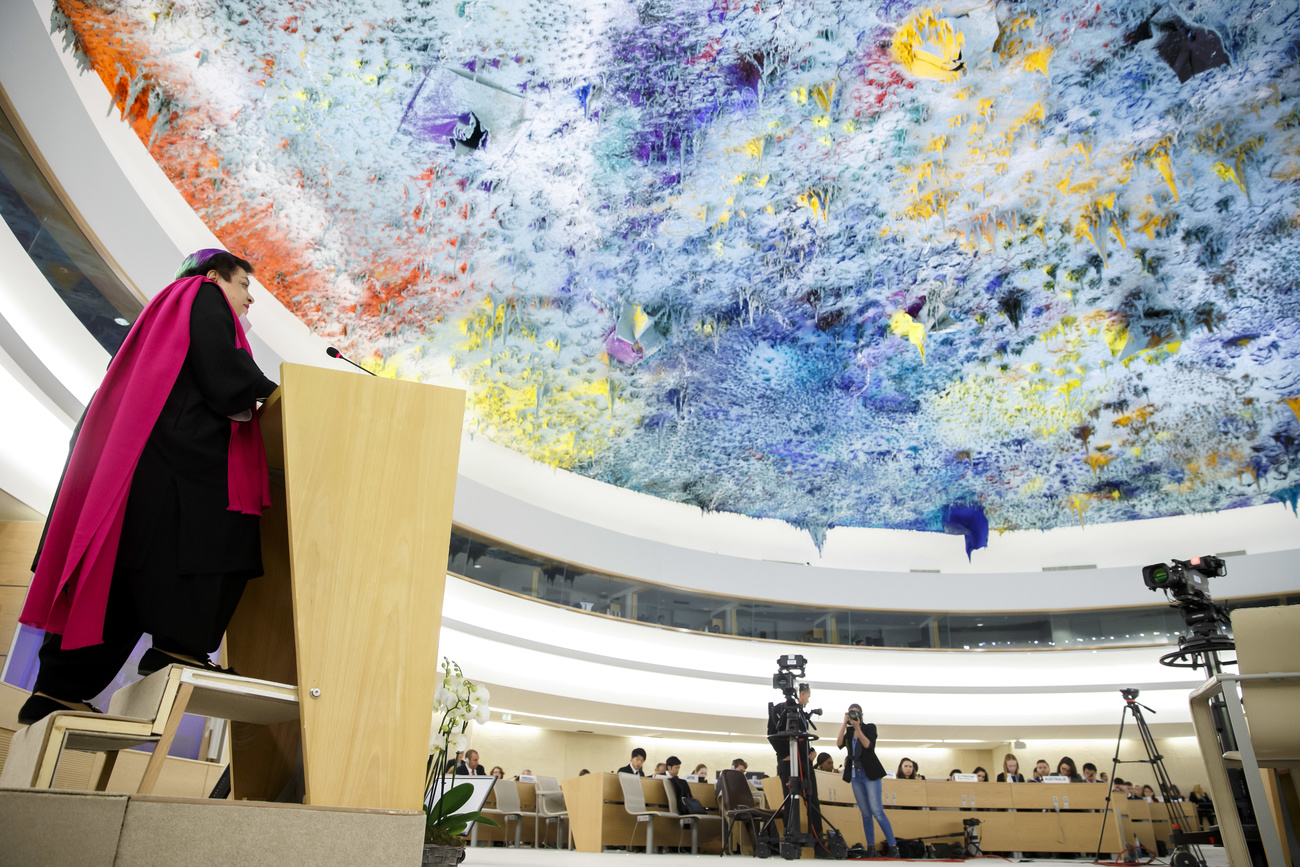
“We are in survival mode.” Addressing diplomats gathered for his annual fundraising appeal on February 5, UN High Commissioner for Human Rights Volker Türk did not mince his words about the precarious financial situation of his Geneva-based organisation.
Like many other UN bodies, the Office of the High Commissioner for Human Rights (OHCHR) faced dwindling resources last year. The reasons: budget cuts driven by several countries, including the United States, as well as delayed payments by some member states, leading to a severe liquidity crisis.
In 2026, the OHCHR – which documents human rights violations worldwide, provides technical support to states and promotes international law – hopes to secure $624.3 million (CHF490 million). That is 16% less than the $746 million budgeted last year (see infobox below).
The OHCHR budget consists of the regular UN budget and voluntary contributions.
In 2026, the regular budget – funded by mandatory state contributions – will be cut by 10%, from $246 million to $224.3 million. The organisation is unlikely to receive this amount in full because of the liquidity crisis. Last year, only 80% of the allocated regular budget was released.
To carry out its mandate, the human rights agency relies heavily on voluntary contributions from governments and other actors, including private donors. In 2026, it hopes to raise an additional $400 million. That is 20% less than the $500 million requested last year, of which roughly half was raised.
The total budget sought for 2026 therefore stands at $624.3 million, compared with $746 million last year – a 16% decrease.
Consequences in the field
Faced with this difficult financial situation, Türk described the impact of the cuts on operations.
In 2025, his organisation was forced to halve its human rights monitoring missions, conducting 5,000 compared with 11,000 the previous year. These missions document violations worldwide, protect victims and help put pressure on responsible states.
“Our reports provide credible information on atrocities and human rights trends at a time when truth is being undermined by disinformation and censorship,” Türk said, adding that they constitute “essential evidence” cited by international courts.
The UN Human Rights Office has also reduced its programme in Myanmar – currently in the grip of a devastating civil war – by 60%. In Chad, some 600 people arbitrarily detained have lost the agency’s support. Overall, the organisation has scaled back or ended its presence in 17 countries, including Colombia, Guinea-Bissau and Tajikistan, cutting 300 positions from a staff of 2,000.
“The cost of our work is small; the human cost of underinvestment is immeasurable,” Türk said, stressing that the mere presence of his organisation in the field can help prevent certain violations.
Chronic underfunding
“The Office of the High Commissioner for Human Rights – and more broadly the UN’s ‘human rights pillar’ – has always been severely underfunded and understaffed,” says Raphaël Viana David, a programme manager at the International Service for Human Rights (ISHR), an NGO based in Geneva and New York.
Human rights are one of the UN’s three pillars; the second is peace and security, and the third, development. Yet they account for only 3% to 7% of the organisation’s regular budget.
“This is not just about a bureaucracy making cutbacks due to financial constraints,” Viana David says. “These cuts have very concrete and deeply harmful effects on individuals and communities around the world, and on states’ ability to better respect human rights.”
Political manoeuvring
Last year, ISHR published a reportExternal link detailing how a small group of states – led by China and Russia – have for years sought to weaken the human rights system by reducing its resources through a little-known body based at UN headquarters in New York.
The body in question is the Advisory Committee on Administrative and Budgetary Questions (ACABQ), which submits recommendations to the Fifth Committee of the UN General Assembly, responsible for UN administrative and budgetary matters.
“It is a highly opaque body, theoretically composed of independent experts, but some members receive instructions directly from their governments. Among them are former – and sometimes even current – delegates of the Fifth Committee,” says Viana David, the author of the investigation.
>>The ACABQ is not the only little-known UN body that exerts a major influence on the UN human rights system:
More
NGOs face uphill battle to gain access to the UN
The ACABQ, whose three annual sessions are held behind closed doors, consists of 21 members from 21 countries representing all world regions. They are elected by the General Assembly for three-year terms.
According to the NGO’s research, the committee’s recommendations – which supplement the secretary-general’s budget proposals – are largely endorsed by the Fifth Committee. “They systematically cut human rights funding more deeply than funding for other areas,” Viana David says.
In this context, Beijing and Moscow play a central role. “China exerts significant diplomatic efforts within the ACABQ to push for budget cuts upstream. Then, when the recommendations reach the Fifth Committee, Russia plays a disruptive role, preventing consensus. In such cases, states fall back on the ACABQ’s recommendations,” he explains.
Investigative mandates on hold
The committee regularly proposes reductions in funding for investigative mechanisms approved by the Geneva-based UN Human Rights Council, the multilateral body tasked with upholding human rights worldwide.
>>While the Security Council is paralysed by vetoes, the UN Human Rights Council in Geneva is increasingly being used to take action on conflicts that are “blocked” in New York:
More
Is the Human Rights Council becoming a mini-Security Council?
Due to a lack of resources, two investigative missions on the Democratic Republic of the Congo and Afghanistan, approved in 2025, had still not begun their work by the end of the year.
In early January, the Fifth Committee largely approved the ACABQ’s recommendations, which called for deeper cuts in 2026 than those proposed by the secretary-general as part of the UN80 reform process launched in 2025. As a result, additional posts were eliminated at the Office of the High Commissioner for Human Rights.
Edited by Virginie Mangin/ptur

More
International Geneva

In compliance with the JTI standards
More: SWI swissinfo.ch certified by the Journalism Trust Initiative

You can find an overview of ongoing debates with our journalists here . Please join us!
If you want to start a conversation about a topic raised in this article or want to report factual errors, email us at english@swissinfo.ch.