








Swiss mountain crack grows after extreme rainfall

A 250-metre-long crack on a Valais mountainside has become a stark sign of the Alps’ growing vulnerability to extreme rainfall. The widening crack in the mountain has raised concerns of a potential landslide, and of extreme flooding in a nearby village.
Select your language
Generated with artificial intelligence.

Listening:
Swiss mountain crack grows after extreme rainfall

“Growth [of the crack] has been relatively constant: between 2-4 millimetres a day,” says local geologist Michael Digout,External link who has been monitoring the “Faille des Fios” scarp since last autumn.
This is fast for a geological process. The main fracture is now 80 centimetres to 1 metre wide, and smaller secondary cracks have appeared nearby like river tributaries.
In a worst-case scenario, up to 500,000 cubic metres of material could crash down, block the Navizence River and cause flooding in Chippis – home to 1,500 residents – in the Rhone Valley below.
>>A short video by Swiss public broadcaster RTS showing the “Faille des Fios” mountain crack.
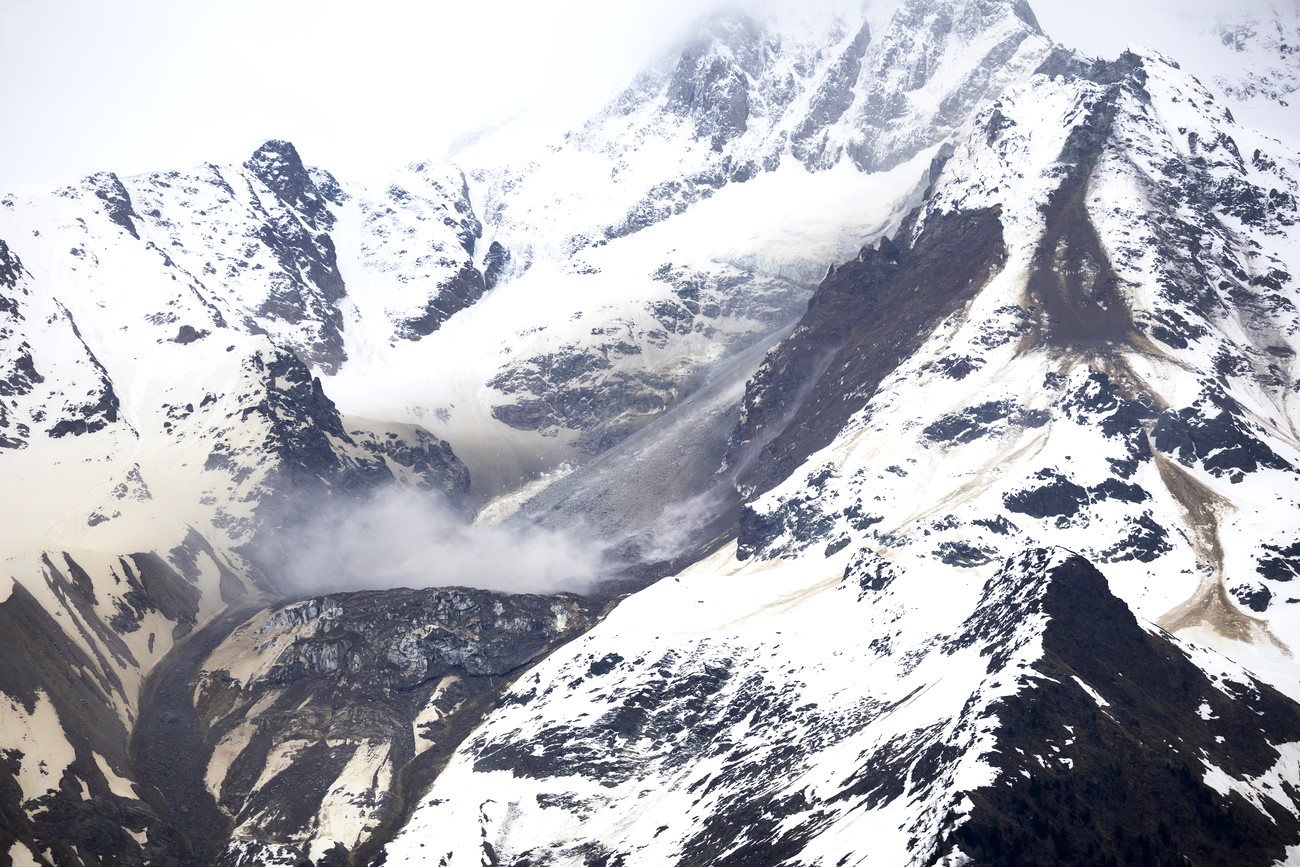
While this is a much smaller volume than fell in last year’s massive landslide in Blatten or in Randa in 1991, “it’s a considerable amount of material and potentially a substantial cascading hazard,” says Raffaele SpielmannExternal link, an engineering geologist at the federal technology institute ETH Zurich.
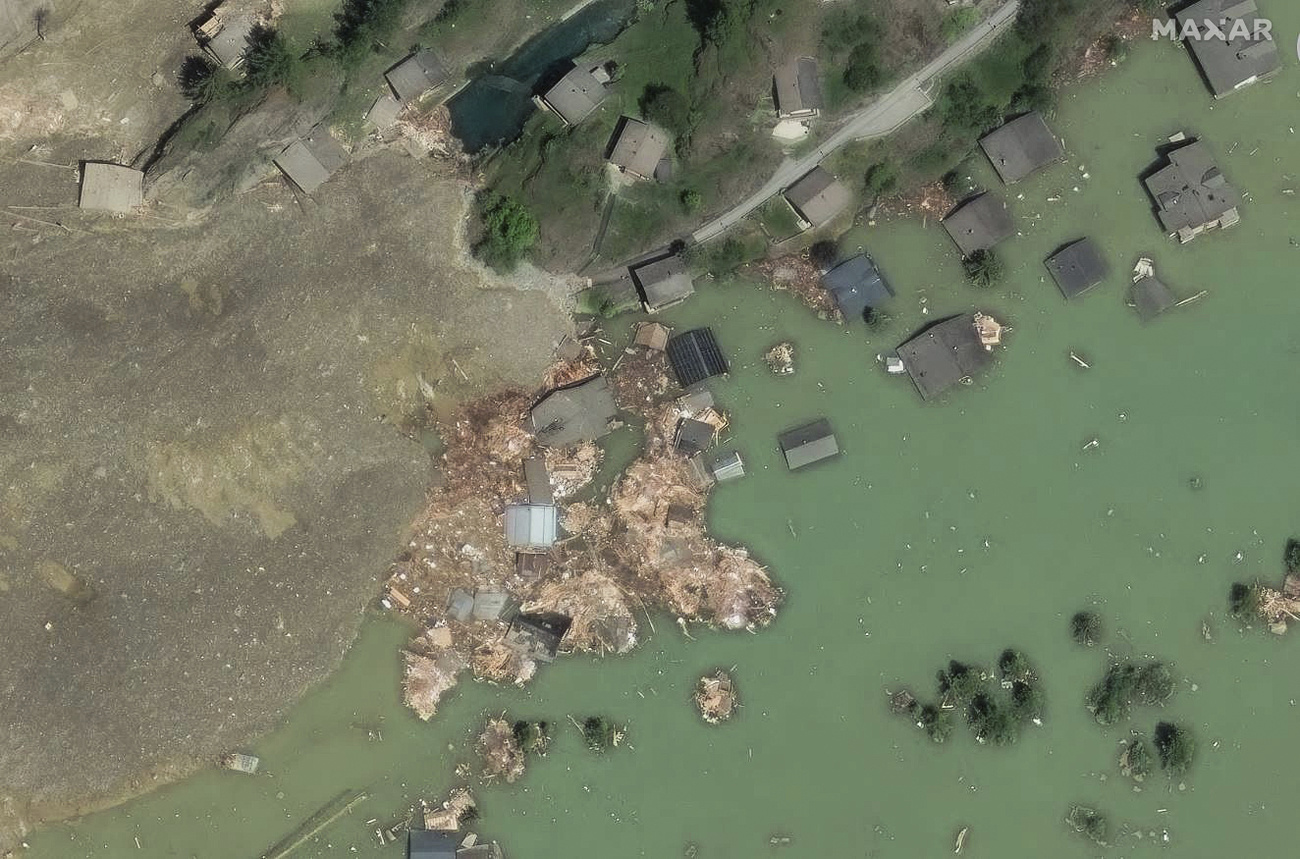
In Blatten, 9-10 million cubic metres of rock, mud, ice and debris wiped out the village in the Lötschental valley. In Randa, two major rockslides above the town released almost 30 million cubic metres of material, burying rail and road links to Zermatt and damming the local river.
More
The seven worst landslides in Swiss history
While the scarp in Val d’Anniviers near Chippis doesn’t pose an immediate danger of collapse, that situation could change as snow in higher altitudes begins to melt. Authorities have prepared an emergency evacuation plan and spots have already been reserved in local civil protection shelters for the residents of Chippis.
“We don’t have certainty about how it will unfold. To prepare emergency and evacuation plans, we are obliged to use the extreme scenario as a basis,” Digout says. “But based on what we’re observing at the moment, it seems more likely that the mass will evolve in stages, in successive phases.”
The fracture is believed to have developed after extreme precipitation and flooding in 2018 and 2024. The intense floods eroded the Navizence riverbed by several metres, which removed support at the foot of the slope, Digout explains. Without the firm ground below, the rock above began to move, causing the fissure.

Rainfall plays a dual role in this case, say specialists. It is responsible for the initial flooding that has destabilised the riverbank of the Navizance and, as rainwater and melting snow flow into the fissures, the slope is further destabilised.
Mounting pressure from a changing climate
In the coming years, as extreme precipitation intensifies due to climate change, natural hazards such as landslides and flooding are likely to be increasingly common in the Alps.
Experts say heavy rainfall events already occur more often in Switzerland – and with greater force – than they did in the early 20th century. A national climate risk assessmentExternal link published last year warned that Switzerland must prepare for heavier rains in all seasons as the planet warms, driving both the frequency and intensity of violent downpours.

More
Switzerland braces for more heatwaves, droughts and violent storms
The studyExternal link by Federal Office of Meteorology and Climatology (MeteoSwiss) and ETH Zurich, found that such events could become up to 30% more intense, with rainfall increasingly compressed into shorter bursts – a shift that heightens the risk of flash floods, mudslides and landslides. Warmer air plays a key role: for every degree of temperature rise, the atmosphere can hold 6–7% more water, allowing storms to deliver more intense rainfall.
A glimpse of the future?
Are events like the one unfolding in Val d’Anniviers becoming routine hazards that Alpine communities must learn to live with?
“It’s difficult to say with certainty, but we are experiencing increasingly significant floods and much heavier summer rainfall,” Digout says. “Floods are becoming more frequent and more intense. We don’t yet have enough long-term perspective to draw definitive conclusions, but it’s true that such events have become more common in recent years.”
More
Why do Swiss mountains collapse? It’s complicated
The “Faille des Fios” is not the only section of the valley showing movement. Experts have identified 20 to 25 other zones along the Navizence where the ground is shifting or eroding.
“There are several similar sites in the valley, but this one is clearly the most problematic in terms of potential mass that could be mobilised,” Digout says.
Join the debate:
External Content
Philippe Bianco, co-director of the Valais engineering firm IdealpExternal link, told local newspaper Le Nouvelliste that his team has observed an increase in such phenomena – a trend he believes “will only intensify”. He attributes the rise to climate change, which is fuelling heavier rainfall that increases pressure on mountainsides and triggers slope failures.
Jacob HirschbergExternal link, an environmental engineer at ETH Zurich, notes that no single rainfall disaster can be attributed directly to climate change but agrees such extreme events are clearly becoming more common.
He adds: “Extreme rainfall events are expected to occur more frequently. But especially in the mountains the triggers can be more complex, and a combination of both snowmelt and rainfall. I would expect, also in the Fios case, that snowmelt could play a role.”
External Content
Edited by Gabe Bullard/Veronica De Vore

In compliance with the JTI standards
More: SWI swissinfo.ch certified by the Journalism Trust Initiative

You can find an overview of ongoing debates with our journalists here . Please join us!
If you want to start a conversation about a topic raised in this article or want to report factual errors, email us at english@swissinfo.ch.